
Why Do Stocks Go Up?
A stock can sit flat for weeks and then jump 8% in a single morning because one new fact changed what the market thinks the business is worth. That is the real answer to why stocks go up: investors suddenly expect higher future cash flow, lower risk, or stronger demand for the shares themselves. Sometimes that shift comes from earnings. Sometimes it comes from rates, buybacks, or a wave of institutional money. Once you understand the mechanism, price action stops looking random.
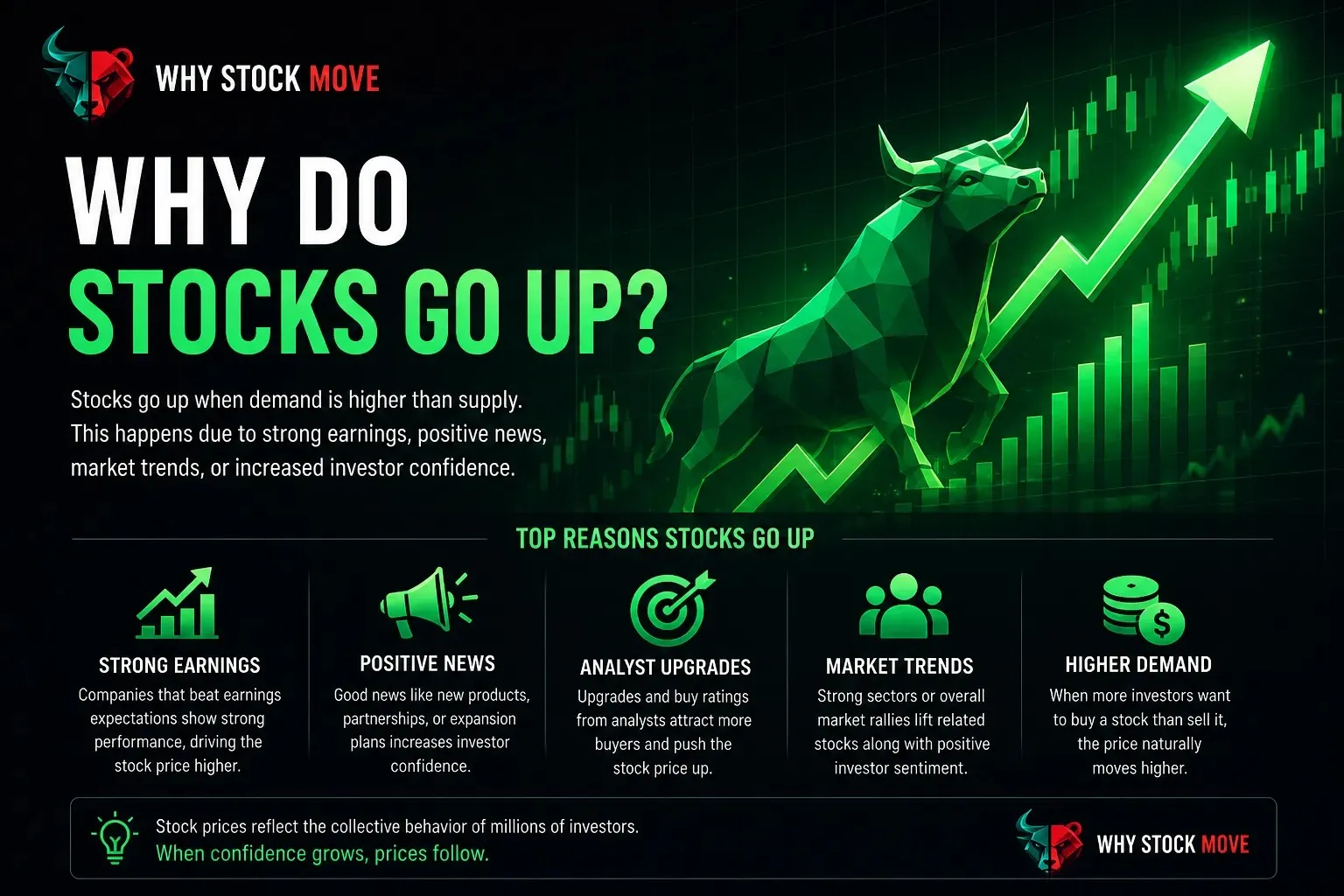
1. Why Do Stocks Go Up After Earnings Growth
When a company grows earnings, the market usually pays more for the stock because the business is producing more profit for each share you own. The plumbing is simple but powerful: analysts lift future EPS estimates, portfolio managers update valuation models, and buyers compete for stock before that new earnings path is fully reflected in price. That repricing happens fast when the beat is large and management sounds confident that the stronger trend will continue.
Example: When Nvidia reported in May , the company crushed expectations and gave AI-driven guidance far above consensus. The stock rose about 24% in a day because the market had to reset its earnings model, not just celebrate a strong quarter.
What to watch for: Compare reported EPS, next-quarter guidance, and estimate revisions over the following 48 hours. The best upside moves usually come when all three move in the same direction.
2. Why Do Stocks Go Up When Revenue Growth Takes Share
Revenue growth matters because it tells you demand is expanding before accounting choices can flatter the income statement. If a company is taking share in a large market, investors start underwriting a longer runway, which supports a higher multiple even before margins fully mature. In practice, that means growth funds, benchmark-aware managers, and momentum traders often buy the same stock for different reasons at the same time, creating a stronger upward move than a clean EPS beat alone.
Example: When Shopify kept posting explosive top-line growth through , the stock more than doubled because investors believed the company was capturing a larger share of online commerce faster than expected.
What to watch for: Watch year-over-year revenue growth against the company’s own history and against peers. A stock often responds most when growth accelerates while competitors slow.
3. Institutional Buying Is the Real Price Engine
Large funds move stocks because they need size, and size changes supply-demand balance for days or weeks instead of minutes. A retail buyer might lift a quote. A mutual fund building a position can absorb available shares across many trading sessions, tighten the float, and force other buyers to pay up. That is why some stocks rise in a steady grind with no obvious headline: the catalyst is not public news but sustained institutional accumulation.
Example: During Meta’s rebound in early , 13F filings and ownership data later showed major institutions rebuilding positions after the washout. The stock rallied sharply because deep pools of capital decided the prior valuation had become too low.
What to watch for: Track volume that stays elevated for several sessions, closes near the daily high, and repeated dips that get bought quickly. That pattern often signals a larger buyer is still at work.
4. Index Inclusion Creates a Forced Buyer
When a company joins a major index, passive funds do not debate the story. They have to buy. That obligation changes the order book because index trackers, closet indexers, and event-driven traders all rush toward the same stock before the rebalance is complete. The move often starts on the announcement, extends into the effective date, and then cools once that one-time demand is fully satisfied.
Example: When Tesla was added to the S&P 500 in November , the stock jumped roughly 8% on the announcement and kept climbing into the inclusion date because passive funds needed to own it.
What to watch for: Watch for official index committee announcements, expected fund flow estimates, and unusually heavy end-of-day volume near the rebalance date.
5. Share Buybacks Shrink Supply
Buybacks can lift a stock even if the business itself has not changed much because management is reducing the number of shares competing for future earnings. That mechanically boosts EPS and also signals that leadership thinks the stock is an attractive use of capital. In the market, buybacks matter most when the authorization is large relative to float and when the company generates enough free cash flow to keep repurchasing through weak tape.
Example: When Apple announced a $100 billion buyback expansion in May , the stock rose about 4% because investors saw both immediate demand support and stronger per-share economics.
What to watch for: Watch buyback size as a percentage of market cap, cash generation, and whether repurchases are actually showing up in the share count, not just in press releases.
6. Dividend Increases Signal Durable Cash Flow
A dividend increase tells the market that management believes cash generation is strong enough to support a higher recurring payout. That matters because boards hate cutting dividends once they raise them, so the announcement carries information about confidence and balance-sheet durability. Income funds, conservative allocators, and total-return investors all respond to that signal, which can widen the buyer base for the stock.
Example: When JPMorgan raised its dividend after the Federal Reserve’s stress-test cycle, the stock added roughly 3% because the move reinforced the market’s view that capital levels and earnings power were healthy.
What to watch for: Watch payout ratio, free cash flow coverage, and whether the dividend hike comes alongside buybacks or strong guidance. A payout rise backed by both is far more credible.
7. Why Stocks Go Up When Interest Rates Fall
Falling rates push stocks higher because they make future cash flows more valuable in today’s dollars and reduce competition from bonds. Lower yields also cut financing costs for businesses and usually support richer valuations for long-duration growth names. The strongest effect shows up where the market was previously worried about discount rates, which is why software, semiconductors, and consumer discretionary names often respond first when Treasury yields break lower.
Example: In late , rate-sensitive growth stocks such as Shopify and Cloudflare rallied sharply as bond yields fell and investors began pricing future Fed cuts into equity valuations.
What to watch for: Watch the 10-year Treasury yield, Fed language, and how high-multiple growth stocks behave on days yields drop. If they lead the tape, rates are likely driving the move.
8. Strong Economic Data Expands the Profit Outlook
Stocks also rise when the economy looks stronger than expected because a better macro backdrop usually leads to higher sales, better credit conditions, and improved operating leverage. The market discounts that future earnings lift before it appears in financial statements. Cyclicals and banks often respond first because their profits are tightly tied to activity levels, but strong data can broaden into an index-wide rally when investors start pricing a softer landing or a stronger expansion.
Example: After the June US jobs report came in far above expectations, cyclical names like JPMorgan and Caterpillar jumped roughly 5% to 7% because investors abruptly upgraded the reopening path.
What to watch for: Watch payrolls, retail sales, PMI data, and whether cyclicals outperform defensives after the release. Relative leadership tells you whether the market believes the data.
9. Analyst Upgrades Pull More Capital In
An upgrade matters less because one analyst changed a label and more because it gives large investors permission to revisit a position. Research desks update models, sales teams pitch the new thesis, and PMs who were underweight the name face pressure to respond. That process can produce real incremental buying, especially when the upgrade follows fresh information that the buy side respects, such as better channel checks or a major earnings revision.
Example: When brokers rushed to raise targets on Nvidia after the May earnings report, the stock surged about 24% because analyst revisions confirmed that consensus numbers were still too low.
What to watch for: Watch whether multiple firms upgrade together and whether price targets are moving because of higher earnings estimates rather than a simple multiple expansion story.
10. Merger Activity Reprices a Stock Overnight
Takeover interest pushes stocks higher because an acquirer often has to offer a premium to convince shareholders to sell. That premium becomes a new reference point immediately, and peer companies can rise too if investors think the whole sector is becoming strategic. The mechanism is straightforward: buyers are no longer valuing the business as a stand-alone asset but as something worth more inside another company’s hands.
Example: When Elon Musk disclosed his bid for Twitter in April , Twitter shares jumped about 27% because the market quickly repriced the stock toward the proposed acquisition value.
What to watch for: Watch unusual strategic rumors, activist involvement, and whether peer multiples suddenly re-rate higher on the same day. M&A moves rarely stay isolated.
11. Short Covering Adds Fuel to an Up Move
A rising stock can move even faster when short sellers have to buy shares back to close losing positions. That flow is powerful because it turns a bearish bet into urgent demand. If the float is tight, borrowed shares are expensive, or the initial catalyst is strong, covering can extend a move far beyond what fundamentals alone would justify in the first few sessions.
Example: During the GameStop squeeze in January , the stock rose roughly 1,700% in weeks because forced short covering collided with aggressive retail buying and limited available shares.
What to watch for: Watch short interest, borrow cost, and whether a strong catalyst hits a stock that already has a crowded short base. That is where upside can become disorderly.
12. Sector Rotation Brings New Buyers All at Once
Stocks go up when capital rotates into their sector because managers often buy baskets before they pick individual winners. That means even a decent company can rally hard simply because it sits in the right part of the market at the right moment. The mechanism is portfolio-level positioning: money leaves one theme, enters another, and ETF flows plus benchmark pressure push the whole group higher together.
Example: After the vaccine news in November , banks and energy names such as JPMorgan and ExxonMobil jumped double digits as investors rotated out of stay-at-home winners and into reopening trades.
What to watch for: Watch sector ETF flows, relative strength charts, and whether multiple stocks in the same group break out together. Rotation moves are usually broad, not isolated.
13. New Products, Deals, and Catalysts Reset Expectations
A stock can reprice higher on a new product launch, contract, or partnership when the event changes the market’s estimate of future revenue. The key is not excitement by itself. The key is whether the catalyst expands demand, improves margins, or opens a new market that investors had not fully included in the prior valuation. When the answer is yes, buyers move quickly because the old model is suddenly obsolete.
Example: When Pfizer received emergency use authorization for its COVID vaccine in November , the stock rose about 15% because the market now had a clearer path to a large new revenue stream.
What to watch for: Watch whether management quantifies the addressable revenue impact and whether suppliers, partners, or competitors move in sympathy. That helps you separate real catalysts from marketing noise.
How to Use This as an Investor
If you want to understand why stocks go up, stop asking whether the headline sounds positive and start asking which valuation input just changed. Did earnings move higher, did the market lower the discount rate, or did a new buyer class show up? Those are very different setups, and they deserve different holding periods. You will make better decisions when you match the move to the mechanism instead of chasing every green candle.
Example: When Nvidia jumped in May , the right lesson was not simply buy AI. The lesson was to recognize a genuine estimate reset and treat it differently from a sentiment-driven pop.
What to watch for: Build a quick checklist around estimates, rates, flows, and positioning. If two or three line up together, the move usually has more room than you think.
Frequently Asked Questions
Why do stocks go up even when nothing obvious is in the news?
A stock can rise without a fresh headline when institutions are quietly accumulating shares, when the sector is attracting new money, or when rates are moving in the background. The tape often sees those forces before financial media does. If volume stays elevated and pullbacks keep getting bought, the market is telling you demand exists whether or not a neat story has been published yet.
Can a stock go up if the company is not profitable yet?
Yes, if investors believe future cash flow will be much larger than today’s losses. That usually happens when revenue is growing quickly, margins are improving, and the company still has a long runway. Unprofitable growth stocks are especially sensitive to interest rates because so much of their value sits in the future.
What should I check first when a stock gaps up?
Start with the actual catalyst, not the chart. Read the earnings release, guidance change, filing, or news item and look for the specific variable that changed expectations. Then compare the move with short interest, valuation, and average daily volume to judge whether the rally looks fundamental, flow-driven, or squeeze-driven.
How can I use this without chasing stocks after they spike?
You can separate moves into estimate resets and temporary excitement. If earnings estimates are rising and the company’s story improved structurally, a stock can still work after a gap. If the move came mostly from short covering or a social burst with no estimate change, the risk of giving it all back is much higher.
Do all stocks go up for the same reasons?
No. Mature dividend payers often move on rates, buybacks, and capital allocation, while high-growth names move more on revenue acceleration and long-term expectations. Banks care about credit quality and the rate curve. Biotech stocks can move mostly on one regulatory decision. The reason matters because it shapes how durable the move is.