
How Do Interest Rates Affect Stocks?
Interest rates are the market’s gravity setting. When they move, stock prices do not just react because the Federal Reserve is on the news. They react because rates change how future cash flows are valued, how expensive debt becomes, and where investors choose to park capital. That is why the same rate move can help banks, hurt software stocks, and leave other sectors barely changed.
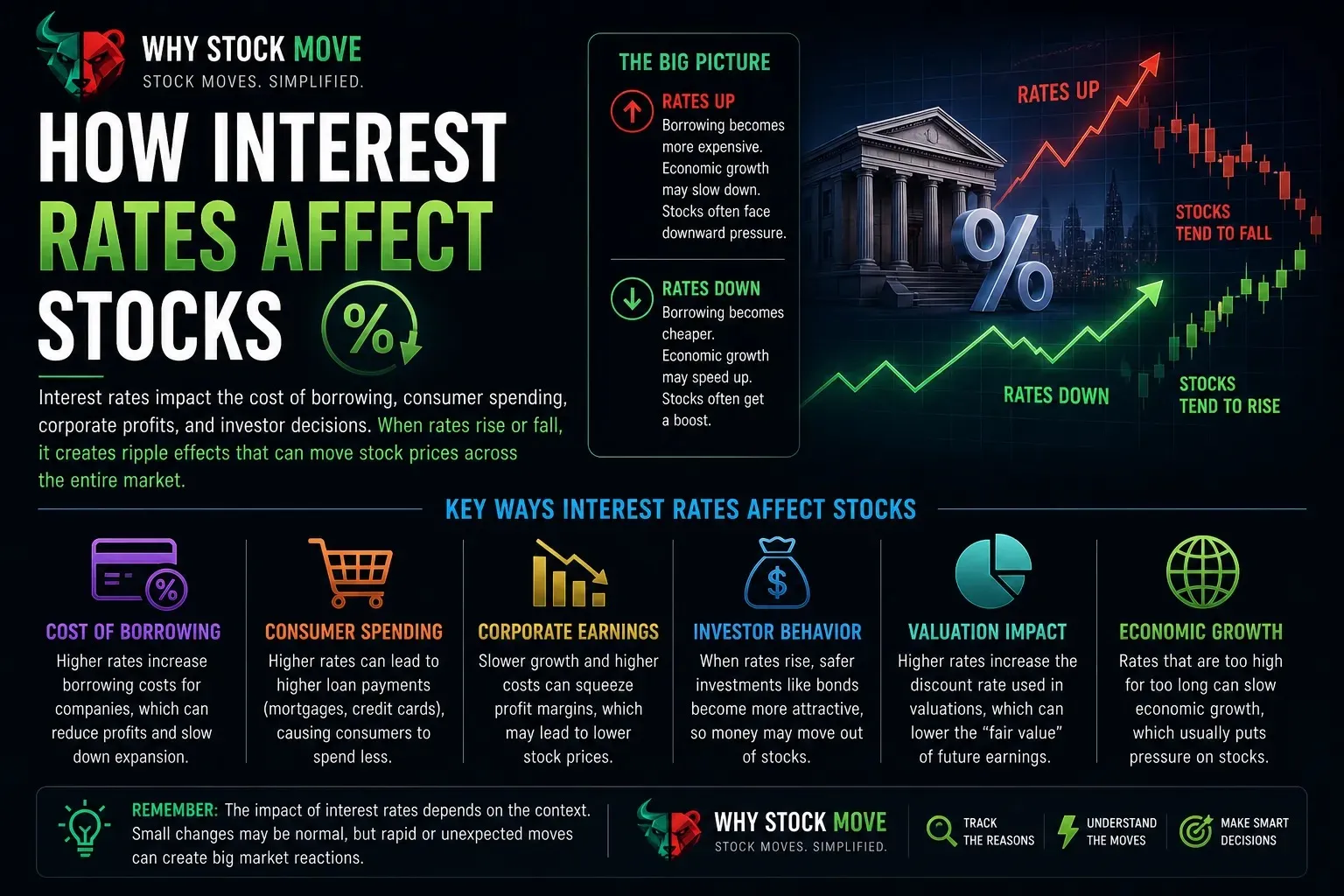
How Interest Rates Affect Stocks Through Valuation
The first channel is valuation. Stocks represent future cash flows, and higher rates reduce what those future dollars are worth today. Lower rates do the opposite. That math matters most for companies whose expected profits sit far out in the future, which is why long-duration growth stocks react so sharply when bond yields move.
Example: In , many high-multiple software and ecommerce names were repriced lower as rates rose because investors were no longer willing to pay peak multiples for distant earnings.
What to watch for: Watch the 10-year Treasury yield and compare how rate-sensitive growth stocks trade on big bond moves. That is usually the cleanest signal.
Growth Stocks and Value Stocks Do Not Feel Rates the Same Way
Growth stocks are more rate-sensitive because so much of their valuation depends on future earnings rather than current cash flow. Value stocks often generate more cash today, so their duration is shorter and the discount-rate hit is smaller. That does not make value immune. It just means the damage or benefit is less extreme.
Example: Shopify’s steep decline during the rate shock contrasted with more stable performance in many traditional value sectors because the market sharply cut what it would pay for far-off growth.
What to watch for: Watch whether software, semiconductors, and speculative growth are leading or lagging on rate days. Relative performance tells you how powerful the duration trade is.
Higher Bond Yields Compete With Stocks for Capital
Rates affect stocks through competition as well as math. When bond yields rise, investors can earn more from safer assets, so equities need to offer a more attractive expected return to compete. That often means lower stock prices, especially in slower-growth sectors where the equity risk premium narrows quickly when Treasuries pay more.
Example: Utility and REIT names have often struggled during sharp yield spikes because income-focused investors can rotate into bonds without taking equity volatility.
What to watch for: Watch Treasury yields against dividend yields and equity valuations. If the spread compresses too much, income-oriented stocks often feel pressure.
Borrowing Costs Hit Corporate Profitability
Higher rates also affect the business itself. Debt refinancing becomes more expensive, floating-rate interest expense rises, and capital-intensive expansion gets harder to justify. Companies with weak balance sheets or frequent funding needs feel the pain first, while cash-rich firms can usually absorb the shift more easily. That is why highly leveraged companies can underperform even before refinancing actually happens.
Example: Homebuilding and consumer-finance names came under pressure in as financing costs climbed because both companies and customers faced more expensive debt.
What to watch for: Watch interest expense, debt maturity schedules, and whether management sounds cautious about financing flexibility. Rate sensitivity often lives on the balance sheet.
Consumers Change Their Spending When Rates Move
Rates affect stocks indirectly through the customer. Higher mortgage, auto, and credit-card costs squeeze household budgets, which can cool demand for housing, discretionary goods, and large financed purchases. Lower rates can support the opposite. Companies tied to interest-sensitive consumption often react before the full spending shift shows up in earnings. Markets usually sniff that pressure out before consumer companies report the full slowdown.
Example: Homebuilder stocks and housing-related retailers weakened as mortgage rates surged in because investors immediately priced a slower housing market.
What to watch for: Watch mortgage applications, auto financing trends, and management commentary on consumer affordability. That is where the second-round effect appears.
Some Sectors Benefit From Rising Rates
Not every rate move is bad for stocks. Banks can benefit when higher rates expand net interest margins, at least until funding costs or credit stress catch up. Insurers may like higher reinvestment yields. Commodity producers sometimes hold up if the rate move reflects strong growth rather than a policy mistake. The market always asks who loses, but the better question is often who wins first.
Example: Large banks such as JPMorgan benefited at times in from higher rates because loan yields moved up faster than deposit costs early in the cycle.
What to watch for: Watch the shape of the yield curve and credit quality, not just the headline rate level. Those determine whether higher rates are actually helpful.
Fed Decisions Move Stocks Through Expectations, Not Just the Hike
The market reacts most to the gap between what the Fed does and what investors thought it would do. A rate hike can lift stocks if it sounds like the last one. A pause can hurt stocks if the language stays hawkish. What matters is the path of policy expectations and the bond market response that follows.
Example: In late , rate-sensitive growth stocks rallied as investors began pricing future cuts and a more dovish policy path, even before rates actually moved lower.
What to watch for: Watch Fed language, dot plots, and the bond market’s reaction in the first hour after the decision. The statement rarely matters in isolation.
How to Use This as an Investor
When rates move, do not think in slogans like “higher rates are bad for stocks.” Ask which part of the market you own and where the sensitivity sits. Some names are valuation-sensitive. Others are balance-sheet-sensitive. Others depend on consumer credit conditions. Once you know the channel, the market’s reaction starts to look much more logical.
Example: A software stock and a bank can react to the same Fed meeting in opposite directions for good reasons.
What to watch for: Keep one eye on the Treasury market whenever you own high-multiple stocks. Sometimes the real catalyst is not the company. It is the discount rate.
Frequently Asked Questions
Why do higher interest rates hurt growth stocks so much?
Because growth stocks rely more on profits expected far in the future. When rates rise, those future profits are discounted more heavily, which lowers present value. The market tends to reprice those names faster and more aggressively than mature cash-generating businesses.
Can stocks rise even when the Fed is hiking rates?
Yes. Stocks can rise if earnings remain strong, if the market had already priced in the hikes, or if investors believe the hiking cycle is close to ending. Markets trade on expectations, so a “bad” rate move can still produce a positive stock reaction if it was less bad than feared.
What should I watch besides the Fed funds rate?
Watch the 10-year Treasury yield, the yield curve, and credit spreads. Those often matter more for equities than the policy rate alone because they shape valuation and financing conditions across the economy. The stock market responds to the whole rate environment, not just one number.
How can I use rate moves in portfolio decisions?
You can map your holdings by rate sensitivity. High-multiple growth, highly leveraged companies, banks, homebuilders, and REITs all react differently. That helps you understand whether you need diversification across rate regimes instead of finding out the hard way during the next big bond move.
Do falling rates always help stocks?
Not always. Falling rates can help valuations, but they can also signal recession fears or weak demand. If rates are dropping because the economy is deteriorating fast, some stocks will still struggle even as the discount rate becomes more favorable.