
Why Do Stocks Go Down?
A stock does not need catastrophic news to fall hard. It only needs reality to come in worse than the market had priced. That is why stocks go down after “good” quarters, why strong companies can drop in panics, and why one weak data point can trigger weeks of selling. Once you understand which expectation broke, the decline gets a lot easier to read.
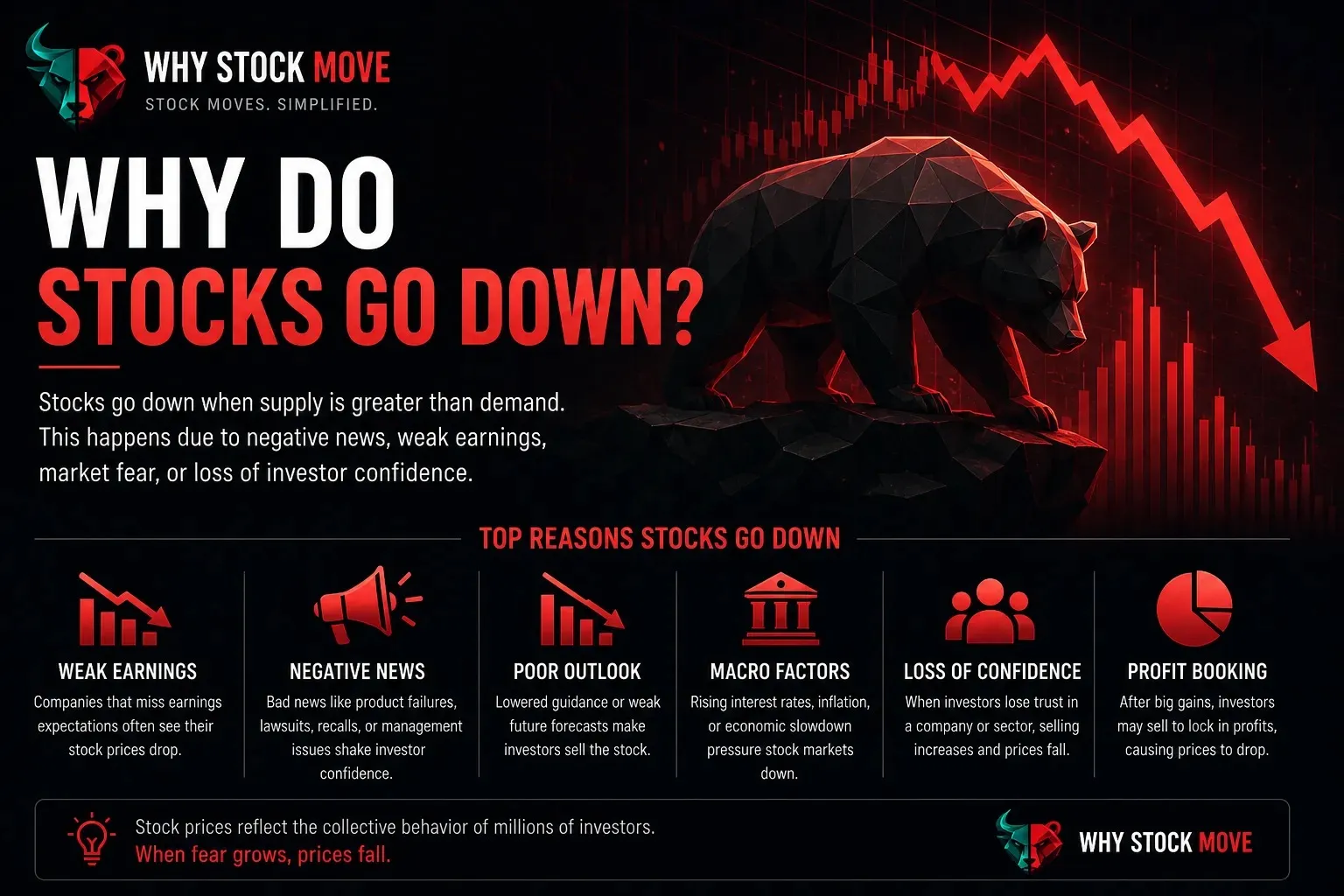
1. Why Do Stocks Go Down After Earnings Misses
An earnings miss hurts a stock because it forces investors to lower what they think the business can earn over the next several quarters. The market does not punish the past quarter by itself. It reprices the entire forward path. When management misses consensus and also sounds less confident on the call, funds cut models, quants pick up the estimate revisions, and sellers hit the tape before slower investors finish reading the release.
Example: Meta fell about 26% in February after earnings disappointed and management flagged weaker growth. The move was so violent because the market had to slash assumptions about future profitability, not just react to one bad print.
What to watch for: Watch the difference between the reported miss and the change in next-quarter or full-year guidance. Guidance is usually what makes the decline persistent.
2. Why Do Stocks Go Down When Interest Rates Rise
Higher rates pressure stocks because they lower the present value of future cash flows and make bonds a more serious competitor for capital. The effect is strongest in long-duration growth names where more of the story depends on profits far out in time. Rising yields also increase borrowing costs for companies and households, which can squeeze margins and demand at the same time.
Example: In , high-multiple growth stocks such as Shopify were crushed as rates surged, with Shopify falling more than 70% from its peak because the market aggressively revalued distant profits.
What to watch for: Watch Treasury yields, especially the 10-year, and compare how software or consumer discretionary names trade versus defensives on rate-driven days.
3. Recession Fears Cut Multiples Before Earnings Fall
Stocks go down ahead of recessions because investors know sales, credit quality, and profit margins rarely stay untouched when the economy slows. The market discounts that risk early. Multiples compress before the actual earnings damage appears because portfolio managers would rather sell first than wait for formal confirmation. Once recession talk takes over, even solid companies can get marked down simply because future demand looks less certain.
Example: In early , retailers and cyclicals such as Target and FedEx sold off sharply as growth fears rose and investors started pricing a weaker consumer backdrop before the worst estimates were published.
What to watch for: Watch PMIs, jobless claims, and credit spreads. When those deteriorate together, equity markets usually start discounting recession risk aggressively.
4. Negative News and Scandals Destroy Trust Fast
Bad news hurts more than good news helps when it damages credibility. Fraud, regulatory violations, product failures, and executive scandals all make investors question not only current earnings but also the reliability of everything management has said before. That uncertainty widens the discount rate, scares away long-only capital, and invites shorts because there is no obvious floor while facts are still emerging.
Example: Boeing sank roughly 12% in March as the 737 Max crisis escalated because the market suddenly had to price legal risk, delivery disruptions, and reputational damage together.
What to watch for: Watch whether the event changes trust in management or only affects one quarter. Trust breaks lead to longer and deeper drawdowns.
5. Analyst Downgrades Can Accelerate a Decline
A downgrade matters because it gives institutions cover to reduce exposure they were already nervous about. The downgrade itself is rarely the whole story. The real mechanism is that research changes tend to cluster after a thesis breaks, and each cut reinforces the next wave of selling. When buy-side models are still coming down, lower targets can keep pressure on the stock for several sessions.
Example: After Netflix’s subscriber miss in January , a series of target cuts followed and the stock dropped about 22% because the market began treating slower growth as a structural problem rather than a temporary wobble.
What to watch for: Watch for several brokers cutting estimates at once. A downgrade paired with lower numbers matters far more than a downgrade with unchanged forecasts.
6. Insider Selling Can Shake Confidence
Insiders sell for many personal reasons, but the market still pays attention when large sales arrive suddenly or cluster near a stock’s highs. Investors assume executives know the business better than anyone else, so heavy selling can create a signal problem even when the company says nothing has changed operationally. That is especially true in expensive stocks where confidence already does a lot of valuation work.
Example: Tesla fell sharply in November after Elon Musk sold stock following his public poll, with the shares dropping about 12% over two sessions as traders recalibrated near-term sentiment and supply.
What to watch for: Watch the size of the sale relative to prior holdings, whether multiple insiders are selling, and whether the sales are preplanned under a 10b5-1 schedule.
7. Market-Wide Selloffs Create Forced Selling
During panics, a stock can fall simply because investors need cash. Funds reduce risk, levered accounts face redemptions or margin calls, and correlations spike as everyone sells what they can rather than what they want to. In that environment fundamentals matter less in the short run than liquidity does. Even great companies can be thrown overboard until the stress passes.
Example: In March , Apple and Microsoft both fell more than 20% in a matter of weeks because the market entered a broad liquidity event where nearly every risk asset was sold.
What to watch for: Watch index volatility, credit spreads, and whether high-quality megacaps are falling alongside weaker names. When everything trades down together, you are dealing with systemic pressure.
8. Sector Headwinds Can Drag Good Companies Lower
A stock can go down because its whole industry just became less attractive. Regulation, commodity swings, new competition, or a funding shock can hit an entire group at once. When that happens, managers often sell the basket first and ask finer company-specific questions later. Relative strength inside the group still matters, but the sector tide can overwhelm solid execution for a while.
Example: Regional bank stocks such as PacWest and Western Alliance collapsed in as deposit fears spread after SVB. Many names fell hard because investors no longer trusted the sector’s funding stability, not because every bank had identical problems.
What to watch for: Watch the sector ETF, peer reactions, and any shared balance-sheet exposure. If peers are all breaking together, company-specific reassurance may not help immediately.
9. Dilution Reduces What Each Share Owns
New share issuance pressures stocks because existing shareholders now own a smaller slice of future earnings. The market also reads dilution as a financing signal: if management is willing to sell stock here, they may think the price is attractive or they may need cash more urgently than investors realized. Either way, the expected per-share value drops unless the new capital clearly earns a strong return.
Example: AMC repeatedly sold shares during and those offerings often cooled the stock because investors had to absorb more supply even while enthusiasm around the name remained intense.
What to watch for: Watch the size of the offering, the stated use of proceeds, and whether the company has a credible path to turn that cash into higher future earnings.
10. Cost Pressure and Supply Issues Hit Margins First
Stocks fall when investors realize revenue is not the full story and margins are getting squeezed underneath. Rising freight, labor, raw materials, or production delays can wreck earnings quality even if demand still looks healthy. Because margins are a leveraged part of the model, a modest cost shock can produce a large earnings reset and a much larger stock reaction.
Example: Nike fell about 12% in September after warning that inventory, discounting, and supply-chain strain were hurting profitability more than investors expected.
What to watch for: Watch gross margin, inventory growth, and management commentary on pricing power. If costs are rising faster than the company can pass them through, estimates usually have to come down.
11. Geopolitical Shocks Raise the Risk Premium
Wars, sanctions, pandemics, and other black swan events push stocks down because they make the future harder to underwrite. Investors respond by demanding a higher risk premium, which means lower stock prices. The exact damage can range from higher energy costs to disrupted trade routes to sudden demand destruction, but the common thread is uncertainty. When the range of outcomes widens, multiples compress quickly.
Example: During the COVID panic in February and March , travel names such as Carnival collapsed by more than 20% in days because investors had no confidence in near-term demand or financing conditions.
What to watch for: Watch whether the shock affects only sentiment or also cash flow, funding, and supply chains. The more channels it hits, the deeper the drawdown can get.
How to Use This as an Investor
When a stock falls, your job is to figure out whether the problem is cyclical, structural, or purely liquidity-driven. A cyclical selloff can create opportunity. A structural break usually deserves respect. A forced-liquidation event may reverse quickly once the selling pressure clears. You get a much better decision process when you classify the decline before you decide whether to buy, hold, or leave.
Example: Meta’s February drop mattered because it reset growth expectations, while many March declines were more about panic and forced de-risking. Those are not the same setup.
What to watch for: Build a habit of checking guidance, peer reactions, and balance-sheet risk before you average down. Cheap gets cheaper when the wrong thing broke.
Frequently Asked Questions
Why do stocks go down on good news?
Because the market trades against expectations, not headlines in isolation. A company can report a solid quarter and still fall if investors had already priced in something even better. That is why you should compare the result with consensus numbers, prior guidance, and how crowded the bullish positioning looked beforehand.
How do I know if a drop is temporary or serious?
Start with the trigger. Temporary declines are often driven by broad market stress, one-off headlines, or valuation compression without a big change in earnings power. Serious declines usually come with lower guidance, broken balance-sheet confidence, or a thesis change that also hits peers and analyst estimates.
What should I do when a stock I own drops 15% in one day?
Do not react to the percentage first. Read the actual catalyst, review whether forward estimates changed, and see how the stock is trading relative to its sector. If the selloff is tied to a structural problem, preserving capital matters more than hoping for a bounce. If it is a liquidity event or an overreaction, the setup is different.
Can strong companies still fall 30% or more?
Yes. Great businesses can get caught in macro panics, valuation resets, or temporary industry stress. The key distinction is that strong companies often recover once the external pressure fades, while weak companies use the same event to reveal deeper problems. Price alone does not tell you which one you own.
How can I use this to avoid panic-selling?
Create a checklist before volatility hits. Look at guidance, margins, debt, peer reactions, and whether the company’s core demand actually changed. That structure helps you separate fear-driven tape action from a genuine deterioration in the business.