
Why Do Stocks Rise After Earnings?
A stock does not rise after earnings just because the headline number beat consensus. It rises when the report makes investors believe the business will earn more than they thought, deserve a higher multiple than they thought, or trap too many bearish traders on the wrong side. That is why two companies can both “beat” and still trade in opposite directions. The market cares about what changed in the forward story.
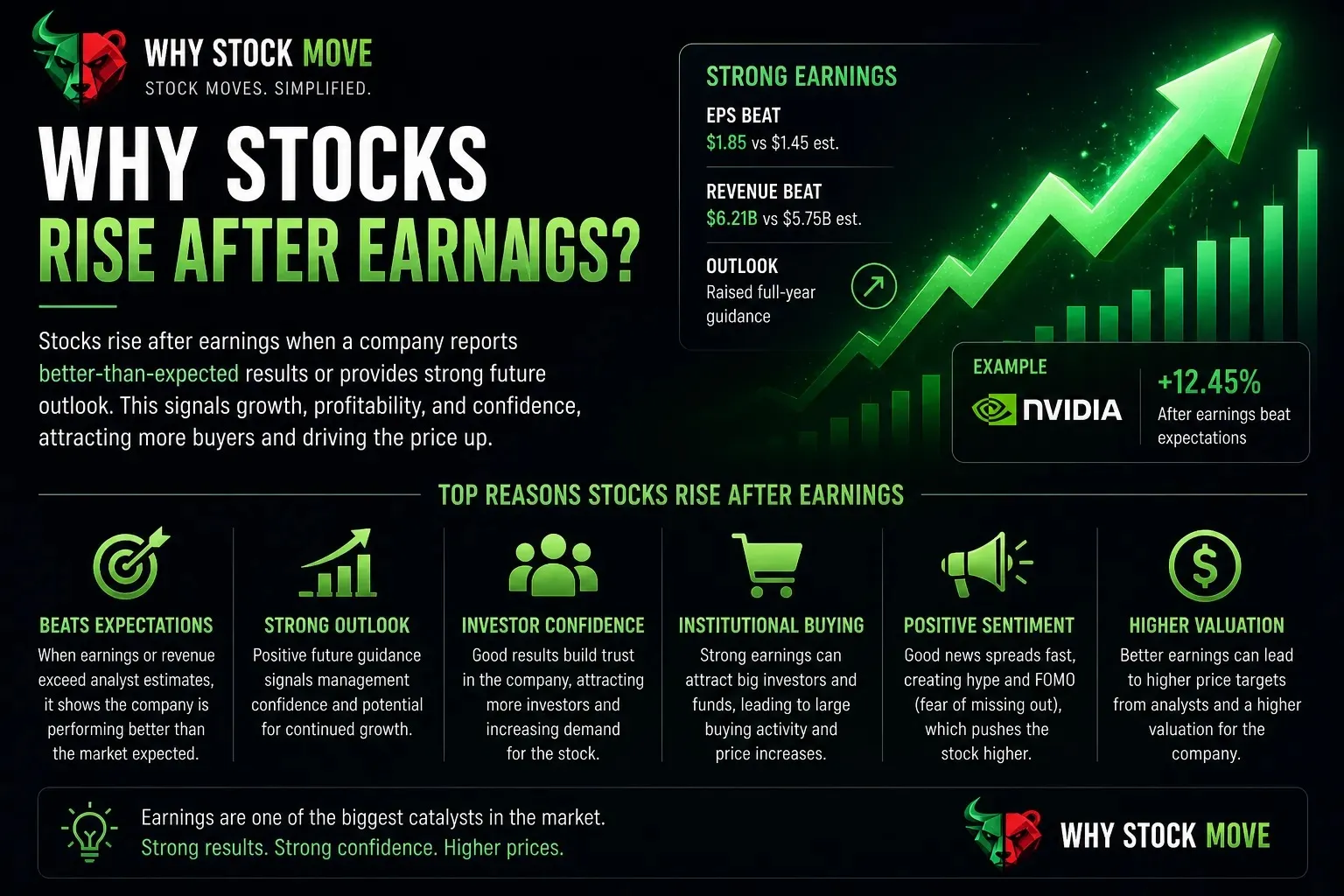
1. Why Stocks Rise After Earnings Beats
A clean EPS beat moves a stock higher because it tells the market the business was stronger than expected in the quarter that just ended. More importantly, it suggests the next few quarters may also be underestimated. Funds quickly rerun models, and if the surprise looks repeatable rather than one-off, buyers step in before consensus catches up.
Example: Nvidia’s May report sent the stock up about 24% because the beat was not marginal. It showed a demand environment far beyond what the Street had modeled.
What to watch for: Watch the size of the EPS surprise and whether revenue, margins, and free cash flow confirmed the same direction. A lone accounting beat is much weaker.
2. Why Stocks Rise After Guidance Goes Higher
Guidance often matters more than the reported quarter because the market owns the next few quarters, not the last one. When management raises full-year revenue or profit expectations, it changes the base case that long-only investors use to size positions. That shift can sustain a rally well beyond the first-day reaction because the numbers inside every model have to move up.
Example: Nvidia’s May earnings are again the clearest example because guidance, not just the quarter, forced a complete rewrite of forward estimates.
What to watch for: Watch whether the company raised both revenue and margin guidance. A narrow guidance lift is better than nothing, but a broad reset is what usually powers the biggest moves.
3. Margin Expansion Improves the Quality of the Beat
A stock often rises more when margins expand because investors care about the quality of growth, not only the quantity. Better gross or operating margins tell you demand is strong enough, pricing is firm enough, or costs are under control enough to turn sales into profit efficiently. That makes future earnings look more durable.
Example: Meta surged about 20% in February after a strong report that showed much better profitability, reinforcing the market’s view that the efficiency push had become real rather than cosmetic.
What to watch for: Watch gross margin, operating margin, and management commentary on whether the improvement came from pricing, mix, or temporary cost cuts. Durable margin gains deserve more respect.
4. Short Covering Can Supercharge the Post-Earnings Move
If a stock had a crowded short base going into earnings, a positive report can force shorts to buy back shares quickly. That creates extra upside demand on top of regular long buying. The result is often a move that looks too large for the earnings beat alone, but the explanation sits in positioning rather than in the business.
Example: Carvana’s sharp rallies in , including around better-than-feared results, were amplified by a large short base that had to cover as the company survived longer than many bears expected.
What to watch for: Watch short interest, borrow cost, and how the stock trades in premarket after the report. Violent squeezes often reveal themselves before the open.
5. Analyst Upgrades Extend the Move
Post-earnings upgrades matter because they broaden the buying audience after the initial headline reaction. Analysts raise targets, sales desks circulate the revised thesis, and PMs who missed the first move feel pressure to catch up. If the upgrades are based on materially higher estimates, the rally can extend for days instead of fading after the gap.
Example: Following Nvidia’s May report, a wave of broker target hikes helped validate the magnitude of the upside move and kept institutions engaged in the story.
What to watch for: Watch whether analysts are raising actual numbers or merely stretching the valuation multiple. Higher estimates are the stronger signal.
6. Management Tone on the Call Can Matter as Much as the Release
Conference calls move stocks because management often provides context the release could not capture. Investors listen for demand visibility, order trends, pricing power, and confidence level. Strong tone matters most when the market was uncertain beforehand. A confident explanation can turn a decent report into a bigger re-rating because it lowers perceived risk around the next few quarters.
Example: Nvidia’s earnings-call commentary in May around AI demand deepened the market’s conviction that the upside was not a one-quarter fluke.
What to watch for: Watch how the stock reacts during the call, not just after the press release. The second move often tells you whether management actually changed minds.
7. Relief Rallies Happen When Expectations Were Too Bearish
A stock can rise after earnings even if the report is only okay because investors had braced for something worse. In that case, the move is driven by relief rather than by a huge fundamental upgrade. The market reprices from a very negative starting point, and shorts or underweight longs scramble to adjust.
Example: Netflix rose strongly after some post- reports that were not perfect but were better than the market’s most anxious expectations around subscriber trends.
What to watch for: Watch the pre-earnings setup, especially implied volatility and sentiment. Relief rallies are much more common when fear was already extreme.
Read the Report Like a Market Participant
To understand why a stock rose after earnings, look beyond the top-line beat. The real signal usually sits in the interaction between the result, guidance, margins, and prior positioning. A stock can beat and still fall if the bar was too high. A stock can beat modestly and soar if the market was leaning the wrong way. Price is the verdict on expectations, not on headlines alone.
Example: Meta’s big post-earnings jumps in and worked because both fundamentals and sentiment changed together.
What to watch for: Watch the estimate revisions, the options market’s pre-earnings pricing, and whether peers move in sympathy. Those clues explain more than the EPS headline does.
How to Use This as an Investor
If a stock rises after earnings, ask whether you are looking at an estimate reset, a relief rally, or a squeeze. Only the first one consistently has room to persist on fundamentals. The second can work for a while but depends on sentiment. The third can reverse brutally once the forced buying is over.
Example: Nvidia in May was a classic estimate reset. Many meme-like reactions are not.
What to watch for: You will improve fast if you stop treating every post-earnings gap the same way. Classify the move first, then decide what kind of opportunity it really is.
Frequently Asked Questions
Can a stock rise after earnings even if revenue misses?
Yes, if margins, guidance, or cash flow are strong enough to offset the revenue shortfall. Markets care about the whole forward earnings picture, not one headline line item. If management shows that the business is becoming more profitable or more durable, the stock can still rise.
Why do stocks sometimes rise more on guidance than on the actual numbers?
Because guidance affects what investors are willing to pay for the next year of earnings. The reported quarter is already over. New guidance changes what every model looks like going forward, which often matters more than a modest beat in the past quarter.
What should I check right after an earnings-driven rally?
Look at estimate revisions, not just price. Check whether analysts are lifting revenue and EPS forecasts, whether short interest was high, and whether the company improved margins or only cleared a low bar. Those details tell you if the move has a fundamental base.
How can I use this before earnings instead of after?
Study the gap between market expectations and the options market’s priced-in move. If the bar is very high, even a good quarter may not be enough. If sentiment is depressed and the business only needs to be less bad than feared, the upside setup can be better than it first appears.
Do post-earnings rallies usually hold?
They hold best when the report resets forward estimates and changes the long-term story. They fade more often when the move is mostly relief or short covering. The easiest way to tell the difference is to track whether analysts and long-only investors keep upgrading the thesis in the days that follow.