
Why Do Stocks Fall After Earnings?
A company can post a quarter that looks fine to a casual reader and still lose 15% before the next opening bell. Stocks fall after earnings when the report damages the future story the market had been paying for. Sometimes that damage comes from a miss. Sometimes it comes from weak guidance, weaker margins, or simply a valuation that had become impossible to justify.
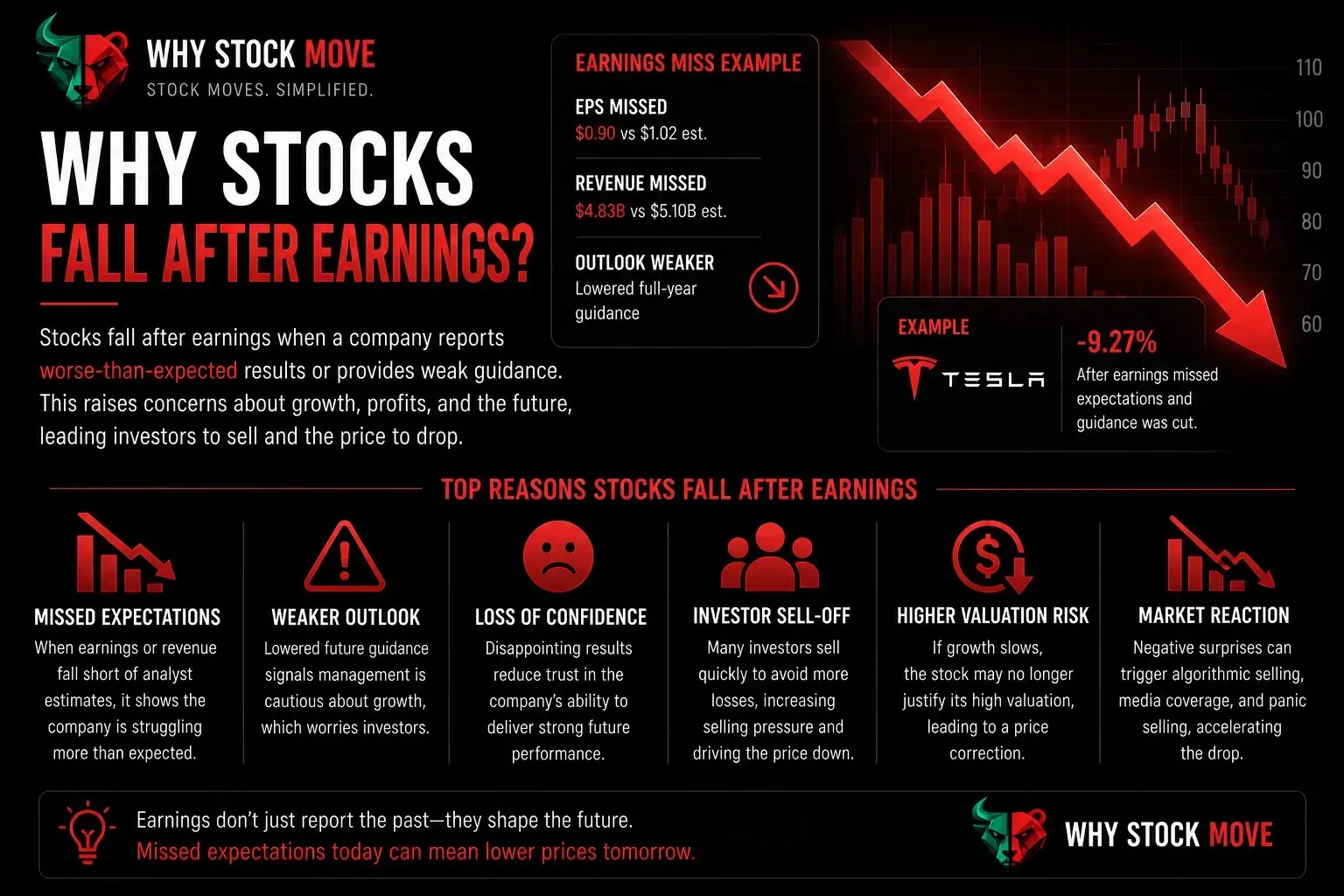
1. Why Stocks Fall After an EPS Miss
An EPS miss hurts because it signals that some part of the business was weaker than consensus expected. The market immediately asks whether the problem is temporary or whether it should pull down future estimates too. If management does not convincingly contain the issue, the stock often sells off as investors reset the full earnings path lower.
Example: Meta’s February report triggered a roughly 26% drop because the miss came with broader concerns around growth and margin pressure, not just one bad quarter.
What to watch for: Watch whether the miss came from weaker demand, higher costs, or accounting noise. Demand and margin misses usually matter most.
2. Lowered Guidance Is the Worst Combination
Weak guidance is often more damaging than a headline miss because it tells investors the disappointment is not over. When management cuts the outlook, long-only funds know their forward numbers are wrong, and they usually sell first while they rebuild the model later. That is why stocks often fall hardest when the company both misses and lowers expectations for what comes next.
Example: FedEx fell about 21% in September after withdrawing guidance because investors suddenly had no reliable near-term earnings framework to hold on to.
What to watch for: Watch for cut guidance on revenue, margins, or capex. The more parts of the outlook that get weaker, the less likely the first drop is enough.
3. Sell-the-News Reactions Punish Crowded Optimism
Sometimes a stock falls after a decent report because investors had already priced in an even better one. In that setup the issue is not bad fundamentals. The issue is that the stock had climbed so far on optimism that the actual numbers could not exceed the bar. Once the event passes, traders take profits and the air comes out.
Example: Apple has seen several post-earnings pullbacks after solid quarters in years when expectations were exceptionally high, because a good report was no longer enough to justify the pre-event run.
What to watch for: Watch how far the stock ran before earnings and how expensive the options market became. Extreme optimism raises the hurdle dramatically.
4. Margin Compression Tells the Market the Beat Was Low Quality
Revenue can look fine while the stock still falls because the profit underneath the revenue is weakening. Margin compression tells investors the company is discounting, facing cost inflation, or losing some operational control. That matters because lower-quality revenue usually deserves a lower multiple and lower future earnings estimates. If markdowns, freight, or mix are doing the damage, that weakness can linger longer than one quarter.
Example: Nike dropped about 12% in September when investors focused on inventory and margin pressure rather than on demand alone.
What to watch for: Watch gross margin, inventory, and operating-expense growth together. Those often explain the move better than EPS by itself.
5. Revenue Misses Break Growth Stories Fast
A revenue miss can hit harder than an EPS miss in a growth stock because investors were often paying for expansion, not current profits. If sales growth slows, the market questions market share, pricing power, and the total addressable market story all at once. That can lead to a more severe multiple reset than a purely cost-driven earnings miss.
Example: Netflix fell about 22% in January after disappointing subscriber guidance because the market treated the slowdown as evidence that the growth story was maturing faster than expected.
What to watch for: Watch revenue guidance, not just current revenue. In growth names, the stock cares most about what the sales curve looks like next.
6. High Valuations Leave No Room for Error
Stocks with rich multiples can fall on merely okay results because the price already assumes excellent execution. When growth decelerates even a little, investors stop paying peak multiples and the rerating can overwhelm the quarter itself. This is why expensive software and pandemic winners often looked especially fragile once their growth rates normalized.
Example: Zoom sold off heavily in late and despite remaining profitable because the market no longer believed its pandemic-era growth justified such a premium valuation.
What to watch for: Watch EV-to-sales or forward P/E relative to the company’s own history. The more stretched the valuation, the smaller the margin for error.
7. Weak Segments Can Poison an Otherwise Decent Quarter
A company with multiple business lines can beat overall numbers and still get sold off if one key segment shows a worrying slowdown. The market often values the fastest-growing or highest-margin segment most heavily, so weakness there can outweigh strength elsewhere. Investors are buying the future engine, not the average of everything.
Example: Alphabet has had earnings reactions where ad or cloud trends mattered more than the consolidated figure because investors cared most about whether the key growth engine was accelerating or slowing.
What to watch for: Watch segment margins, management commentary by division, and which business investors think deserves the premium multiple. That is usually where the stock reaction comes from.
8. One-Time Items Do Not Calm the Market if Quality Looks Weak
Adjusted earnings can hide a lot, and investors know it. If a company beats on adjusted EPS while free cash flow, margins, or customer metrics weaken, the stock can still fall because the market distrusts the quality of the quarter. Traders quickly separate cosmetic beats from durable operating strength.
Example: Several PayPal reports in and were met skeptically when investors focused less on adjusted profit and more on transaction margin and user quality.
What to watch for: Watch cash flow, recurring demand indicators, and the gap between GAAP and adjusted results. A wide gap often invites skepticism instead of confidence.
How to Use This as an Investor
When a stock falls after earnings, do not ask only whether the numbers were good or bad. Ask what the market had been paying for and which part of that story just broke. Lower guidance, weaker margins, and a stretched valuation all demand different responses. A miss in a cheap cyclical is not the same thing as a wobble in a stock priced for perfection.
Example: Meta’s collapse and Netflix’s subscriber miss both mattered because the market suddenly questioned future growth, not because one line item looked ugly.
What to watch for: You will handle earnings season better when you focus on expectation gaps instead of headline adjectives like beat or miss.
Frequently Asked Questions
Why do stocks fall after earnings even when EPS beats?
Because EPS alone rarely tells the whole story. Weak guidance, shrinking margins, slowing revenue, or a poor segment mix can outweigh a narrow beat. In many cases the stock was priced for a great quarter, not a merely good one.
How do I know whether a post-earnings drop is overdone?
Check what changed in forward estimates and whether peers are seeing the same issue. If guidance is intact and the selloff came from temporary noise, the reaction may reverse. If the company cut the outlook or exposed a structural problem, the first drop is often not the final one.
What should I do if I own a stock before earnings?
Decide in advance which metrics matter most and how much downside you can tolerate. Earnings losses often feel worse when you had no explicit plan for what would make you exit. If the catalyst can change the thesis, size the position as if that risk is real.
Can a stock recover quickly after a bad earnings reaction?
Yes, but usually only when the market concludes it overreacted to a temporary issue. Clean recoveries are much rarer when the problem involves guidance, competitive position, or balance-sheet stress. The fastest rebounds often happen after relief from an exaggerated first interpretation.
How can I use post-earnings selloffs to find opportunities?
Look for strong businesses where the stock fell more than the fundamentals deteriorated. That usually means guidance held up, margins are still healthy, and peers did not confirm a broader problem. A good setup is not simply a stock that got cheaper. It is a stock that got cheaper without the thesis truly breaking.