
Why Do Stocks Crash Suddenly?
A stock crash usually feels sudden only because the market stops offering you a graceful exit. One moment there is a bid. The next moment a new fact, a broken balance sheet, or a forced-liquidation loop has changed what buyers are willing to pay. When that happens, normal price discovery gives way to urgency.
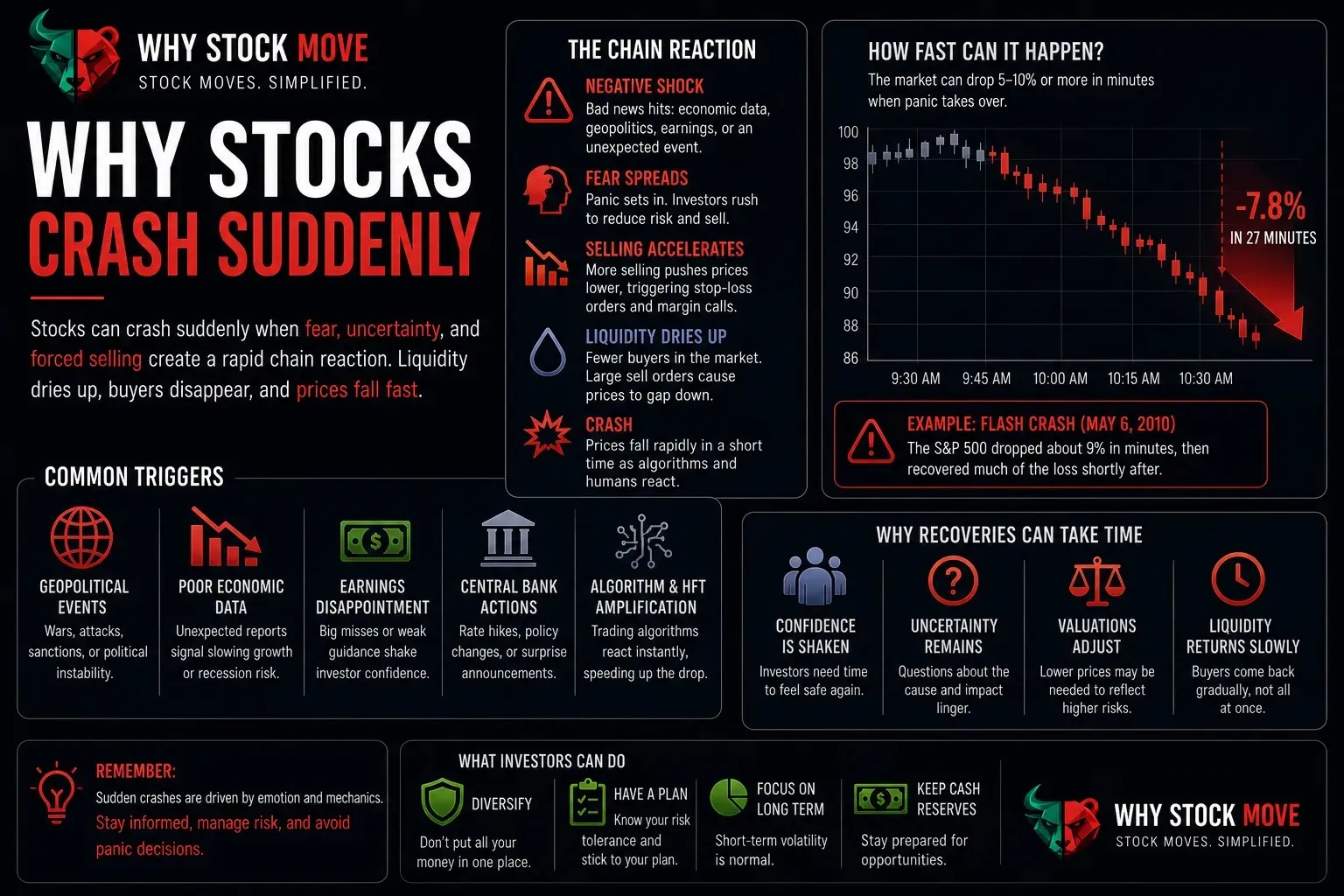
1. Earnings Shocks Can Break Confidence in Minutes
Stocks crash after earnings when the report does more than miss. It destroys the prior growth or profitability narrative. Once investors realize their forward assumptions were badly wrong, they do not wait around for a balanced debate. They dump exposure first and rebuild the model later. That gap between old expectations and new reality is where crashes begin.
Example: Meta’s roughly 26% drop in February showed how quickly a megacap can reprice when the market stops trusting the growth path it was paying for.
What to watch for: Watch for large gaps between consensus and guidance, not just between consensus and the reported quarter. Crashes usually come from the forward damage.
2. Fraud Revelations Remove the Benefit of the Doubt
Fraud is crash fuel because it attacks the basic credibility of the numbers. If investors cannot trust the accounts, they cannot trust the valuation model either. Buyers step back, shorts press, and the stock can gap repeatedly lower as each new detail worsens the picture. Once trust goes, valuation usually follows it lower in steps rather than all at once.
Example: Luckin Coffee plunged roughly 75% in April after it disclosed fabricated sales, because the market no longer had confidence in the business it thought it owned.
What to watch for: Watch for auditor issues, delayed filings, and sudden management turnover. Those are often early warning signs that trust itself is at risk.
3. Regulatory and Legal Shocks Can Reprice the Whole Business
A regulatory shock crashes a stock when the government threatens a core part of the company’s operating model. Fines matter, but restrictions on growth, distribution, or data use matter more because they change the future cash-flow path. Investors sell hard when they realize the business is less free to monetize than they assumed.
Example: Didi fell sharply after its US listing as Chinese regulatory action upended the listing story and raised existential questions about growth and compliance.
What to watch for: Watch for investigations tied to the company’s main product, market access, or data practices. Peripheral legal noise usually does less damage.
4. Flash Crashes Happen When Market Structure Fails
A flash crash is not always about new fundamentals. Sometimes the market’s plumbing fails first. Liquidity providers step back, algos pull quotes, and a modest sell order starts hitting a very thin book. Price then gaps violently because there are not enough resting bids to slow it down. The shock feels fundamental in the moment even when it is mostly structural.
Example: During the May flash crash, shares including Accenture briefly collapsed to absurd levels as liquidity evaporated and price discovery broke.
What to watch for: Watch for extreme intraday moves that reverse quickly once liquidity returns. That pattern often points to structure rather than business value.
5. Margin Call Cascades Turn Pressure Into Panic
Leverage can turn a bad day into a crash because one forced seller creates the next. If a fund or large trader cannot meet margin requirements, positions get liquidated into a falling market. That pushes price lower, which stresses the next levered holder. Cascades move faster than normal because the orders are mandatory.
Example: ViacomCBS fell about 27% in March during the Archegos unwind as block sales overwhelmed natural demand and turned a concentrated risk problem into a market event.
What to watch for: Watch for huge block volume, unexplained collapses in correlated names, and headlines about prime broker exposure. Those are classic cascade clues.
6. Contagion Spreads Fear Beyond the First Victim
A stock can crash because another stock already did. Contagion works by making investors question which names share the same hidden risk, whether that is funding exposure, customer overlap, or mark-to-market losses. Once the market starts grouping companies together, fear can move faster than facts. That is why second-order crashes can look irrational until the exposure map becomes clearer.
Example: After SVB Financial imploded in March , other regional bank stocks such as First Republic and PacWest collapsed as investors hunted for the next weak link.
What to watch for: Watch peer reactions and balance-sheet similarities. Contagion is strongest when the market can tell a simple story across multiple names.
7. Geopolitical and Black Swan Shocks Widen Every Outcome
Black swan events crash stocks because they make normal forecasting useless. Demand can disappear, supply chains can freeze, and financing conditions can tighten all at once. The market responds by demanding a much higher risk premium immediately, which means much lower prices. When the range of outcomes explodes, price usually adjusts before confidence does.
Example: Travel and leisure names such as Carnival crashed during the early COVID shock because investors suddenly had to price almost no near-term revenue and heavy funding risk.
What to watch for: Watch whether the event affects only sentiment or also revenue, solvency, and access to capital. Multi-channel shocks do the deepest damage.
Circuit Breakers Show How Stress Reaches the Whole Market
Circuit breakers exist because crashes can become self-reinforcing if trading never pauses. A halt gives market participants time to process information, recalculate risk, and re-enter orders more rationally. That does not stop stocks from falling, but it can stop disorder from becoming total chaos. The presence of halts itself is often a sign that you are dealing with systemic stress, not an ordinary selloff.
Example: During March , market-wide circuit breakers hit multiple times as selling across the entire tape became too violent for normal trading conditions.
What to watch for: Watch whether halts are isolated to one stock or broad across the market. Broad halts usually tell you the problem is much bigger than one company.
How to Use This as an Investor
When a stock crashes suddenly, the first task is diagnosis, not bravery. Ask whether the cause is structural, regulatory, balance-sheet-related, or simply a liquidity accident. Some crashes create opportunity. Others are the market discovering that the old valuation framework was nonsense. You do not want to confuse the two while the tape is still emotional. Most errors happen when investors assume every crash is a bargain.
Example: Luckin’s crash was about trust. ViacomCBS’s crash was about forced selling. Those setups deserved very different responses.
What to watch for: The faster the drop, the more disciplined your checklist needs to become. Speed is not evidence. It is stress.
Frequently Asked Questions
Why do stocks sometimes crash with no warning?
Often there were warnings, but the market did not care until a trigger forced it to care. Hidden leverage, weak funding, aggressive accounting, or crowded positioning can sit quietly for months. Then one event removes confidence and the repricing happens all at once.
Can a stock recover after a crash?
Yes, but recovery depends entirely on the cause. Liquidity-driven crashes can reverse quickly once forced selling ends. Fraud, regulatory damage, or broken balance sheets are much harder to repair because the business itself changed or trust disappeared.
What should I do when a stock I own crashes suddenly?
Do not average down automatically. First identify whether the issue affects solvency, earnings power, or only market structure. A disciplined read of the cause is far more valuable than a fast emotional reaction to the size of the drop.
How can I tell a crash from a normal correction?
Crashes usually involve a gap in information or liquidity, not just a routine pullback after a run. They come with panic volume, a sharp change in risk perception, and often broader spillover into peers or the market. Corrections are uncomfortable. Crashes change the rules of the setup.
Are flash crashes good buying opportunities?
Sometimes, but only if the move was clearly caused by market structure rather than by bad new information. If liquidity temporarily failed and the stock quickly reclaims value, that can create opportunity. If the crash exposed a real business problem, the lower price is not automatically attractive.