
How Market Sentiment Moves Stocks
Markets do not move on facts alone. They move on how investors feel about the facts, how much risk they want to carry, and which stories they are willing to believe. That is market sentiment. When sentiment shifts, prices can move long before earnings statements catch up, and that is why understanding sentiment helps you interpret moves that fundamentals alone cannot explain.
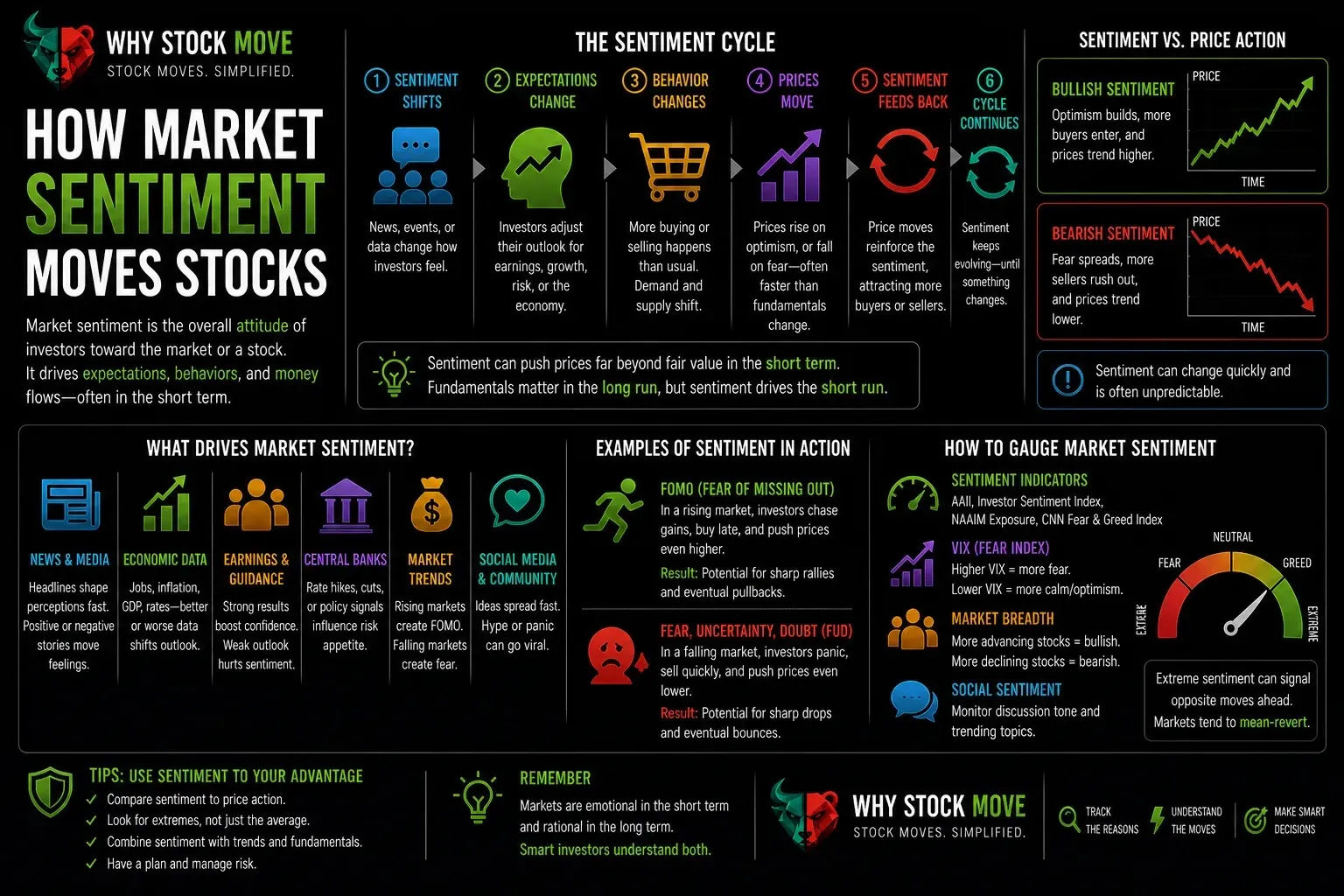
What Market Sentiment Actually Is
Market sentiment is the prevailing mood investors bring to risk. It shapes how aggressively they buy good news, how violently they punish bad news, and how much uncertainty they are willing to tolerate. Sentiment does not replace fundamentals, but it changes the multiple the market is willing to pay for those fundamentals.
Example: Meta’s collapse in late and rebound in showed how fast the same business can be valued differently when sentiment around management discipline and growth potential changes.
What to watch for: Watch valuation multiples, not just earnings. Sentiment often shows up first in what investors are willing to pay for a given level of profit.
Fear and Greed Create the Biggest Sentiment Swings
Fear compresses time horizons and makes investors sell first and analyze later. Greed does the opposite, stretching time horizons and making investors pay for optimistic stories before the evidence is complete. Those emotional regimes create big valuation swings because the market stops weighting risk and reward evenly.
Example: The meme-stock boom in showed greed in its purest form, while the March panic showed how fear can make even strong businesses trade like broken ones.
What to watch for: Watch whether dips are being bought quickly or whether every rally is getting sold. That tells you a lot about the current emotional regime.
Sentiment Indicators Matter When They Reach Extremes
Tools like the CNN Fear and Greed Index matter most at extremes because they summarize how stretched positioning and emotion may have become. These indicators are not timing tools by themselves, but they can tell you when the market is leaning too far in one direction. Extreme fear often creates better prospective returns than the mood would suggest. Extreme greed does the opposite.
Example: In late , extreme bearish sentiment around beaten-down tech names set the stage for powerful rebounds once macro pressure eased.
What to watch for: Watch sentiment indicators alongside price stabilization, not in isolation. Extremes can stay extreme longer than you expect.
Narratives Move Money Before Models Catch Up
Narratives matter because investors allocate around stories that simplify the future. AI, reopening, rate cuts, or deglobalization are all examples of narratives that can redirect capital before precise earnings estimates catch up. The market often buys the story first and refines the math later.
Example: Nvidia’s AI narrative became so powerful because it was backed by earnings, but the story itself also helped pull capital into the broader semiconductor ecosystem ahead of full consensus revisions.
What to watch for: Watch whether the narrative is starting to influence peer stocks and sector ETFs. That is how you know it is becoming a capital-allocation force.
Retail Sentiment Became a Real Force
Retail sentiment matters more than it used to because commission-free trading, social platforms, and options access let many small accounts act together in real time. That does not mean retail sets long-term value, but it can absolutely set the pace of short-term moves in the right setup. Retail no longer needs Wall Street’s permission to matter in the short run.
Example: GameStop and AMC in proved that coordinated retail enthusiasm can change actual price behavior, not just online conversation.
What to watch for: Watch call-option activity and social attention when sentiment looks euphoric. Retail influence often travels through those channels first.
Institutional Sentiment Leaves Slower but Larger Footprints
Institutional sentiment matters because the biggest pools of capital move more slowly but with much more size. When institutions collectively turn optimistic or pessimistic on a theme, you often see it in sector leadership, ownership changes, and sustained relative strength rather than in one explosive session. Their sentiment is quieter but more durable.
Example: Energy and bank leadership in parts of reflected improving institutional appetite for value and reopening-sensitive sectors even while many speculative growth names kept struggling.
What to watch for: Watch sector rotation, 13F trends, and how dips behave over several weeks. Institutional sentiment usually shows up in persistence.
Short Interest Is Also a Sentiment Signal
Short interest tells you where pessimism is concentrated. A heavily shorted stock is one where many investors believe the story is broken or overvalued. That can be useful even if you are not trading squeezes, because it reveals where sentiment is most one-sided and where any positive surprise could have outsized impact. It is pessimism measured in actual positioning. It shows you where skepticism has real teeth.
Example: GameStop’s setup was so explosive partly because negative sentiment had become extreme and highly concentrated in one name.
What to watch for: Watch whether short interest remains high as fundamentals stabilize. That mismatch can create powerful asymmetry.
Sentiment Changes with the Business Cycle
Sentiment rotates across the cycle. Early in recoveries, investors usually favor cyclicals and riskier growth because they expect improving demand. Late in the cycle, they often shift toward defensives or cash-generating quality. Understanding that rhythm helps explain why the same good company can look exciting in one macro regime and ignored in another.
Example: Banks and industrials outperformed sharply during reopening periods because sentiment favored cyclical earnings leverage, while defensive stocks often led when slowdown fears grew.
What to watch for: Watch which sectors lead after major macro data releases. Sentiment about the cycle usually reveals itself in leadership first.
Contrarian Investing Works Best at Sentiment Extremes
Contrarian investing is not about being opposite for the sake of it. It is about recognizing when sentiment has pushed price too far away from a reasonable range of outcomes. That setup is strongest when the business is better than the tape suggests and when the consensus view has become emotionally crowded. That is when being early can finally be worth it.
Example: Meta’s recovery from its lows rewarded investors who noticed that sentiment had become far more negative than the company’s long-term cash-generation ability justified.
What to watch for: Watch for extreme pessimism paired with stabilizing fundamentals. That combination is where contrarian opportunities are most credible.
How to Use This as an Investor
Sentiment is most useful when you treat it as a valuation amplifier. It can push good businesses too low and fashionable stories too high. That means your job is not to ignore sentiment. It is to understand when sentiment is confirming the fundamentals and when it is outrunning them. Sentiment is not fluff. It is pricing pressure. That distinction protects you from both euphoria and despair.
Example: The best opportunities often appear when sentiment and fundamentals temporarily disagree.
What to watch for: Use sentiment to frame risk and timing, not to replace business analysis. Mood moves prices, but cash flow decides where they settle.
Frequently Asked Questions
Can market sentiment move a stock more than fundamentals?
For short stretches, yes. Sentiment changes the multiple investors are willing to pay and the urgency with which they react to news. Over longer periods, fundamentals usually reassert themselves, but the path can still be dominated by mood and positioning.
How do I know if a move is sentiment-driven?
Look for price action that is bigger than the underlying earnings change would justify, especially when peers or themes are moving together. Check social attention, options activity, and whether valuation multiples are expanding or compressing faster than estimates. Those are all signs sentiment is leading.
What should I do when sentiment is extremely bullish?
Be more selective about valuation and more skeptical of easy stories. Extreme optimism raises the bar for future upside because so much good news is already embedded in price. You do not need to fight the trend, but you do need to respect the expectation risk.
How can I use fear in the market constructively?
Fear is useful when it pushes prices below what the fundamentals justify. The best setup is not simply a scary chart. It is a strong or improving business trading as if the worst case is certain. That is where sentiment can create opportunity.
Are sentiment indicators enough to make investment decisions?
No. They are context tools, not complete systems. Sentiment can stay extreme for a long time, and fundamentals can worsen while sentiment still looks washed out. Use sentiment to frame odds and timing, but keep your thesis grounded in the business.