
How Does News Affect Stock Prices?
News moves stocks only when it changes what investors think the future looks like. That sounds obvious, but it explains almost every confusing reaction you see. Great headlines can lead to red candles when the market expected even better. Awful headlines can lead to rallies when the fear had already been overdone. The market prices the surprise, not the storytelling.
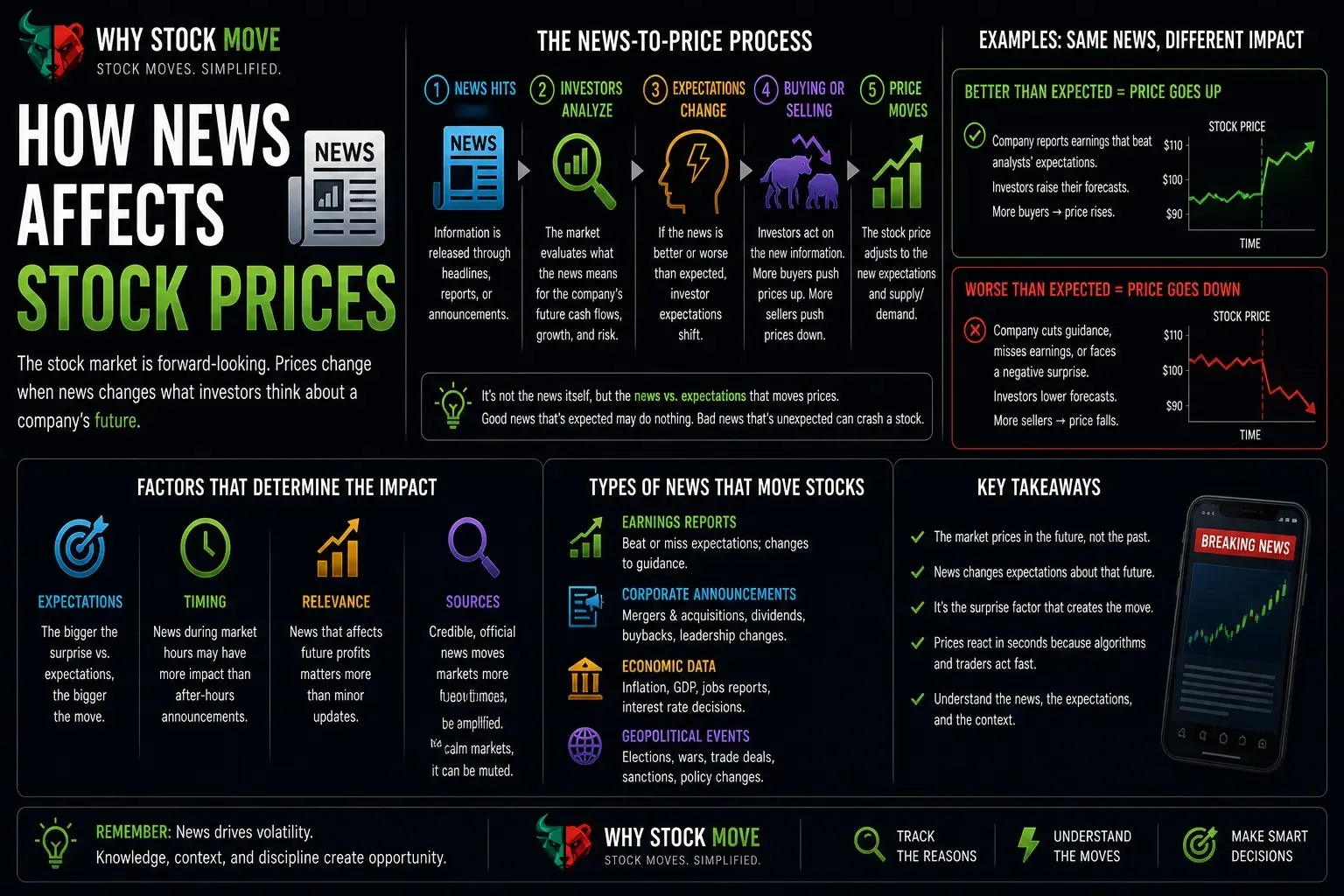
How News Affects Stock Prices Through Expectations
The core mechanism is expectation versus reality. A headline matters if it changes expected earnings, risk, or capital flows more than investors had already assumed. If the news confirms what everyone knew, the move may be small. If it forces a new valuation model, the move can be huge. The same headline can therefore produce opposite reactions in different setups.
Example: Meta’s February earnings news crushed the stock because it did not just report weak numbers. It changed the market’s expectations for growth and margins in future quarters.
What to watch for: Watch what analysts and traders expected before the event. The surprise gap is usually the real catalyst.
Speed Matters Because Markets Reprice Instantly
News affects stocks quickly because the market is a live auction where informed participants act before slower ones finish reading. Algorithms scan headlines, discretionary traders respond, and options desks hedge immediately. That is why a stock often makes its largest move in the first few minutes after material news hits.
Example: Twitter’s stock jumped about 27% in April when Musk’s bid became public because the repricing to a takeover framework happened almost instantly.
What to watch for: Watch the first reaction, but also whether the second reaction confirms it. The best signals often come from what happens after the initial scramble.
Company-Specific News Has the Most Direct Impact
Company news such as earnings, product approvals, leadership changes, or major contracts has the clearest effect because it directly alters that company’s future cash flows or risk profile. Investors can immediately tie the event to valuation. The cleaner that line is, the cleaner the stock reaction tends to be. The cleaner that connection, the less time the market needs to decide.
Example: Pfizer rose about 15% in November after vaccine authorization news because the market could directly connect the event to potential revenue and strategic relevance.
What to watch for: Watch whether the news changes revenue, margins, or trust. Those three channels explain most stock reactions.
Industry News Creates Read-Through Moves
Sector news affects multiple stocks because investors use one company’s update to infer something about peers. A strong order cycle at one chip company can lift the group. A regulatory problem at one bank can hit the whole region. The mechanism is read-through, not lazy correlation. Markets are always trying to pull tomorrow’s peer results into today’s prices.
Example: After Nvidia’s AI-driven guidance blowout in May , related semiconductor and infrastructure names rallied because investors extrapolated stronger demand across the ecosystem.
What to watch for: Watch which peers move and by how much. That tells you whether the market sees the news as isolated or industry-wide.
Macroeconomic News Moves the Discount Rate for Everyone
Macro news matters because it changes interest-rate expectations, recession odds, or demand assumptions across the market. Inflation prints, jobs data, and Fed decisions all work through this channel. The stock reaction may have nothing to do with the company’s latest quarter and everything to do with the valuation environment investors are using for all equities.
Example: In , CPI releases regularly moved megacap tech stocks because each report altered expectations for future Fed tightening and equity multiples.
What to watch for: Watch Treasury yields and sector leadership after the macro release. That tells you which part of the market the news hit hardest.
Geopolitical News Raises Uncertainty and Selective Winners
Geopolitical headlines can hit stocks by raising uncertainty broadly or by changing demand for specific industries. Defense names, energy producers, airlines, and global banks often react most because they sit closest to the direct economic channel. The move can be sharp even when the long-term impact is unclear because the market hates open-ended uncertainty.
Example: Lockheed Martin and other defense names strengthened after Russia invaded Ukraine in February as investors priced higher defense spending expectations.
What to watch for: Watch whether the move is broad risk-off selling or targeted sector rotation. Geopolitical news rarely affects every business in the same way.
Buy the Rumor, Sell the News Happens When the Move Came First
Sometimes the stock already rallied on anticipation, so the actual news becomes a liquidity event for profit-taking rather than a fresh bullish trigger. In those cases the market is not rejecting the news. It is admitting the news was already priced. This is common around product events, policy decisions, and well-telegraphed catalysts.
Example: Tesla fell after its highly anticipated Battery Day event in September because enthusiasm had run far ahead of what the actual presentation delivered to investors.
What to watch for: Watch the pre-event run, options premiums, and sentiment. The more stretched the setup, the easier it is for good news to disappoint.
Fake News and Bad Information Can Still Move Real Prices
Markets can react to false information because traders and algorithms act before every claim is verified. If the headline looks credible enough and touches a sensitive part of the story, the stock may move first and sort it out later. That makes misinformation dangerous in fast markets. That makes source discipline a practical edge, not just a good habit.
Example: Eli Lilly fell about 4% in November after a fake social-media post about free insulin circulated, showing how quickly bad information can affect a real stock.
What to watch for: Watch source quality, filing confirmation, and whether the company responds quickly. In rumor-driven moves, verification speed matters.
How to Use News Intelligently
The best way to use news is to separate the event from the market’s prior assumption. Ask what changed, who is forced to react, and whether the news affects one company, a sector, or the entire discount-rate environment. That framework stops you from confusing headlines with edge. You gain a major edge once you stop reading headlines at face value.
Example: Nvidia’s May report mattered because it changed future earnings models across a whole part of the market, not because it generated dramatic headlines.
What to watch for: Read the stock reaction, peer reaction, and bond-market reaction together. News rarely operates through only one channel.
How to Use This as an Investor
If you want to understand how news affects stock prices, start by asking what the market expected five minutes before the story hit. That is the baseline everything else is measured against. Then ask how direct the link is to earnings, risk, or flows. That is the part that determines whether the move is likely to persist. Expectations are the invisible part of every price reaction. That hidden baseline is where most of the edge lives.
Example: Good investors do not just read news. They read what the market thought before the news.
What to watch for: That extra layer is what turns headlines from entertainment into usable information.
Frequently Asked Questions
Why does bad news sometimes make a stock go up?
Because the market may have feared something even worse. If investors were braced for disaster and the actual news is merely bad, the stock can rally on relief. Stocks trade against expectations, not against your emotional reaction to the headline.
How quickly is news priced into a stock?
Often within seconds for the first move and within hours for the fuller move. Algorithms and active traders react immediately, but analyst revisions and institutional interpretation can extend the repricing over the next few sessions. The first move is not always the final move.
What should I check after a big news-driven move?
Look at the source, the direct business impact, and how peers are trading. Then check whether analysts are changing estimates or whether the move seems mostly emotional. Those steps tell you whether the event changed value or just changed attention.
How can I use news without overtrading it?
Create a habit of classifying news by type: company-specific, sector, macro, or rumor. That prevents you from reacting the same way to an FDA approval, a CPI print, and a viral social post. Better classification usually means fewer impulsive trades.
Is the first reaction to news usually right?
Not always. Fast markets can overshoot, underreact, or misunderstand details initially. What matters is whether the second wave of analysis confirms the first price move. Estimate revisions and peer reactions are often more reliable than the first five-minute candle.