
Why Is a Stock Going Up With No News?
A stock can rise hard even when there is no obvious headline on your screen. That does not mean nothing is happening. It usually means the catalyst sits in flow, positioning, or market structure rather than in a press release. Once you know where to look, these “mystery pumps” become a lot less mysterious.
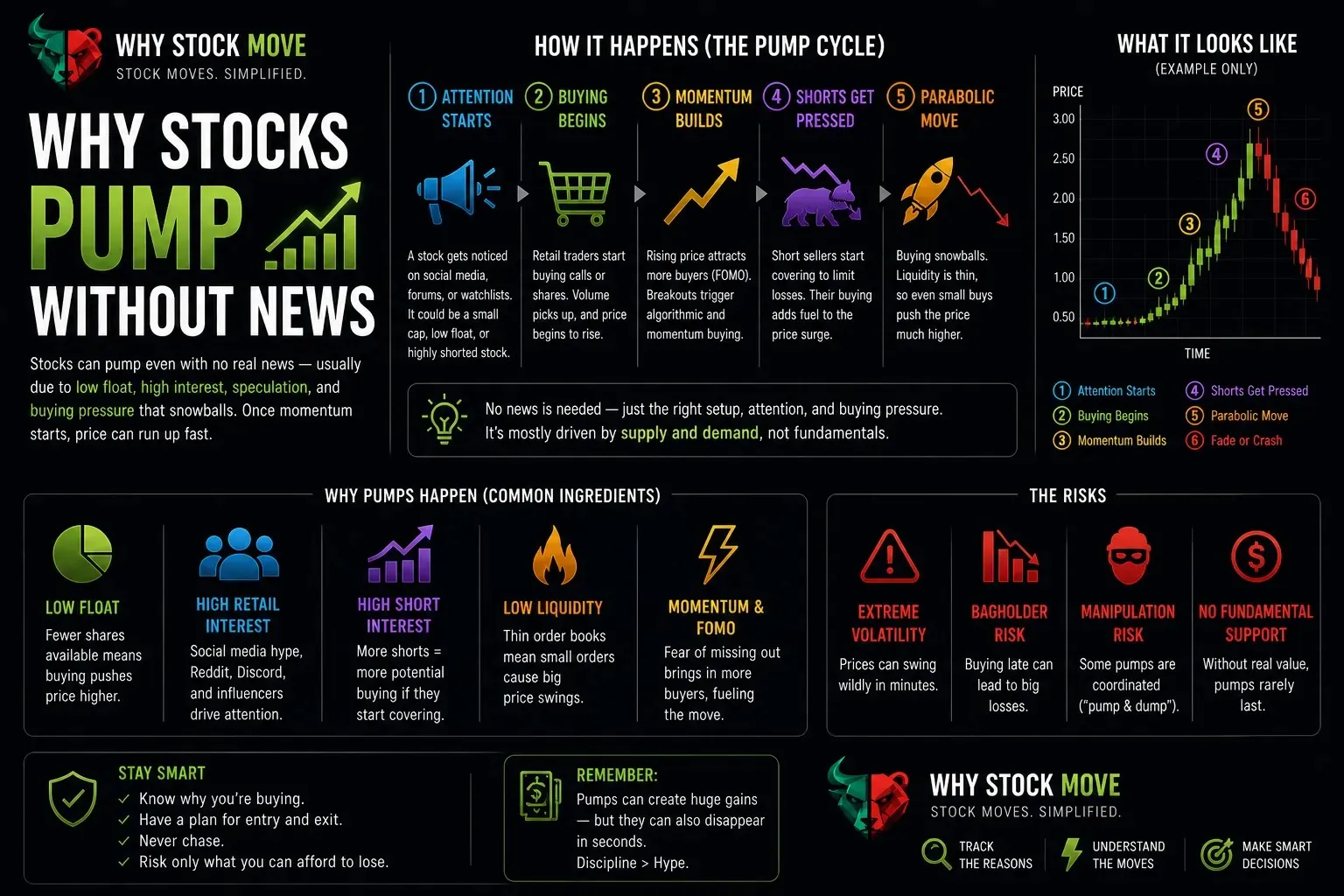
1. Quiet Institutional Accumulation Can Lift a Stock for Days
Stocks pump without news when a large buyer starts building a position and the market only sees the footprint after the fact. Institutions rarely announce their purchases in real time, but their demand still changes the tape. Repeated buying on dips, stronger closes, and persistent volume can all signal that the real story is capital flow, not public information.
Example: Nvidia’s climb ahead of the full AI frenzy in early often looked quiet on the surface, but the tape suggested powerful accumulation before the narrative became obvious to everyone else.
What to watch for: Watch multi-day volume expansion and stocks that keep recovering intraday weakness. Persistent support often means someone larger is still working the order.
2. Unusual Options Activity Can Force Stock Buying
A stock can move with no news because options traders are creating the catalyst themselves. Heavy call buying may force market makers to buy stock as a hedge, and that dealer flow can push price higher even before anyone sees a public reason. In effect, the flow becomes the headline.
Example: Many meme-era names in , including AMC, saw bursts of upside where options demand clearly helped power the move before any new fundamental news emerged.
What to watch for: Watch same-day and near-dated call volume, especially if it arrives at strikes close to the current price. That is where dealer hedging tends to bite fastest.
3. Technical Breakouts Attract Self-Fulfilling Buyers
Stocks also pump without news when they break important chart levels that many traders watch at the same time. A breakout through prior highs, moving averages, or long consolidations can trigger systematic buying, stop-ins from shorts, and momentum participation from discretionary traders. The reason is not magic. It is synchronized behavior.
Example: Carvana’s rebounds repeatedly accelerated as technical levels broke because a heavily watched chart started forcing both shorts and momentum traders to react.
What to watch for: Watch volume on the breakout and whether the stock can hold above the level into the close. Real breakouts attract commitment, not just intraday excitement.
4. Sector Rotation and Sympathy Moves Create Hidden Catalysts
A stock may pump because another stock in the same theme just changed the market’s appetite for the entire group. This is common in semiconductors, biotech, and commodity-linked names. Traders extrapolate the read-through, ETFs pull money across the basket, and second-tier names move before they have said anything new themselves. The catalyst exists, but it lives next door rather than inside the company itself.
Example: After Nvidia’s May earnings, multiple AI-adjacent stocks rose sharply in sympathy because investors repriced the broader semiconductor and infrastructure theme.
What to watch for: Watch peer charts and sector ETFs. If several related names move together, the “no news” move may actually be a theme move.
5. Short Seller Capitulation Looks Like a Pump Until You Read Positioning
A stock can rip higher with no news because the real event is short sellers giving up. That is especially common after a long downtrend when the short thesis starts feeling crowded and the stock refuses to break lower. Once the first shorts cover, their buying creates price strength that pressures the next layer.
Example: Carvana’s dramatic rallies in were partly driven by short capitulation as bankruptcy expectations faded and bears were forced to reassess.
What to watch for: Watch short interest, borrow costs, and whether the stock is rising on no obvious catalyst after a long period of pessimism. That is fertile squeeze territory.
6. Risk-On Tape Can Lift Speculative Stocks Together
Sometimes the stock is pumping because the whole market has moved into a risk-seeking mood. In that environment, capital chases beta, story stocks, and lower-quality names because investors want upside exposure more than they want certainty. The move may feel stock-specific, but the true driver is a broader appetite for risk.
Example: During stretches of and , names like Palantir and other speculative growth stocks often surged together as liquidity and sentiment pushed money toward higher-beta trades.
What to watch for: Watch the Russell , ARKK-style growth baskets, and retail trading activity. If they are all running, the pump may be macro sentiment in disguise.
7. Some Pumps Really Are Manipulation
Not every unexplained rally is innocent. Thinly traded stocks can be pushed higher by coordinated promotion, rumor, and aggressive trading designed to attract outside buyers. These pump-and-dump setups often rely on attention more than substance. The price rise is real, but the underlying demand is fragile and usually disappears once promotion fades.
Example: AMTD Digital’s extraordinary spike became a public example of how detached price action can get from fundamental explanation when float, attention, and speculation collide.
What to watch for: Watch tiny floats, vague narratives, and moves unsupported by filings, financials, or credible catalysts. When you cannot explain the business, respect the risk.
How to Use This as an Investor
When a stock pumps without news, the useful question is not “who knows something?” but “what kind of flow is most likely active?” If the answer is accumulation or a sector read-through, the move may have legs. If the answer is gamma, a squeeze, or pure promotion, the risk profile is very different. Understanding the flow lets you stop treating every unexplained rally as one category.
Example: A sympathy move after Nvidia’s AI reset is not the same setup as a tiny-float social-media frenzy.
What to watch for: Read the tape, the options activity, and the peer group before you invent a story. The market often leaves clues even when the news feed does not.
Frequently Asked Questions
Can insiders be buying when a stock pumps without news?
They can, but you usually will not know in real time unless filings appear later. More often, the move comes from institutions, options activity, short covering, or sector flows that are visible only through price and volume at first. That is why tape-reading matters.
How can I tell a real accumulation move from a pump-and-dump?
Look at liquidity, filings, and the quality of the company. Real accumulation usually shows persistent volume, orderly pullback buying, and eventually some fundamental validation. Pump-and-dump behavior often looks chaotic, thin, promotional, and disconnected from any credible operating story.
What should I do when I see a stock pumping without news?
First, identify whether peers are moving, whether options activity is extreme, and whether short interest is high. That helps you classify the move before you decide whether to engage. Acting without classification is how traders end up chasing the wrong kind of rally.
Do these no-news pumps usually fade?
Many do, especially when they were driven by gamma or promotion rather than by a deeper change in ownership or expectations. But some continue if the move was actually early evidence of institutional accumulation or a broader thematic repricing. The tape alone is not enough. Context matters.
How can investors use this without becoming technical traders?
You can use these moves as prompts for research. If a stock keeps attracting demand with no obvious news, ask what the market may be pricing before it becomes widely discussed. Sometimes the move is noise. Sometimes it is an early clue that a thesis is changing.