
Why Are Stocks Volatile?
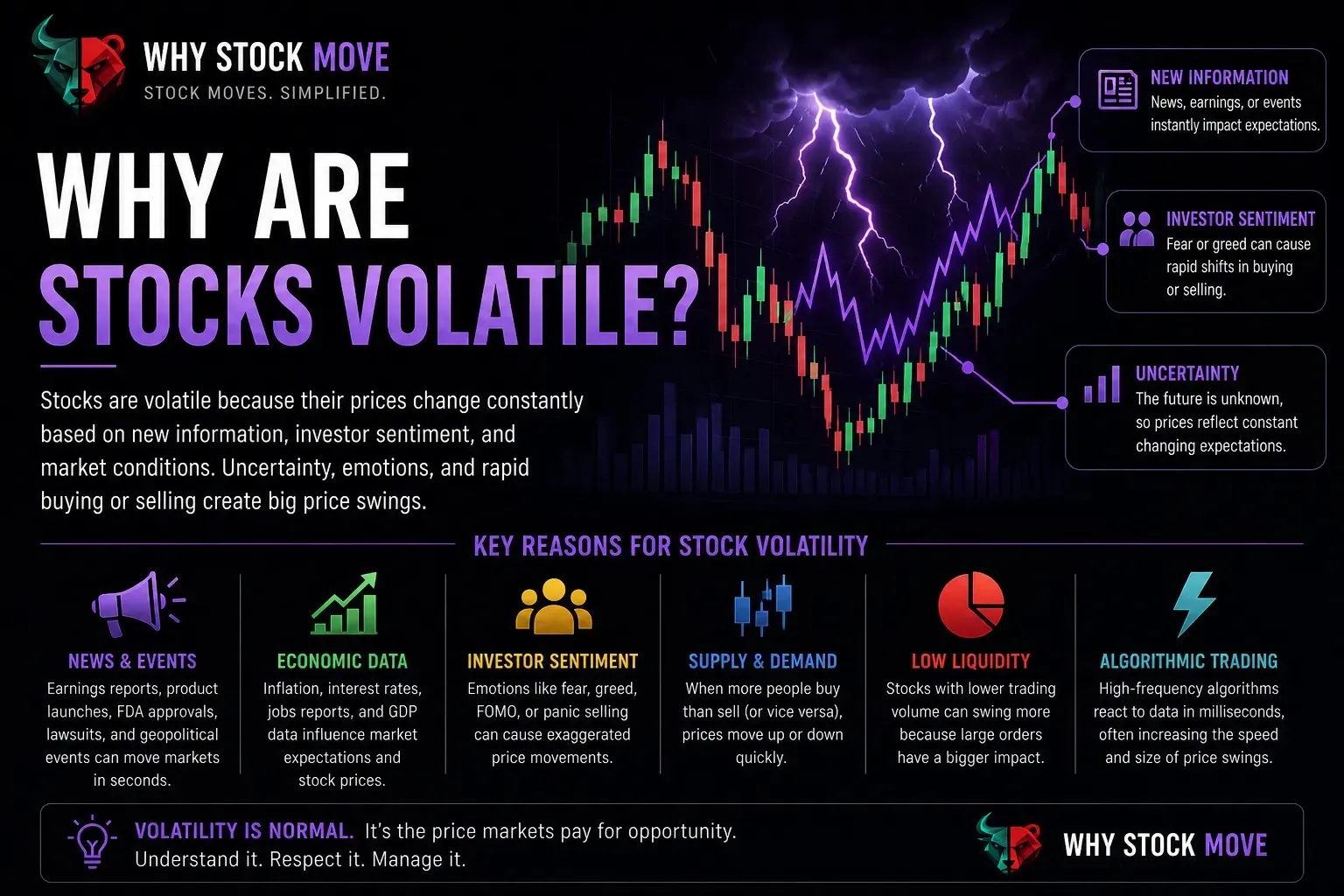
A stock does not become volatile because investors suddenly lose discipline. It becomes volatile because uncertainty, leverage, and market structure start feeding on each other. One headline widens the range of outcomes. Then options hedging, thin liquidity, and emotional positioning widen it again. That is why some periods feel calm and others feel impossible to trade.
What Volatility Really Means in a Stock
Volatility is the size and speed of a stock’s price swings, not the direction. A stock can be volatile on the way up, on the way down, or while snapping violently between both. The mechanism behind volatility is uncertainty about future cash flows or future positioning. When investors disagree sharply on value, or when the order book cannot absorb trades smoothly, the gap between bids and offers widens and price moves get larger.
Example: SVB Financial’s collapse in March was a stark example because the market had to reprice survival odds in real time, which made the stock wildly volatile before the business effectively broke.
What to watch for: Watch average true range, implied volatility, and how much the stock moves around routine headlines. Volatility is easiest to manage when you quantify it instead of describing it emotionally.
1. Uncertainty Is the Core Engine of Volatility
Stocks get volatile when investors cannot confidently estimate future earnings, cash flow, or solvency. That uncertainty increases disagreement, and disagreement creates wider price swings as buyers and sellers demand bigger concessions to trade. Volatility often spikes before facts are fully known, which is why rumor-heavy periods can feel wilder than the final resolution.
Example: During the regional bank panic in March , names tied to deposit stability swung violently because the market could not agree on which balance sheets were safe and which were not.
What to watch for: Watch for situations where one unanswered question dominates the story, such as liquidity, regulation, or a make-or-break product decision. Uncertainty clusters create volatility clusters.
2. Leverage and Margin Turn Moves Into Cascades
Leverage makes stocks more volatile because borrowed money shortens investor patience. When a position moves the wrong way, brokers demand more collateral or force sales, which creates fresh price pressure and triggers the same problem for the next levered holder. That feedback loop can turn an ordinary drawdown into a cascade.
Example: ViacomCBS fell roughly 27% in one day during the Archegos unwind in March because forced liquidations overwhelmed the normal buyer base.
What to watch for: Watch leverage-sensitive ownership, unusual block volume, and whether the stock is falling faster than any new information would justify. Forced selling often leaves that fingerprint.
3. Algorithmic Trading Reacts Faster Than Humans
Algorithmic and high-frequency trading increase volatility because many systems are built to respond instantly to price, volume, and news signals. They provide liquidity in calm conditions but can pull back or trade with the move when uncertainty jumps. That makes the book thinner exactly when traders need it most, which exaggerates gaps and intraday reversals.
Example: During the May flash crash, shares in companies such as Accenture briefly collapsed by extreme amounts because automated liquidity vanished and price discovery broke.
What to watch for: Watch for sudden air pockets, outsized moves without clear new headlines, and sharp reversals once normal liquidity returns. That pattern often points to market structure rather than fundamentals.
4. Options Markets and Gamma Exposure Add Fuel
Options can amplify stock volatility because dealers hedge dynamically. When traders aggressively buy calls, market makers may need to buy stock as price rises. When they buy puts, dealers may need to sell or reduce long hedges as price falls. That gamma feedback loop can make routine moves extend far beyond what the underlying news alone would suggest.
Example: GameStop’s surge showed how options activity can help turn an already unstable setup into a historic squeeze.
What to watch for: Watch open interest at nearby strikes, same-day options activity, and whether the stock accelerates as it moves through crowded option levels.
5. Macro Events Push Many Stocks at Once
Macro uncertainty raises volatility because it changes the discount rate and the earnings outlook for large parts of the market at the same time. Fed meetings, inflation prints, and recession fears can all widen expected outcomes before any one company reports results. That is why a stock can swing sharply on a day when nothing happened inside the business itself.
Example: In , inflation surprises repeatedly knocked around megacap tech names because each CPI print changed the market’s view of future Fed tightening and valuation multiples.
What to watch for: Watch the economic calendar and the 10-year Treasury yield. If a stock is moving with rates instead of with company news, macro is in charge.
6. News Flow and Information Gaps Create Violent Repricing
New information makes stocks volatile when the market learns something material all at once. The move gets even larger when only a few participants understand the news immediately and others react later. That information gap creates a staggered repricing process where the stock keeps moving as more investors catch up.
Example: Pfizer’s vaccine news in November sent multiple healthcare and reopening-related names sharply higher because investors had to reprice the path of demand and recovery in real time.
What to watch for: Watch whether the first move is followed by analyst revisions and sector sympathy. News that keeps creating second-order reactions usually has deeper significance.
7. Thin Liquidity Magnifies Every Order
A thinly traded stock is volatile because there are fewer resting orders to absorb buying or selling pressure. One large order can gap the price several percentage points if the book is shallow. Small caps, after-hours trading, and stressed markets all suffer from this problem, which is why the same catalyst can produce a much bigger percentage move in one stock than in a liquid megacap.
Example: Many regional bank names in March saw violent intraday swings partly because liquidity thinned as market makers widened out and natural buyers stepped back.
What to watch for: Watch average daily dollar volume, bid-ask spreads, and how the stock trades outside regular market hours. Thin books make every decision more expensive.
8. Fear and Greed Make Investors Hit at the Same Time
Psychology adds volatility because humans crowd into the same narratives and then rush for the exit together. Fear compresses time horizons and greed stretches them. When investors stop thinking independently, order flow becomes one-sided and price swings get larger than the underlying facts would normally support. Sentiment does not replace fundamentals, but it can dominate them for stretches.
Example: Meme-stock episodes in showed how greed, FOMO, and public scorekeeping can make already risky stocks move in absurdly wide ranges.
What to watch for: Watch social chatter, retail options demand, and how quickly dips reverse or extend. Emotional markets trade with far less patience.
How to Measure and Use Volatility
Volatility becomes useful once you treat it as an input instead of as a feeling. Historical volatility tells you how much a stock has been moving. Implied volatility tells you how much the options market expects it to move. The gap between the two can help you judge whether upcoming risk is underpriced or overpriced. That matters for position sizing, entry timing, and whether you should even be in the trade before a catalyst.
Example: Before Nvidia’s May earnings, options priced a large move and the stock still exceeded expectations with a roughly 24% jump, showing that even elevated implied volatility can underestimate a true regime change.
What to watch for: Watch ATR, implied volatility, and your position size together. Most mistakes come from trading volatile stocks as if they were stable ones.
How to Use This as an Investor
Volatility is not automatically a warning sign. Sometimes it is just the price of uncertainty. Your edge comes from knowing whether the volatility is tied to changing fundamentals, unstable positioning, or thin liquidity. Those demand different responses. A great company in a macro-driven volatility spike can be very different from a weak company in a leverage unwind.
Example: The Archegos collapse and the SVB panic both produced huge moves, but for very different reasons and with very different recovery potential.
What to watch for: Size positions for the range a stock can actually trade, not for the range you hope it will trade. That single discipline solves more problems than most indicators do.
Frequently Asked Questions
Why are some stocks much more volatile than others?
Volatility depends on uncertainty, liquidity, and who owns the stock. Small caps, heavily shorted names, biotech companies, and high-multiple growth stocks usually have wider possible outcomes than steady cash generators. When the ownership base is fragile or the story is binary, price swings widen fast.
Is volatility the same thing as risk?
Not exactly. Volatility measures movement, while risk is the chance of a permanent capital loss or of being wrong in a way that matters. A volatile stock can still be attractive if the business is strong and you sized the position properly. A calm stock can be risky if the balance sheet is fragile or the valuation is unrealistic.
What should I do when volatility suddenly spikes?
First, identify whether the spike came from a scheduled event, a macro shock, or a market-structure problem. Then reassess your position size and your time horizon. A volatility spike is usually a signal to get more precise, not to get more emotional.
How can I use implied volatility as an investor?
Implied volatility is the options market’s estimate of future movement. If it is extremely high ahead of an event, the market already expects chaos, which changes how much upside or downside surprise remains. Even if you never trade options, it is a useful way to read the market’s fear level around a stock.
Can volatility create opportunity?
Yes, if you understand why it is happening. Macro-driven volatility can create better entries in strong companies. Event-driven volatility can reveal that the market was badly wrong about a business. The mistake is assuming all volatility means the same thing.