
What Makes Stocks Move Fast?
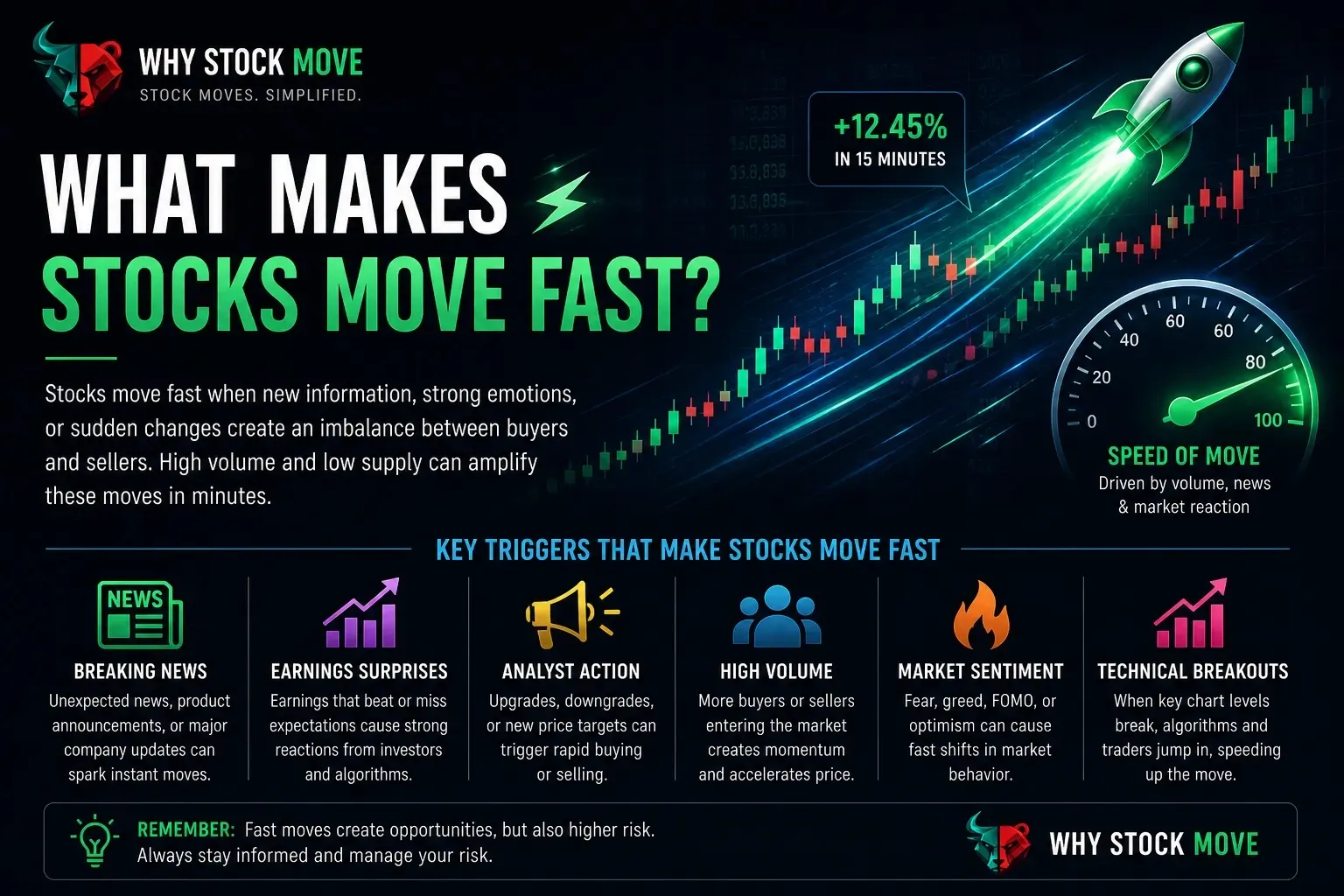
Most stocks spend their days drifting. Then one name suddenly gaps 18% before the open or falls 35% before lunch. What makes stocks move fast is not randomness. It is a catalyst strong enough to force the market to rewrite value immediately, usually while short sellers, options desks, and momentum traders make the first move even bigger.
1. What Makes Stocks Move Fast During Earnings Season
Earnings create fast moves because they deliver hard information about revenue, margins, and guidance all at once. The market is not just reacting to a headline beat or miss. It is repricing the next year or two of earnings in a single session. Options market makers, quant funds, and institutions all respond together, which is why the reaction can go from a premarket gap to a full-day trend in minutes.
Example: Nvidia surged about 24% after its May earnings report because the company’s AI guidance was so far above expectations that the old valuation framework no longer worked.
What to watch for: Watch implied earnings move, estimate revisions, and whether the company changed full-year guidance. The biggest moves usually need both a surprise and a new forward story.
2. FDA Decisions Create Binary Repricing
Biotech stocks move fast because an FDA decision can change a company’s future from speculative to commercial in a single headline. Approval means the market can start modeling revenue with more confidence. Rejection can wipe out the core thesis entirely. That binary setup attracts traders ahead of the event and causes extreme repricing once the uncertainty resolves.
Example: Biogen jumped about 38% in June after the FDA approved Aduhelm because investors suddenly had to price the possibility of a large Alzheimer’s treatment market.
What to watch for: Watch the exact catalyst date, prior trial readouts, and how much of the company’s value depends on that one asset. Single-asset stories move the fastest.
PDUFA Dates Are Scheduled Speed Traps
A PDUFA date matters because it puts a public deadline on a yes-or-no regulatory decision. Traders know the date, options markets know the date, and shorts know the date, so positioning builds before the announcement. Once the decision hits, all that stored tension resolves at once. That is why even small-cap biotech names can trade like meme stocks around the event.
Example: When Alnylam won FDA approval for Onpattro in August , the shares rose roughly 8% as a scheduled catalyst turned a years-long development story into an approved commercial opportunity.
What to watch for: Watch option premiums, prior FDA communications, and whether the stock is already running into the date. A crowded long setup can still fade on approved news.
3. Takeover Announcements Teleport the Price
M&A news produces some of the cleanest fast moves in the market because a buyer usually announces an explicit premium. Once that number is on the table, the stock jumps toward it immediately and then trades in a narrow spread based on deal risk. There is very little debate about the direction. The only question becomes whether the deal closes on the proposed terms.
Example: Twitter rose about 27% in April after Musk’s bid became public because the market instantly shifted from valuing Twitter as a standalone platform to valuing it as a takeover target.
What to watch for: Watch the spread between the current price and the offer price, financing certainty, and antitrust risk. That spread tells you how much the market trusts the deal.
4. Short Squeezes Force Buyers Into a Scarce Float
Short squeezes make stocks move fast because the people who were betting on downside suddenly become emergency buyers. If the float is tight and the initial spark is strong enough, short covering collides with momentum buying and price discovery breaks down. The move often looks irrational because the near-term flow is stronger than valuation logic.
Example: GameStop’s January run, which sent the stock up roughly 1,700% in weeks, is the textbook example of a squeeze overpowering fundamental anchors.
What to watch for: Watch short interest, borrow cost, and whether the stock is breaking key levels on unusually heavy volume. Fast squeezes rarely start from a quiet tape.
5. Pre-Announcements and Warnings Hit Before the Market Is Ready
A pre-announcement moves a stock quickly because management is telling you the quarter is materially different from what Wall Street still expects. The market hates surprise changes outside the normal earnings calendar because investors are less prepared and hedge levels are often wrong. Good pre-announcements can lift a stock hard. Revenue warnings can crush it even faster.
Example: FedEx fell about 21% in September after withdrawing guidance and warning on demand because the announcement reset global growth expectations before the scheduled earnings release.
What to watch for: Watch for unusual corporate press releases, 8-K filings, and company appearances at investor conferences. Management often updates the story there first.
6. New Coverage Can Wake Up an Ignored Stock
Analyst initiations on lesser-known companies can trigger fast moves when they introduce a story to institutions that were not paying attention. The mechanism is distribution: a fresh report gives sales desks something to market, gives PMs a starting model, and can create the first real liquidity event in a previously overlooked name. The effect is stronger in small and mid caps where the shareholder base is still forming.
Example: When coverage broadened around Arm after its listing, the stock saw sharp single-day swings as new institutional attention changed how aggressively investors were willing to price the story.
What to watch for: Watch for first-time initiations from major banks, not routine maintenance notes. New coverage matters most when it expands the pool of potential buyers.
7. Government Decisions and Contracts Can Reprice Revenue Overnight
A government contract, approval, or policy decision can move a stock fast because it changes revenue visibility and regulatory risk in one shot. The market especially reacts when the event confirms demand that had been debated for months. Defense, pharma, energy, and infrastructure names are highly sensitive to this kind of binary official validation.
Example: Pfizer rose about 15% in November after emergency vaccine authorization news because the path to meaningful COVID revenue suddenly looked far more concrete.
What to watch for: Watch agency calendars, procurement cycles, and whether the company has already signaled the financial significance of the decision. The bigger the revenue concentration, the faster the move.
8. Social Media Virality Can Create Real Order Flow
A stock can move fast on social media when online attention turns into synchronized buying from thousands of small accounts at once. That flow is real even if the thesis is weak. It changes the tape, forces market makers to hedge, and sometimes pulls in momentum funds that only care about price confirmation. Viral attention alone does not create lasting value, but it can absolutely create violent short-term price changes.
Example: AMC’s June surge, which briefly sent the stock up several hundred percent from earlier levels, was fueled by social amplification that created genuine order flow and forced participation from other market players.
What to watch for: Watch message volume, retail options activity, and whether the move is spreading across the same online watchlists. Virality shows up in behavior before it shows up in headlines.
9. Index Rebalances and ETF Flows Create Mechanical Speed
Index and ETF events move stocks fast because they are mechanical and time-bound. Funds do not care whether the valuation looks fair on the rebalance date. They care about matching the index. Traders know that, so they position in front of the flow and often amplify the move into the close. In names with thinner floats, that can create a surprisingly large one-day effect.
Example: Tesla’s run into its S&P 500 inclusion in late showed how passive demand and anticipatory trading can speed up an already strong move.
What to watch for: Watch the effective date, estimated fund demand, and closing auction volume. Rebalance-driven moves often peak when the forced flow finishes.
Technical Amplifiers Make Fast Moves Faster
Fast moves often start with a catalyst and then get magnified by market structure. Gamma squeeze dynamics matter because market makers who sold calls may need to buy stock as price rises, which creates a feedback loop. Stop-loss cascades matter because each break of a key level creates fresh sell or buy orders from traders using similar risk rules. Algorithmic momentum matters because trend-following systems are built to add exposure when a move proves itself. None of those flows care about your opinion. They care about price and positioning.
Example: GameStop in January was the clearest public example because short covering, call buying, and dealer hedging all reinforced one another into an extreme multi-day spike.
What to watch for: Watch options volume, open interest around obvious strike prices, and whether the stock accelerates as it clears technical levels. That is usually where structure overtakes narrative.
How to Use This as a Trader or Investor
Fast moves are easiest to understand when you separate the trigger from the amplifier. The trigger tells you whether the new price might stick. The amplifier tells you why the move may overshoot in the short run. If you blur those together, you will either chase a squeeze as if it were fundamentals or dismiss a real earnings reset as just noise.
Example: Nvidia’s May move had both a real catalyst and structural follow-through. A meme burst usually has far less staying power once the flow cools.
What to watch for: Before you react, identify the catalyst calendar, the positioning, and the options setup. That three-part read will keep you out of a lot of bad impulses.
Frequently Asked Questions
Why do some stocks move 20% in a day while others barely react?
Big moves happen when new information changes the market’s valuation model or when positioning was badly offside into the event. A boring company with balanced positioning rarely needs a dramatic reset. A crowded biotech, meme stock, or high-multiple growth name can move violently because both the narrative and the flow change at once.
What should I look at before trading a fast-moving stock?
Start with the catalyst and the calendar. Then check short interest, options activity, average volume, and whether the company has a history of gapping on similar events. That combination tells you whether you are dealing with a clean information move or a messy flow-driven chase.
How can I tell if a fast move is real or just hype?
A real move usually comes with new information that changes earnings power, risk, or capital flows. Hype-driven moves lean more on social attention, call buying, and vague narrative momentum. If analysts, estimates, and informed long-only buyers are not adjusting, the move is more vulnerable than it looks.
Do fast upside moves usually keep going?
Some do, especially after major earnings resets or credible M&A announcements. Many do not, particularly when they are powered mainly by squeezes or retail excitement. The crucial question is whether the catalyst changed intrinsic value or merely changed who needed to buy that day.
How can investors use fast moves without becoming day traders?
You can treat fast moves as information instead of as invitations to chase. A huge reaction often reveals where the market was wrong or where positioning was fragile. That helps you decide which themes deserve deeper work and which names are better left to short-term traders.