
What Is a Short Squeeze?
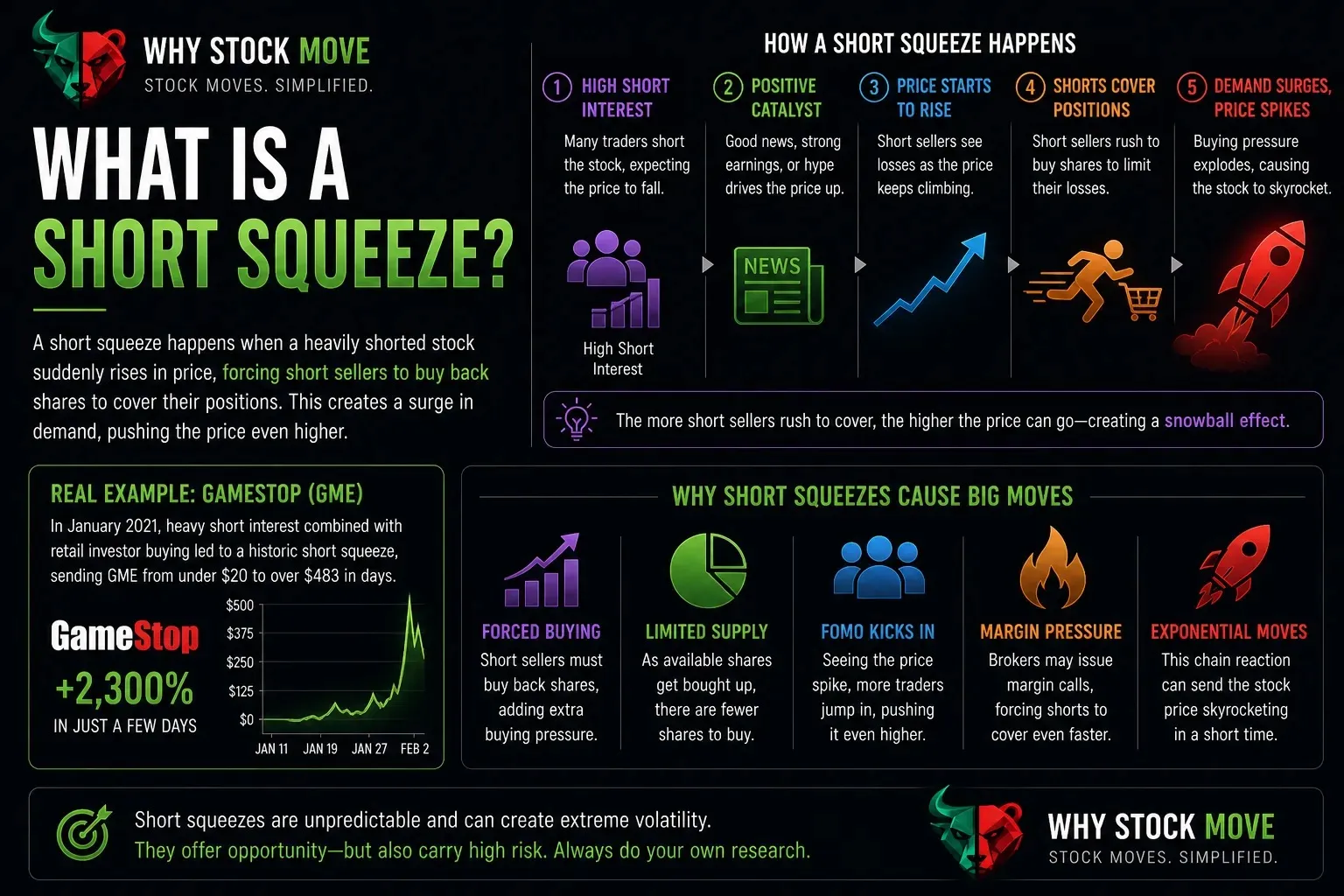
A short squeeze looks irrational only if you ignore the mechanics. When too many traders are betting against a stock, any strong upside move can turn those bearish positions into forced buying. That is why a short squeeze does not just create pain for shorts. It creates new demand exactly when supply is already getting tighter.
What Short Selling Actually Is
Short selling means borrowing shares, selling them, and hoping to buy them back later at a lower price. The short seller profits if the stock falls, but unlike a long investor, the downside is not capped because a stock can rise much more than 100%. That asymmetry is what makes squeezes so dangerous once a short thesis starts breaking.
Example: Tesla’s long advance from into forced many bearish positions to unwind because the company kept surviving and then outperforming the thesis against it.
What to watch for: Watch whether a short case depends on timing, solvency, or pure valuation. Timing-sensitive shorts are easiest to squeeze.
What Short Interest Tells You
Short interest measures how many shares have been sold short relative to the float. High short interest does not guarantee a squeeze, but it tells you there is a large pool of traders who may need to buy later if price moves against them. In other words, it is stored future demand sitting inside a bearish bet.
Example: GameStop entered with extremely elevated short interest, which made the stock uniquely vulnerable to a squeeze once the tape turned higher.
What to watch for: Watch short interest as a percentage of float and compare it with average trading volume. The ratio matters more than the headline number alone.
How a Short Squeeze Actually Starts
A squeeze usually starts with a catalyst that changes the story or with a technical breakout that forces the first shorts to cover. Once price rises, mark-to-market losses grow, brokers tighten risk limits, and some shorts buy back stock simply to survive. That buying drives price higher, which pressures the next layer of shorts. The squeeze is a feedback loop, not a single event.
Example: GameStop’s January surge began with improving sentiment and coordinated buying, then accelerated as short-covering demand fed the move higher.
What to watch for: Watch for a real catalyst plus a heavily shorted setup. A crowded short without a spark can stay crowded for months.
Days to Cover Tells You How Crowded the Exit Is
Days to cover compares total short interest with average daily volume. A high number means shorts would need many trading days to exit cleanly if they all wanted out. That matters because squeezes become more violent when the exit door is smaller than the crowd trying to use it. It is one of the simplest ways to measure how hard a clean unwind could become.
Example: GameStop’s days-to-cover dynamics helped explain why the move became so unstable once buying pressure accelerated in .
What to watch for: Watch both volume and float. A stock with high short interest but huge liquidity can behave very differently from one with the same short interest and thin volume.
Gamma Squeezes Can Amplify Short Squeezes
A gamma squeeze happens when aggressive call buying forces market makers to hedge by purchasing stock. If that stock is also heavily shorted, the dealer hedging flow collides with short covering and creates a stronger upward spiral. This is why some squeezes move far beyond what fundamentals or even ordinary covering would justify.
Example: GameStop again provided the public case study in , with call activity and dealer hedging helping intensify the already extreme short squeeze.
What to watch for: Watch near-dated call volume, open interest at key strikes, and whether the stock accelerates as those strikes come into play.
Famous Short Squeezes Show the Pattern Clearly
History repeats in squeezes because the ingredients are consistent: crowded shorts, limited supply, and a catalyst that forces fast reconsideration. Sometimes the catalyst is operational improvement. Sometimes it is ownership concentration. Either way, the market discovers that too many bears were leaning on the same trade. The details differ, but the supply-demand imbalance looks familiar every time.
Example: Volkswagen’s October squeeze sent the stock up roughly 300% in two days after the market realized the tradable float was far smaller than many short sellers assumed.
What to watch for: Watch for setups where float availability changes suddenly. Supply surprises can matter as much as company news.
How to Identify a Potential Short Squeeze
A good squeeze candidate usually has elevated short interest, a catalyst calendar, improving price action, and a float that is not especially deep. You also want to know whether the short thesis is crowded but fragile. A stock can stay heavily shorted forever if the business keeps deteriorating. The best squeezes happen when the bearish narrative stops getting cleaner.
Example: Carvana’s recovery rallies in showed how a stock with heavy short interest can rip higher when bankruptcy fears ease faster than bears expected.
What to watch for: Watch borrow cost, days to cover, and whether the company has a catalyst that could force shorts to re-evaluate. Squeezes need both pressure and a trigger.
How to Use This as an Investor
A short squeeze is a market-structure event first and a fundamental statement second. That does not mean you should ignore it. It means you should classify it correctly. Some squeezes reveal that the short thesis was badly wrong. Others are mostly mechanical and collapse once buying pressure burns out. That is where context matters more than excitement.
Example: Volkswagen in and GameStop in both squeezed hard, but for very different reasons and with very different implications.
What to watch for: Use short-interest data as context, not prophecy. The setup matters only when price and a catalyst start to validate it.
Frequently Asked Questions
Can a stock squeeze without very high short interest?
It can rally sharply, but a true short squeeze usually needs a meaningful short base. Without that stored future demand, you may just be looking at a momentum move or an options-driven spike. Short interest is not enough by itself, but it is usually necessary.
How do I know if a rally is a squeeze or just good fundamentals?
Look at positioning and the catalyst together. If short interest is elevated, borrow costs are high, and the move is unusually fast relative to the news, a squeeze is probably involved. If estimates are rising and institutional ownership is building steadily, fundamentals may be doing more of the work.
What should I do if I own a stock that starts squeezing?
Decide whether you are investing in the business or trading the squeeze. Those are different time horizons and different risk rules. Mechanical squeezes can reverse violently, so it helps to have a plan before the tape gets emotional.
How can I use short-interest data without overreacting to it?
Treat it as one variable in the setup. High short interest becomes actionable only when a catalyst, improving price action, or tighter float conditions make the bearish trade harder to hold. Plenty of heavily shorted stocks never squeeze because the business keeps getting worse.
Why do short squeezes often end so suddenly?
Because the forced-buying fuel eventually runs out. Once shorts have covered and dealer hedging cools, price has to stand on ordinary buyers and ordinary fundamentals again. If that underlying demand is weak, the reversal can be just as violent as the ascent.