
What Causes Volume Spikes in Stocks?
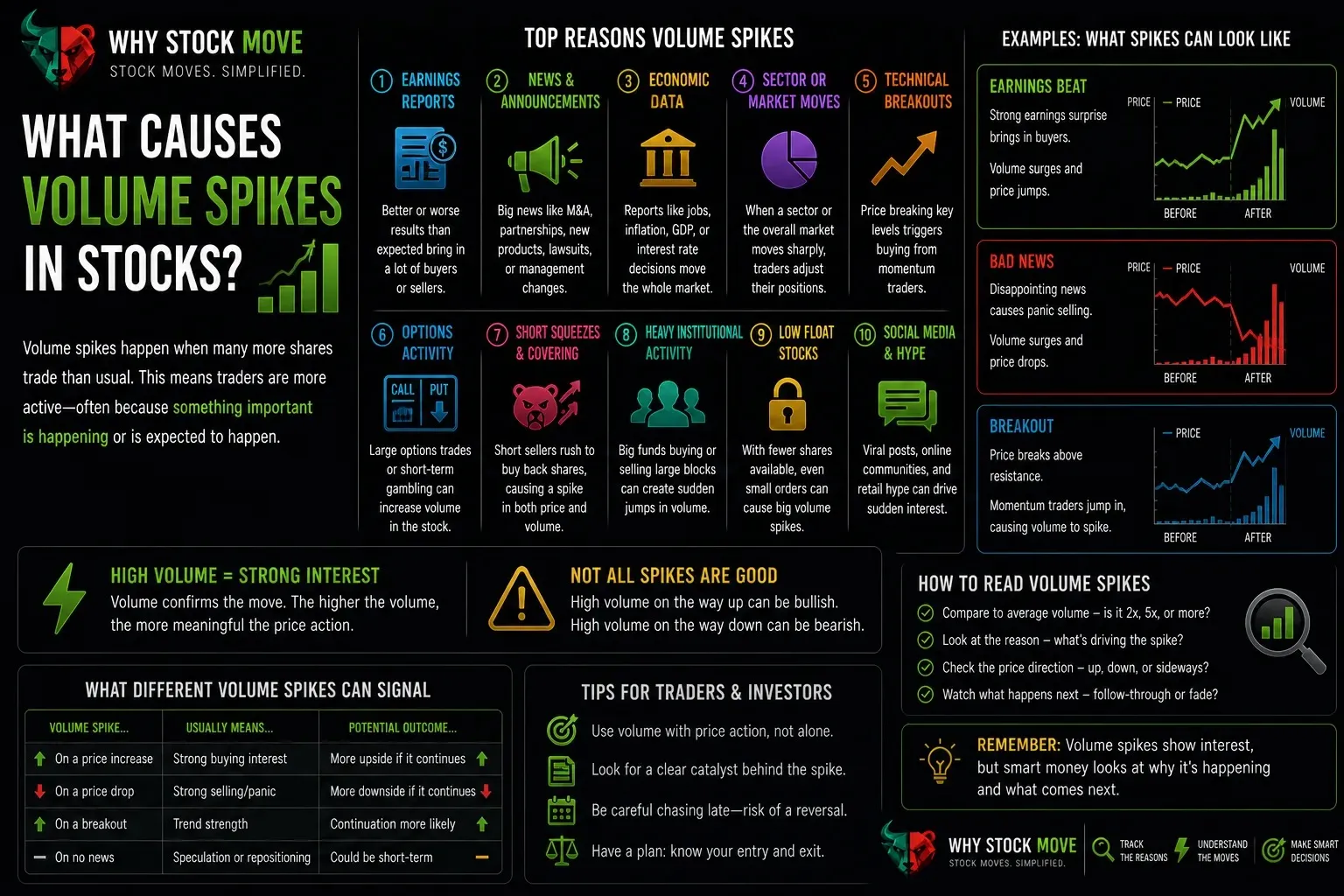
A price move tells you direction. A volume spike tells you participation. When volume suddenly explodes, the market is telling you more people than usual care about the stock right now, and that usually means something important changed in information, positioning, or mechanical flow.
What Trading Volume Really Tells You
Volume measures how many shares changed hands, but the more useful question is why so many people suddenly needed to trade. High volume can confirm that a move reflects real conviction, or it can reveal conflict where buyers and sellers violently disagree on price. Either way, volume is evidence that the market is processing something meaningful.
Example: Nvidia’s massive volume after its May earnings report showed that the move was not a niche reaction. It was the whole market repricing the name at once.
What to watch for: Watch volume relative to the stock’s normal baseline. A big percentage jump matters more than the raw number by itself.
1. Earnings Are the Biggest Routine Driver of Volume
Earnings create volume spikes because they force almost every category of participant to update at once. Long-only investors rebalance, shorts react, market makers hedge, and event-driven traders pile in. That concentration of decision-making creates some of the heaviest turnover a stock will see all year. Few other scheduled events force so many opinions into the market at once.
Example: Nvidia’s May earnings session produced enormous volume because the report forced a broad reset in valuation and positioning.
What to watch for: Watch volume relative to the size of the earnings surprise. Big volume with a small move can still tell you there was serious disagreement underneath.
2. News Events Pull in New Urgency
Breaking news causes volume spikes because it changes who feels compelled to trade immediately. Buyers appear if the news improves the thesis. Sellers appear if it damages confidence. Even neutral observers can jump in because volatility itself becomes an opportunity. Volume expands whenever the stock moves from background object to urgent object.
Example: Pfizer saw a major surge in trading volume in November when vaccine authorization news hit because investors across healthcare and reopening themes had to reposition quickly.
What to watch for: Watch whether the volume follows a clearly material headline or a vague rumor. The quality of the catalyst shapes the quality of the participation.
3. Analyst Rating Changes Can Create Unusual Turnover
Analyst calls create volume because they give institutions a reason to revisit position size and provide traders with a fresh narrative to act on. The effect is strongest when the call arrives after a catalyst and the analyst materially changes estimates. In that case, the note is not the cause of volume by itself. It is a distribution mechanism for a new thesis.
Example: Nvidia’s post-earnings target hikes in helped keep turnover high as institutions re-underwrote the AI story.
What to watch for: Watch whether volume spikes on one note or on a cluster of revisions. Clusters usually matter more.
4. Index Rebalances Force Mechanical Volume
Index events create volume spikes because funds that track the benchmark have to trade regardless of opinion. Traders front-run that demand, passive funds execute it, and closing auctions become especially busy. The result can be huge turnover even if there is no fundamental news at all. That is why some of the busiest sessions on a stock have little to do with the business itself.
Example: Tesla’s S&P 500 inclusion in late created exceptional trading volume as passive flows and anticipatory trading collided around the effective date.
What to watch for: Watch rebalance calendars and closing-auction data. Mechanical volume often concentrates late in the session.
5. Short Squeezes Concentrate Buyers and Sellers Together
Short squeezes produce volume spikes because every part of the market starts engaging at once. Shorts are forced to cover, momentum traders chase, dealers hedge options exposure, and opportunistic sellers take the other side. That collision can create turnover far above anything the stock sees in normal conditions. Everyone is acting for a different reason, but all of them increase turnover.
Example: GameStop’s January episode showed how a squeeze can turn one stock into the center of the market’s attention and produce staggering volume.
What to watch for: Watch short interest and options activity when volume explodes without a clean fundamental reason. That often points to a squeeze dynamic.
6. Options Expiration Can Pull Stock Volume Forward
Options expiration matters because hedges get adjusted, exercised positions roll into stock, and traders rebalance exposure around key strikes. The stock itself may not have fresh news, but the derivatives market can still force unusually active trading in the underlying. This effect is strongest in names with heavy retail or speculative options activity.
Example: Tesla has repeatedly seen unusually active stock trading around major options-expiration dates because the listed options market in the name is so large and so engaged.
What to watch for: Watch open interest concentration and whether price keeps gravitating toward big strike levels into expiration. That often explains otherwise strange turnover.
7. Social Media Attention Can Create Real Volume Fast
A spike in social-media attention matters because it can funnel thousands of small orders into the same stock at once. The individual trades are small, but the aggregate is not. When that attention also attracts options speculation or short-covering fear, volume can go from ordinary to extreme in a single session.
Example: AMC’s meme-stock run in came with enormous trading volume because viral attention translated into actual buying and constant repositioning.
What to watch for: Watch message traffic, retail call buying, and whether volume is spreading across the same basket of story stocks. That is usually how the pattern shows up.
8. Dark Pool and Block Trades Signal Institutional Activity
Not all volume spikes come from public excitement. Large institutions often execute blocks or dark-pool transactions that later show up in the tape as unusual prints or abnormal turnover. These trades can reflect quiet repositioning rather than obvious headlines, but they still matter because they reveal size moving between large hands.
Example: Many large-cap names, including Meta during major repositioning periods, have shown unusually high turnover even without headline news because institutions were actively reshuffling exposure under the surface.
What to watch for: Watch for repeated large prints, elevated volume without retail-style price frenzy, and end-of-day tape strength. That often signals institutional rather than viral participation.
How to Use Volume in Analysis
Volume is most useful when you pair it with price and catalyst quality. A breakout on huge volume is more credible than a breakout on thin trade. A selloff on massive turnover after weak guidance deserves more respect than a sleepy pullback. Volume does not tell you what to think. It tells you how many people were forced to express an opinion.
Example: Nvidia’s earnings reaction worked because price and volume confirmed one another instead of contradicting one another.
What to watch for: Watch for moves that attract abnormal volume and hold into the close. That combination usually carries more information than either signal alone.
How to Use This as an Investor
When you see a volume spike, ask who had to trade. Was it earnings, passive funds, shorts, options desks, or retail attention? The answer tells you whether the move looks like fresh information, mechanical flow, or emotional churn. Volume becomes useful when you identify the participants behind it. Participation matters as much as direction.
Example: Big volume on a clean catalyst is often informative. Big volume on a vague rumor can be a trap.
What to watch for: Use volume to improve context, not to replace analysis. It tells you the market is shouting. You still need to know what it is shouting about.
Frequently Asked Questions
Does high volume always mean a stock will keep moving?
No. High volume means a lot of people traded, not that the next move is guaranteed. Sometimes volume confirms a durable reprice after important news. Other times it marks the end of a move because everyone who wanted to act already acted.
Why does volume spike even when the stock price barely changes?
Because volume can reflect intense disagreement rather than directional conviction. Large buyers and large sellers may both believe they are getting a good trade at the same time. That often happens around earnings, rebalances, or major macro events.
What should I check when I see a sudden volume spike?
Start with the catalyst calendar and the news feed. Then check short interest, options activity, and sector behavior. Those clues usually tell you whether the volume came from new information, mechanical flows, or a positioning event.
How can I use volume to avoid false breakouts?
Look for breakouts that happen on meaningfully higher volume than normal and that hold up into the close or over several sessions. Thin-volume breakouts fail more often because they do not show broad participation. Volume is one of the best ways to judge whether a move has real sponsorship.
Can dark-pool activity explain unusual volume?
Sometimes. Institutions often move large blocks off-exchange and those prints can later show up in the tape. That kind of volume usually looks different from a meme frenzy because the stock may trade more orderly even as turnover rises sharply.