
Why Investors Panic Sell — And What to Do Instead
At some point, every investor panic sells. The stock falls 20%. The news is bad. The feeling is unbearable. And then the hand moves to the sell button. It is one of the most predictable, human, and costly mistakes in all of investing. Understanding why it happens doesn't make you immune to it — but it gives you a fighting chance of overriding it when it counts.
The Psychology Behind the Move
At some point, every investor panic sells. The stock falls 20%. The news is bad. The feeling is unbearable. And then the hand moves to the sell button. It is one of the most predictable, human, and costly mistakes in all of investing. Understanding why it happens doesn't make you immune to it — but it gives you a fighting chance of overriding it when it counts. Behavioral setups matter because the market is not just a valuation engine. It is also a crowd machine. Fear, greed, recency bias, and social proof all change what investors do with the same set of facts. Once those biases line up across enough accounts, price starts moving in ways that feel irrational up close but become obvious in hindsight.
The pattern becomes clearer when you compare it with What To Do When Market Crashes, What To Do When Your Stock Drops 10 Percent, Why Stocks Recover After A Crash, How Market Sentiment Moves Stocks, and What Is A Bear Market, because behavior usually amplifies another market mechanism rather than acting alone.
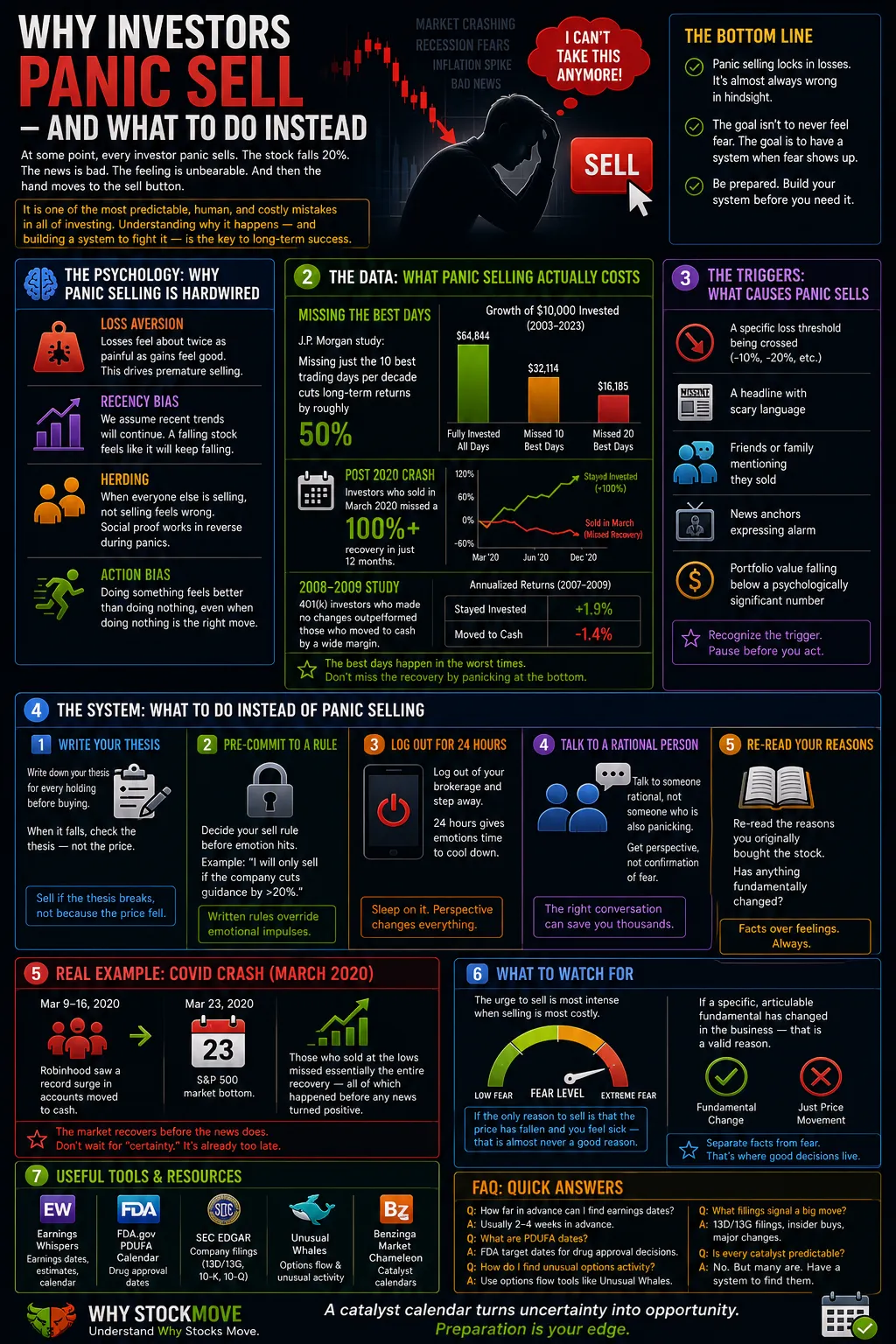
Example: During the COVID crash in March , Robinhood saw a record surge in accounts moved to cash in the week of March 9–16. The S&P 500 bottomed on March 23. Those who sold at the lows and waited for "stability" before re-entering missed essentially the entire recovery — all of which happened before any news turned positive.
What to watch for: The urge to sell is most intense at the moment when selling is most costly. If the only reason to sell is that the price has fallen and you feel sick — that is almost never a good reason. If a specific, articulable fundamental has changed in the business — that is a valid reason.
Why Smart Investors Still Get Caught
Bias does not only affect beginners. It affects anyone under stress, especially when price is moving quickly and social reinforcement is loud. That is why experienced investors still chase, freeze, or sell at the wrong time. The real defense is not confidence. It is a prewritten process that leaves less room for emotion to improvise.
Example: During the COVID crash in March , Robinhood saw a record surge in accounts moved to cash in the week of March 9–16. The S&P 500 bottomed on March 23. Those who sold at the lows and waited for "stability" before re-entering missed essentially the entire recovery — all of which happened before any news turned positive.
What to watch for: The urge to sell is most intense at the moment when selling is most costly. If the only reason to sell is that the price has fallen and you feel sick — that is almost never a good reason. If a specific, articulable fundamental has changed in the business — that is a valid reason.
What the Historical Pattern Shows
Behavioral patterns repeat because human reactions repeat. Investors extrapolate the recent move, assume the crowd knows more than they do, and mistake urgency for clarity. Looking at the historical example forces you to see the cost of those habits in actual price terms instead of only in theory.
Example: During the COVID crash in March , Robinhood saw a record surge in accounts moved to cash in the week of March 9–16. The S&P 500 bottomed on March 23. Those who sold at the lows and waited for "stability" before re-entering missed essentially the entire recovery — all of which happened before any news turned positive.
What to watch for: The urge to sell is most intense at the moment when selling is most costly. If the only reason to sell is that the price has fallen and you feel sick — that is almost never a good reason. If a specific, articulable fundamental has changed in the business — that is a valid reason.
How to Build a Better Decision Process
The antidote is mechanical: write down the thesis, pre-commit to exit rules, separate business change from price change, and impose a cooling-off period before major decisions. Those habits sound simple, but they are exactly what keep behavioral bias from taking over at the worst possible moment. Process does not remove emotion. It just stops emotion from getting the final vote.
Example: During the COVID crash in March , Robinhood saw a record surge in accounts moved to cash in the week of March 9–16. The S&P 500 bottomed on March 23. Those who sold at the lows and waited for "stability" before re-entering missed essentially the entire recovery — all of which happened before any news turned positive.
What to watch for: The urge to sell is most intense at the moment when selling is most costly. If the only reason to sell is that the price has fallen and you feel sick — that is almost never a good reason. If a specific, articulable fundamental has changed in the business — that is a valid reason.
How to Use This as an Investor
Panic selling is not a character flaw — it's a design flaw. Human brains were not built for stock markets. The investors who perform best long-term are not the ones who feel no fear. They're the ones who built systems before the fear arrived: written theses, pre-committed rules, and the discipline to check the facts before checking the price. Build the system now, before you need it. Behavioral edge usually looks boring in real time: fewer impulsive trades, clearer written rules, and a willingness to look wrong briefly without needing to act immediately. Over a full cycle, that boring discipline compounds into a very real advantage.
Example: During the COVID crash in March , Robinhood saw a record surge in accounts moved to cash in the week of March 9–16. The S&P 500 bottomed on March 23. Those who sold at the lows and waited for "stability" before re-entering missed essentially the entire recovery — all of which happened before any news turned positive.
What to watch for: The urge to sell is most intense at the moment when selling is most costly. If the only reason to sell is that the price has fallen and you feel sick — that is almost never a good reason. If a specific, articulable fundamental has changed in the business — that is a valid reason.
Frequently Asked Questions
Why do investors panic sell at the worst time?
Why Investors Panic Sell — And What to Do Instead matters because markets move on expectation gaps, not on headlines alone. That is why the same event can create a modest move in one setup and a violent repricing in another. During the COVID crash in March 2020, Robinhood saw a record surge in accounts moved to cash in the week of March 9–16. The S&P 500 bottomed on March 23. Those who sold at the lows and waited for "stability" before re-entering missed essentially the entire recovery — all of which happened before any news turned positive. The urge to sell is most intense at the moment when selling is most costly. If the only reason to sell is that the price has fallen and you feel sick — that is almost never a good reason. If a specific, articulable fundamental has changed in the business — that is a valid reason.
How do I stop myself from panic selling stocks?
The urge to sell is most intense at the moment when selling is most costly. If the only reason to sell is that the price has fallen and you feel sick — that is almost never a good reason. If a specific, articulable fundamental has changed in the business — that is a valid reason. The key is to classify the move before you commit capital or change a position. Once you know whether the setup is fundamental, mechanical, or behavioral, the right response becomes much clearer. If you want the adjacent setup, start with [What To Do When Market Crashes](/why-stocks-move/what-to-do-when-market-crashes).
Is panic selling ever the right decision?
Panic selling locks in losses and is almost always wrong in hindsight. Here's the psychology behind it — and the system that prevents it. The practical edge comes from understanding the mechanism, checking whether the example fits the current setup, and then using the same watchlist items every time you see the pattern. The urge to sell is most intense at the moment when selling is most costly. If the only reason to sell is that the price has fallen and you feel sick — that is almost never a good reason. If a specific, articulable fundamental has changed in the business — that is a valid reason. If you want the adjacent setup, start with [What To Do When Market Crashes](/why-stocks-move/what-to-do-when-market-crashes).
What is loss aversion in investing?
Panic selling locks in losses and is almost always wrong in hindsight. Here's the psychology behind it — and the system that prevents it. In practice, the useful part is not the label by itself but the mechanism underneath it: how it changes expectations, liquidity, or positioning. During the COVID crash in March 2020, Robinhood saw a record surge in accounts moved to cash in the week of March 9–16. The S&P 500 bottomed on March 23. Those who sold at the lows and waited for "stability" before re-entering missed essentially the entire recovery — all of which happened before any news turned positive. If you want the adjacent setup, start with [What To Do When Market Crashes](/why-stocks-move/what-to-do-when-market-crashes).
How much does panic selling hurt returns over time?
Panic selling locks in losses and is almost always wrong in hindsight. Here's the psychology behind it — and the system that prevents it. The fastest way to use that information is to compare the catalyst, the tape, and what the market had already priced before the event arrived. The urge to sell is most intense at the moment when selling is most costly. If the only reason to sell is that the price has fallen and you feel sick — that is almost never a good reason. If a specific, articulable fundamental has changed in the business — that is a valid reason. If you want the adjacent setup, start with [What To Do When Market Crashes](/why-stocks-move/what-to-do-when-market-crashes).
What should I do instead of selling during a market crash?
Panic selling locks in losses and is almost always wrong in hindsight. Here's the psychology behind it — and the system that prevents it. The practical edge comes from understanding the mechanism, checking whether the example fits the current setup, and then using the same watchlist items every time you see the pattern. The urge to sell is most intense at the moment when selling is most costly. If the only reason to sell is that the price has fallen and you feel sick — that is almost never a good reason. If a specific, articulable fundamental has changed in the business — that is a valid reason. If you want the adjacent setup, start with [What To Do When Market Crashes](/why-stocks-move/what-to-do-when-market-crashes).
How do I know if I should sell or hold a falling stock?
The urge to sell is most intense at the moment when selling is most costly. If the only reason to sell is that the price has fallen and you feel sick — that is almost never a good reason. If a specific, articulable fundamental has changed in the business — that is a valid reason. The key is to classify the move before you commit capital or change a position. Once you know whether the setup is fundamental, mechanical, or behavioral, the right response becomes much clearer. If you want the adjacent setup, start with [What To Do When Market Crashes](/why-stocks-move/what-to-do-when-market-crashes).