
Why Do Stocks Almost Always Recover After a Market Crash?
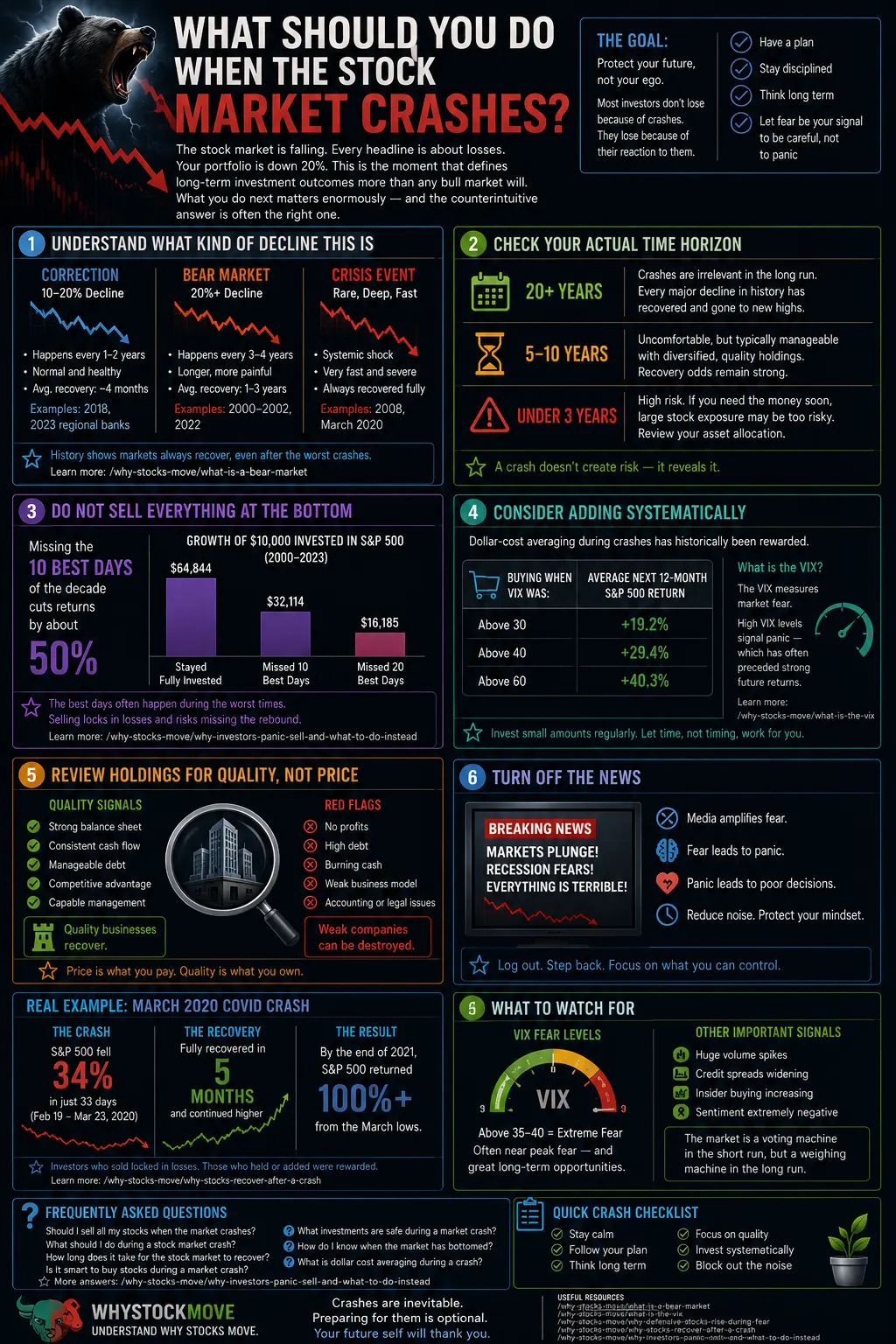
Market crashes feel final while they are happening. Then, almost every time, the market eventually recovers and moves to new highs. That pattern is not magic. It comes from earnings power, policy response, economic adaptation, and the market's habit of turning before the news feels comfortable again.
The Psychology Behind the Move
Market crashes feel final while they are happening. Then, almost every time, the market eventually recovers and moves to new highs. That pattern is not magic. It comes from earnings power, policy response, economic adaptation, and the market's habit of turning before the news feels comfortable again. Behavioral setups matter because the market is not just a valuation engine. It is also a crowd machine. Fear, greed, recency bias, and social proof all change what investors do with the same set of facts. Once those biases line up across enough accounts, price starts moving in ways that feel irrational up close but become obvious in hindsight.
The pattern becomes clearer when you compare it with What Is A Bear Market, What To Do When Market Crashes, What Is The Vix, and Why Investors Panic Sell And What To Do Instead, because behavior usually amplifies another market mechanism rather than acting alone.
Example: The S&P 500 recovered from the financial crisis, the COVID crash, and the bear market because profits eventually stabilized, policy adjusted, and investors started discounting the next expansion before the headlines improved.
What to watch for: The market usually bottoms when fear is still high but rate expectations, credit stress, and earnings revisions start getting less bad. Improvement on the margin matters more than perfect news.
Why Smart Investors Still Get Caught
Bias does not only affect beginners. It affects anyone under stress, especially when price is moving quickly and social reinforcement is loud. That is why experienced investors still chase, freeze, or sell at the wrong time. The real defense is not confidence. It is a prewritten process that leaves less room for emotion to improvise.
Example: The S&P 500 recovered from the financial crisis, the COVID crash, and the bear market because profits eventually stabilized, policy adjusted, and investors started discounting the next expansion before the headlines improved.
What to watch for: The market usually bottoms when fear is still high but rate expectations, credit stress, and earnings revisions start getting less bad. Improvement on the margin matters more than perfect news.
What the Historical Pattern Shows
Behavioral patterns repeat because human reactions repeat. Investors extrapolate the recent move, assume the crowd knows more than they do, and mistake urgency for clarity. Looking at the historical example forces you to see the cost of those habits in actual price terms instead of only in theory.
Example: The S&P 500 recovered from the financial crisis, the COVID crash, and the bear market because profits eventually stabilized, policy adjusted, and investors started discounting the next expansion before the headlines improved.
What to watch for: The market usually bottoms when fear is still high but rate expectations, credit stress, and earnings revisions start getting less bad. Improvement on the margin matters more than perfect news.
How to Build a Better Decision Process
The antidote is mechanical: write down the thesis, pre-commit to exit rules, separate business change from price change, and impose a cooling-off period before major decisions. Those habits sound simple, but they are exactly what keep behavioral bias from taking over at the worst possible moment. Process does not remove emotion. It just stops emotion from getting the final vote.
Example: The S&P 500 recovered from the financial crisis, the COVID crash, and the bear market because profits eventually stabilized, policy adjusted, and investors started discounting the next expansion before the headlines improved.
What to watch for: The market usually bottoms when fear is still high but rate expectations, credit stress, and earnings revisions start getting less bad. Improvement on the margin matters more than perfect news.
How to Use This as an Investor
Stocks recover because markets price the future, and the future is rarely as bad as the panic moment suggests forever. The lesson is not that every stock recovers. It is that broad markets and quality businesses often do, long before the average investor feels ready to believe it. Behavioral edge usually looks boring in real time: fewer impulsive trades, clearer written rules, and a willingness to look wrong briefly without needing to act immediately. Over a full cycle, that boring discipline compounds into a very real advantage.
Example: The S&P 500 recovered from the financial crisis, the COVID crash, and the bear market because profits eventually stabilized, policy adjusted, and investors started discounting the next expansion before the headlines improved.
What to watch for: The market usually bottoms when fear is still high but rate expectations, credit stress, and earnings revisions start getting less bad. Improvement on the margin matters more than perfect news.
Frequently Asked Questions
Why do stocks recover after a market crash?
Why Do Stocks Almost Always Recover After a Market Crash matters because markets move on expectation gaps, not on headlines alone. That is why the same event can create a modest move in one setup and a violent repricing in another. The S&P 500 recovered from the 2008 financial crisis, the 2020 COVID crash, and the 2022 bear market because profits eventually stabilized, policy adjusted, and investors started discounting the next expansion before the headlines improved. The market usually bottoms when fear is still high but rate expectations, credit stress, and earnings revisions start getting less bad. Improvement on the margin matters more than perfect news.
How long does it usually take stocks to recover after a crash?
Stocks usually recover after crashes because earnings, policy, and risk appetite eventually reset. Here is why recoveries happen so reliably. The fastest way to use that information is to compare the catalyst, the tape, and what the market had already priced before the event arrived. The market usually bottoms when fear is still high but rate expectations, credit stress, and earnings revisions start getting less bad. Improvement on the margin matters more than perfect news. If you want the adjacent setup, start with [What Is A Bear Market](/why-stocks-move/what-is-a-bear-market).
Do all stocks recover after big selloffs?
Stocks usually recover after crashes because earnings, policy, and risk appetite eventually reset. Here is why recoveries happen so reliably. The practical edge comes from understanding the mechanism, checking whether the example fits the current setup, and then using the same watchlist items every time you see the pattern. The market usually bottoms when fear is still high but rate expectations, credit stress, and earnings revisions start getting less bad. Improvement on the margin matters more than perfect news. If you want the adjacent setup, start with [What Is A Bear Market](/why-stocks-move/what-is-a-bear-market).
What helped the market recover after the 2020 crash?
Stocks usually recover after crashes because earnings, policy, and risk appetite eventually reset. Here is why recoveries happen so reliably. The practical edge comes from understanding the mechanism, checking whether the example fits the current setup, and then using the same watchlist items every time you see the pattern. The market usually bottoms when fear is still high but rate expectations, credit stress, and earnings revisions start getting less bad. Improvement on the margin matters more than perfect news. If you want the adjacent setup, start with [What Is A Bear Market](/why-stocks-move/what-is-a-bear-market).
Should I buy stocks when the market crashes?
The market usually bottoms when fear is still high but rate expectations, credit stress, and earnings revisions start getting less bad. Improvement on the margin matters more than perfect news. The key is to classify the move before you commit capital or change a position. Once you know whether the setup is fundamental, mechanical, or behavioral, the right response becomes much clearer. If you want the adjacent setup, start with [What Is A Bear Market](/why-stocks-move/what-is-a-bear-market).
Why does the market bottom before the economy feels better?
Why Do Stocks Almost Always Recover After a Market Crash matters because markets move on expectation gaps, not on headlines alone. That is why the same event can create a modest move in one setup and a violent repricing in another. The S&P 500 recovered from the 2008 financial crisis, the 2020 COVID crash, and the 2022 bear market because profits eventually stabilized, policy adjusted, and investors started discounting the next expansion before the headlines improved. The market usually bottoms when fear is still high but rate expectations, credit stress, and earnings revisions start getting less bad. Improvement on the margin matters more than perfect news.
What is the best lesson investors should take from past recoveries?
Stocks usually recover after crashes because earnings, policy, and risk appetite eventually reset. Here is why recoveries happen so reliably. In practice, the useful part is not the label by itself but the mechanism underneath it: how it changes expectations, liquidity, or positioning. The S&P 500 recovered from the 2008 financial crisis, the 2020 COVID crash, and the 2022 bear market because profits eventually stabilized, policy adjusted, and investors started discounting the next expansion before the headlines improved. If you want the adjacent setup, start with [What Is A Bear Market](/why-stocks-move/what-is-a-bear-market).