
What Should You Do When Your Stock Drops 10% in One Day?
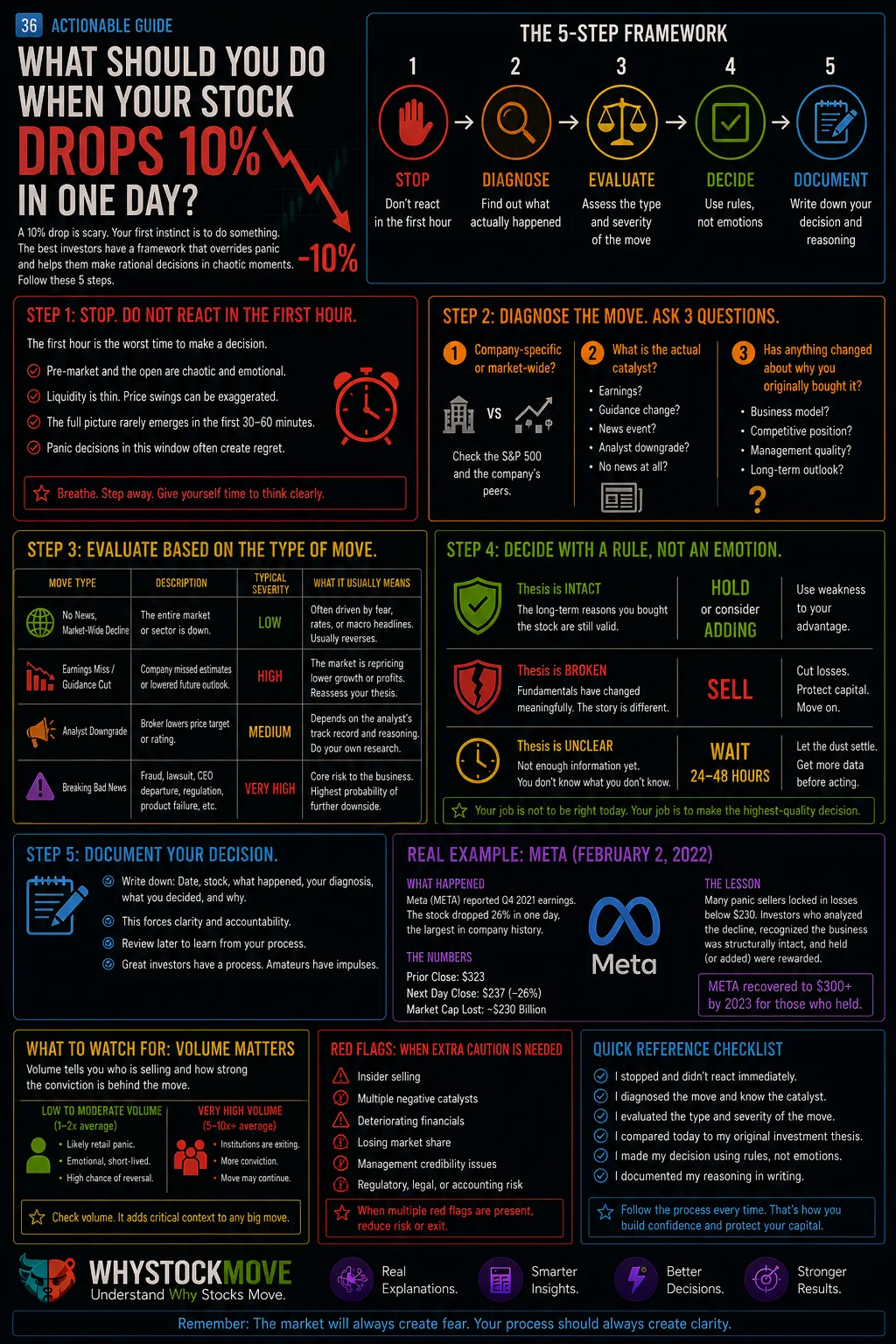
Your stock is down 10% and the number keeps moving. Your stomach is tight. You're refreshing the page. You want to do something. This is exactly the moment when most investors make their worst decisions — not because they're foolish, but because fear is biological and markets are unforgiving of emotional reactions. Here is the framework that overrides the panic.
Slow the First Reaction
Your stock is down 10% and the number keeps moving. Your stomach is tight. You're refreshing the page. You want to do something. This is exactly the moment when most investors make their worst decisions — not because they're foolish, but because fear is biological and markets are unforgiving of emotional reactions. Here is the framework that overrides the panic. The first goal is not to be brave or clever. It is to avoid letting a single price print make the decision for you. Fast moves create urgency, and urgency creates bad process. Slowing yourself down by even one review cycle usually improves the quality of the decision because you can separate the headline, the catalyst, and the actual thesis risk instead of treating them as the same thing.
Example: When Meta fell 26% in one day in February , panic sellers locked in losses below $230. Investors who analyzed the decline and recognized that while the quarter was bad, the business was structurally intact held on — and were rewarded with a recovery to $300+ by for those who held or added.
What to watch for: Volume on the day of the drop tells you who is selling. If volume is 10x average, institutions are exiting and the move may continue. If volume is 1–2x average, it's likely retail panic that will settle.
Diagnose the Real Problem
Once the emotion settles, the useful question is simple: did the business break, did the market environment change, or did the tape simply become disorderly for a while? Those are different problems and they deserve different responses. Investors usually make mistakes when they try to solve a structural problem with patience or a temporary liquidity problem with a permanent exit.
The surrounding mechanics are easier to classify if you compare them with Why Investors Panic Sell And What To Do Instead, Why Stocks Fall After Earnings, How Analyst Downgrades Affect Stocks, and What Causes Volume Spikes In Stocks.
Example: When Meta fell 26% in one day in February , panic sellers locked in losses below $230. Investors who analyzed the decline and recognized that while the quarter was bad, the business was structurally intact held on — and were rewarded with a recovery to $300+ by for those who held or added.
What to watch for: Volume on the day of the drop tells you who is selling. If volume is 10x average, institutions are exiting and the move may continue. If volume is 1–2x average, it's likely retail panic that will settle.
Use Rules Instead of Feelings
Good decisions under stress are usually pre-committed, not improvised. That means using written sell conditions, position-size limits, and a simple checklist for whether the thesis has changed. The market will happily supply urgency. Your process has to supply discipline. That is especially true when social pressure, financial media, and your own P&L are all telling you to do something immediately.
Example: When Meta fell 26% in one day in February , panic sellers locked in losses below $230. Investors who analyzed the decline and recognized that while the quarter was bad, the business was structurally intact held on — and were rewarded with a recovery to $300+ by for those who held or added.
What to watch for: Volume on the day of the drop tells you who is selling. If volume is 10x average, institutions are exiting and the move may continue. If volume is 1–2x average, it's likely retail panic that will settle.
What the Historical Example Actually Teaches
Historical examples matter because they show how bad decisions cluster around discomfort, not around objective analysis. Investors often sell near fear peaks and buy back after the hard part is already over. Studying the timeline forces you to respect how quickly markets can reverse once the panic is fully priced. It also reminds you that not every sharp decline deserves rescue. Some really do break the thesis.
Example: When Meta fell 26% in one day in February , panic sellers locked in losses below $230. Investors who analyzed the decline and recognized that while the quarter was bad, the business was structurally intact held on — and were rewarded with a recovery to $300+ by for those who held or added.
What to watch for: Volume on the day of the drop tells you who is selling. If volume is 10x average, institutions are exiting and the move may continue. If volume is 1–2x average, it's likely retail panic that will settle.
How to Use This as an Investor
A 10% drop is not the signal to act — it's the signal to think. Every investor who has built real wealth has been through this exact moment, multiple times. The ones who came out ahead were not the ones who reacted fastest. They were the ones who slowed down, asked the right questions, and let the quality of the answer — not the pain of the loss — determine their next move. The practical edge is not perfect timing. It is staying process-driven while other people become headline-driven. If you can classify the move, write down the reason for your decision, and wait for actual evidence instead of emotional relief, you will already be acting more like a professional than most of the market.
Example: When Meta fell 26% in one day in February , panic sellers locked in losses below $230. Investors who analyzed the decline and recognized that while the quarter was bad, the business was structurally intact held on — and were rewarded with a recovery to $300+ by for those who held or added.
What to watch for: Volume on the day of the drop tells you who is selling. If volume is 10x average, institutions are exiting and the move may continue. If volume is 1–2x average, it's likely retail panic that will settle.
Frequently Asked Questions
Should I sell my stock if it drops 10% in one day?
Volume on the day of the drop tells you who is selling. If volume is 10x average, institutions are exiting and the move may continue. If volume is 1–2x average, it's likely retail panic that will settle. The key is to classify the move before you commit capital or change a position. Once you know whether the setup is fundamental, mechanical, or behavioral, the right response becomes much clearer. If you want the adjacent setup, start with [Why Investors Panic Sell And What To Do Instead](/why-stocks-move/why-investors-panic-sell-and-what-to-do-instead).
Why did my stock drop so much today with no news?
What Should You Do When Your Stock Drops 10% in One Day matters because markets move on expectation gaps, not on headlines alone. That is why the same event can create a modest move in one setup and a violent repricing in another. When Meta fell 26% in one day in February 2022, panic sellers locked in losses below $230. Investors who analyzed the decline and recognized that while the quarter was bad, the business was structurally intact held on — and were rewarded with a recovery to $300+ by 2023 for those who held or added. Volume on the day of the drop tells you who is selling. If volume is 10x average, institutions are exiting and the move may continue. If volume is 1–2x average, it's likely retail panic that will settle.
How do I know if a stock will recover after a big drop?
Volume on the day of the drop tells you who is selling. If volume is 10x average, institutions are exiting and the move may continue. If volume is 1–2x average, it's likely retail panic that will settle. The key is to classify the move before you commit capital or change a position. Once you know whether the setup is fundamental, mechanical, or behavioral, the right response becomes much clearer. If you want the adjacent setup, start with [Why Investors Panic Sell And What To Do Instead](/why-stocks-move/why-investors-panic-sell-and-what-to-do-instead).
Is a 10% drop in one day serious?
A 10% single-day drop is scary. Here's the exact framework for deciding whether to hold, buy more, or sell — without letting panic decide for you. The practical edge comes from understanding the mechanism, checking whether the example fits the current setup, and then using the same watchlist items every time you see the pattern. Volume on the day of the drop tells you who is selling. If volume is 10x average, institutions are exiting and the move may continue. If volume is 1–2x average, it's likely retail panic that will settle. If you want the adjacent setup, start with [Why Investors Panic Sell And What To Do Instead](/why-stocks-move/why-investors-panic-sell-and-what-to-do-instead).
When should I cut my losses on a stock?
A 10% single-day drop is scary. Here's the exact framework for deciding whether to hold, buy more, or sell — without letting panic decide for you. The fastest way to use that information is to compare the catalyst, the tape, and what the market had already priced before the event arrived. Volume on the day of the drop tells you who is selling. If volume is 10x average, institutions are exiting and the move may continue. If volume is 1–2x average, it's likely retail panic that will settle. If you want the adjacent setup, start with [Why Investors Panic Sell And What To Do Instead](/why-stocks-move/why-investors-panic-sell-and-what-to-do-instead).
What does it mean when a stock drops on high volume?
A 10% single-day drop is scary. Here's the exact framework for deciding whether to hold, buy more, or sell — without letting panic decide for you. The practical edge comes from understanding the mechanism, checking whether the example fits the current setup, and then using the same watchlist items every time you see the pattern. Volume on the day of the drop tells you who is selling. If volume is 10x average, institutions are exiting and the move may continue. If volume is 1–2x average, it's likely retail panic that will settle. If you want the adjacent setup, start with [Why Investors Panic Sell And What To Do Instead](/why-stocks-move/why-investors-panic-sell-and-what-to-do-instead).
How do I stop panic selling?
Volume on the day of the drop tells you who is selling. If volume is 10x average, institutions are exiting and the move may continue. If volume is 1–2x average, it's likely retail panic that will settle. The key is to classify the move before you commit capital or change a position. Once you know whether the setup is fundamental, mechanical, or behavioral, the right response becomes much clearer. If you want the adjacent setup, start with [Why Investors Panic Sell And What To Do Instead](/why-stocks-move/why-investors-panic-sell-and-what-to-do-instead).