
How to Spot a Stock Catalyst Before It Happens
Most retail investors find out about a catalyst after the stock has already moved. But a surprisingly large number of the biggest single-day moves in markets are attached to events that were publicly known weeks or months in advance. The question isn't whether catalysts are knowable — it's whether you have a system for finding them.
Start With the Primary Source
Most retail investors find out about a catalyst after the stock has already moved. But a surprisingly large number of the biggest single-day moves in markets are attached to events that were publicly known weeks or months in advance. The question isn't whether catalysts are knowable — it's whether you have a system for finding them. The first edge in any workflow comes from going to the source instead of waiting for somebody else to summarize it for you. In markets, summaries are often late, incomplete, or framed around the wrong metric. Reading the original release, filing, or calendar item forces you to see the numbers and the wording the market is actually reacting to. That is where speed and clarity begin.
If you want to extend the workflow after the first read, What Makes Stocks Move Fast, How To Read Earnings Before They Move Stocks, What Causes Volume Spikes In Stocks, and How Dark Pool Trading Affects Stocks are the natural next guides.
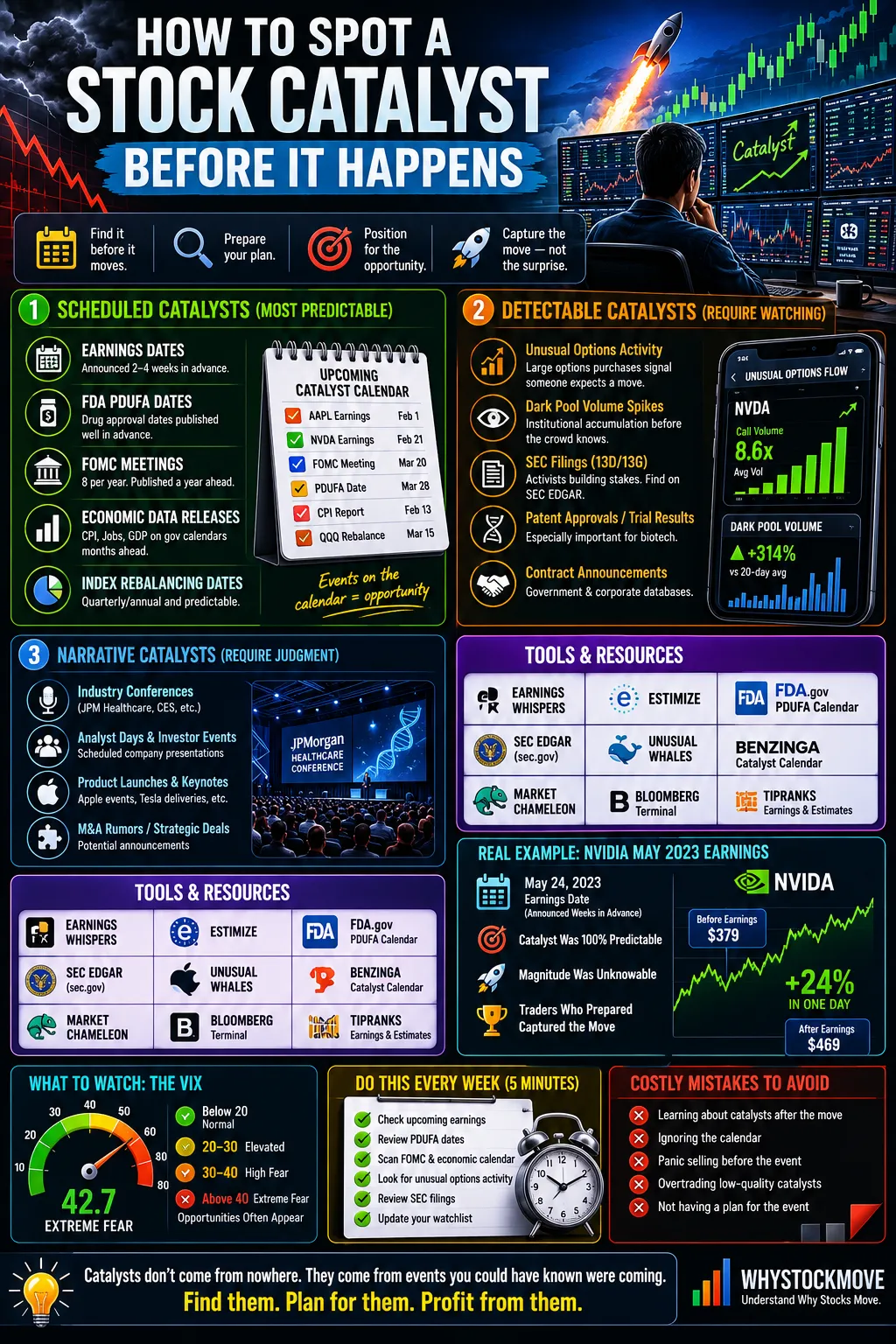
Example: Nvidia's explosive May earnings move was 100% predictable as a catalyst event — the earnings date was public. What was unknowable was the magnitude. But traders who had Nvidia on a watchlist going into earnings, understood the AI demand story, and were positioned for a move (through stock or defined- risk positions) captured the opportunity. The event was on the calendar; the preparation was the edge.
What to watch for: Write down the catalyst, the thesis, and the next condition that would change your decision before you act. That slows emotion down and makes the move easier to judge clearly.
Know Which Lines Move the Stock
Not every line in a filing or report deserves equal attention. The market usually cares most about the handful of variables that reset expectations: guidance, margins, subscriber growth, liquidity, backlog, or rate path. Investors lose time when they read everything with equal weight. A better process is to know in advance which two or three lines are most likely to move the stock for this type of event.
Example: Nvidia's explosive May earnings move was 100% predictable as a catalyst event — the earnings date was public. What was unknowable was the magnitude. But traders who had Nvidia on a watchlist going into earnings, understood the AI demand story, and were positioned for a move (through stock or defined- risk positions) captured the opportunity. The event was on the calendar; the preparation was the edge.
What to watch for: Write down the catalyst, the thesis, and the next condition that would change your decision before you act. That slows emotion down and makes the move easier to judge clearly.
Compare the Number With Expectations
A number is only meaningful relative to what the market expected before it arrived. That means comparing it with consensus, with the company's own prior guidance, and with the setup in the options market or peer group. This is where most reactive investors fall behind. They read the number but never ask whether the number was already priced.
Example: Nvidia's explosive May earnings move was 100% predictable as a catalyst event — the earnings date was public. What was unknowable was the magnitude. But traders who had Nvidia on a watchlist going into earnings, understood the AI demand story, and were positioned for a move (through stock or defined- risk positions) captured the opportunity. The event was on the calendar; the preparation was the edge.
What to watch for: Write down the catalyst, the thesis, and the next condition that would change your decision before you act. That slows emotion down and makes the move easier to judge clearly.
Turn the Read Into a Repeatable Checklist
The workflow becomes powerful when it is repeatable. You want the same small set of questions every time: what changed, what did the market expect, who is forced to react, and what would confirm the first move tomorrow? That structure turns stock moves from entertainment into a process. It also keeps you from overtrading because not every event earns the same level of conviction.
Example: Nvidia's explosive May earnings move was 100% predictable as a catalyst event — the earnings date was public. What was unknowable was the magnitude. But traders who had Nvidia on a watchlist going into earnings, understood the AI demand story, and were positioned for a move (through stock or defined- risk positions) captured the opportunity. The event was on the calendar; the preparation was the edge.
What to watch for: Write down the catalyst, the thesis, and the next condition that would change your decision before you act. That slows emotion down and makes the move easier to judge clearly.
How to Use This as an Investor
A catalyst calendar is one of the most practical tools any active investor can maintain. Five minutes of setup per week — checking the upcoming earnings, FDA dates, and FOMC meetings for stocks you follow — turns you from a reactive investor into a prepared one. Most of the biggest moves in markets don't come from nowhere. They come from events you could have known were coming. A repeatable workflow compounds because every event becomes easier to read than the last one. You do not need perfect speed. You need a sequence that is good enough to keep you looking at the right information while most people are still reacting to a headline.
Example: Nvidia's explosive May earnings move was 100% predictable as a catalyst event — the earnings date was public. What was unknowable was the magnitude. But traders who had Nvidia on a watchlist going into earnings, understood the AI demand story, and were positioned for a move (through stock or defined- risk positions) captured the opportunity. The event was on the calendar; the preparation was the edge.
What to watch for: Write down the catalyst, the thesis, and the next condition that would change your decision before you act. That slows emotion down and makes the move easier to judge clearly.
Frequently Asked Questions
How do I find upcoming stock catalysts?
Write down the catalyst, the thesis, and the next condition that would change your decision before you act. That slows emotion down and makes the move easier to judge clearly. The key is to classify the move before you commit capital or change a position. Once you know whether the setup is fundamental, mechanical, or behavioral, the right response becomes much clearer. If you want the adjacent setup, start with [What Makes Stocks Move Fast](/why-stocks-move/what-makes-stocks-move-fast).
What is a stock catalyst in investing?
Catalysts move stocks — and most of them are on a calendar. Here's how to identify upcoming earnings, FDA dates, and events before they move prices. In practice, the useful part is not the label by itself but the mechanism underneath it: how it changes expectations, liquidity, or positioning. Nvidia's explosive May 2023 earnings move was 100% predictable as a catalyst event — the earnings date was public. What was unknowable was the magnitude. But traders who had Nvidia on a watchlist going into earnings, understood the AI demand story, and were positioned for a move (through stock or defined- risk positions) captured the opportunity. The event was on the calendar; the preparation was the edge. If you want the adjacent setup, start with [What Makes Stocks Move Fast](/why-stocks-move/what-makes-stocks-move-fast).
Where can I find earnings dates for stocks?
Catalysts move stocks — and most of them are on a calendar. Here's how to identify upcoming earnings, FDA dates, and events before they move prices. The practical edge comes from understanding the mechanism, checking whether the example fits the current setup, and then using the same watchlist items every time you see the pattern. Write down the catalyst, the thesis, and the next condition that would change your decision before you act. That slows emotion down and makes the move easier to judge clearly. If you want the adjacent setup, start with [What Makes Stocks Move Fast](/why-stocks-move/what-makes-stocks-move-fast).
What are PDUFA dates and how do I track them?
Catalysts move stocks — and most of them are on a calendar. Here's how to identify upcoming earnings, FDA dates, and events before they move prices. In practice, the useful part is not the label by itself but the mechanism underneath it: how it changes expectations, liquidity, or positioning. Nvidia's explosive May 2023 earnings move was 100% predictable as a catalyst event — the earnings date was public. What was unknowable was the magnitude. But traders who had Nvidia on a watchlist going into earnings, understood the AI demand story, and were positioned for a move (through stock or defined- risk positions) captured the opportunity. The event was on the calendar; the preparation was the edge. If you want the adjacent setup, start with [What Makes Stocks Move Fast](/why-stocks-move/what-makes-stocks-move-fast).
How do I find unusual options activity?
Write down the catalyst, the thesis, and the next condition that would change your decision before you act. That slows emotion down and makes the move easier to judge clearly. The key is to classify the move before you commit capital or change a position. Once you know whether the setup is fundamental, mechanical, or behavioral, the right response becomes much clearer. If you want the adjacent setup, start with [What Makes Stocks Move Fast](/why-stocks-move/what-makes-stocks-move-fast).
What SEC filings signal a big move is coming?
Catalysts move stocks — and most of them are on a calendar. Here's how to identify upcoming earnings, FDA dates, and events before they move prices. The practical edge comes from understanding the mechanism, checking whether the example fits the current setup, and then using the same watchlist items every time you see the pattern. Write down the catalyst, the thesis, and the next condition that would change your decision before you act. That slows emotion down and makes the move easier to judge clearly. If you want the adjacent setup, start with [What Makes Stocks Move Fast](/why-stocks-move/what-makes-stocks-move-fast).
How far in advance can I find earnings dates?
Catalysts move stocks — and most of them are on a calendar. Here's how to identify upcoming earnings, FDA dates, and events before they move prices. The fastest way to use that information is to compare the catalyst, the tape, and what the market had already priced before the event arrived. Write down the catalyst, the thesis, and the next condition that would change your decision before you act. That slows emotion down and makes the move easier to judge clearly. If you want the adjacent setup, start with [What Makes Stocks Move Fast](/why-stocks-move/what-makes-stocks-move-fast).