
How to Read an Earnings Report Before It Moves a Stock
An earnings release hits at 4:05 PM. By 4:07 PM, the stock has moved 12%. Most investors wait for the news article summary at 4:30 PM, by which time the initial move is done. If you can read the primary document itself in under 10 minutes, you can understand the move — and sometimes get ahead of it. Here's exactly how to do it.
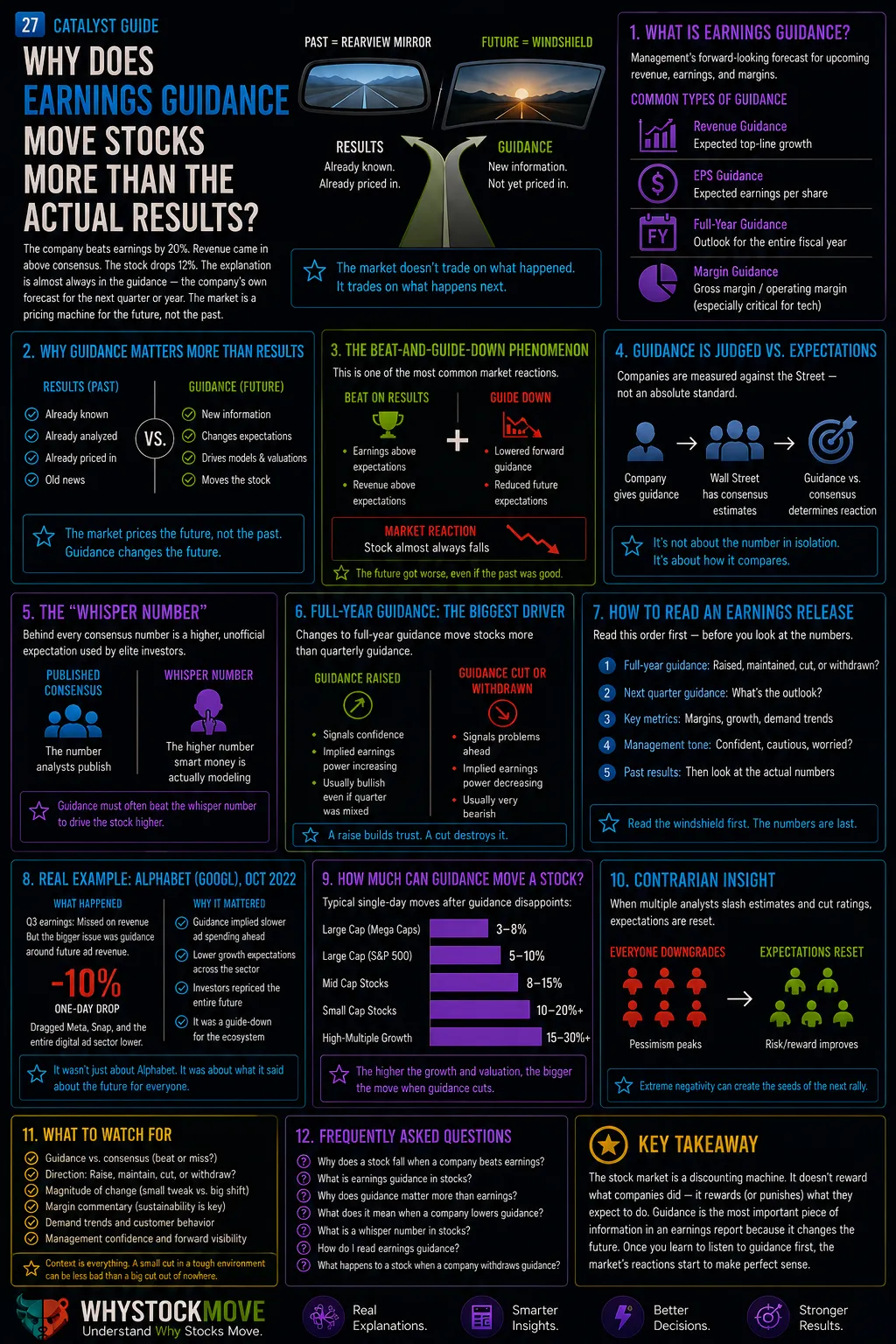
Start With the Primary Source
An earnings release hits at 4:05 PM. By 4:07 PM, the stock has moved 12%. Most investors wait for the news article summary at 4:30 PM, by which time the initial move is done. If you can read the primary document itself in under 10 minutes, you can understand the move — and sometimes get ahead of it. Here's exactly how to do it. The first edge in any workflow comes from going to the source instead of waiting for somebody else to summarize it for you. In markets, summaries are often late, incomplete, or framed around the wrong metric. Reading the original release, filing, or calendar item forces you to see the numbers and the wording the market is actually reacting to. That is where speed and clarity begin.
If you want to extend the workflow after the first read, How Earnings Guidance Moves Stocks, Why Stocks Rise After Earnings, Why Stocks Fall After Earnings, and How To Spot A Stock Catalyst Before It Happens are the natural next guides.
Example: Nvidia's May earnings release showed Q1 revenue of $7.19 billion (beating $6.5B consensus) and Q2 guidance of $11B (vs. $7.2B expected) — a 53% guidance beat. Investors who read the guidance line immediately knew the stock would surge before any analysis was published. The move confirmed within minutes.
What to watch for: Write down the catalyst, the thesis, and the next condition that would change your decision before you act. That slows emotion down and makes the move easier to judge clearly.
Know Which Lines Move the Stock
Not every line in a filing or report deserves equal attention. The market usually cares most about the handful of variables that reset expectations: guidance, margins, subscriber growth, liquidity, backlog, or rate path. Investors lose time when they read everything with equal weight. A better process is to know in advance which two or three lines are most likely to move the stock for this type of event.
Example: Nvidia's May earnings release showed Q1 revenue of $7.19 billion (beating $6.5B consensus) and Q2 guidance of $11B (vs. $7.2B expected) — a 53% guidance beat. Investors who read the guidance line immediately knew the stock would surge before any analysis was published. The move confirmed within minutes.
What to watch for: Write down the catalyst, the thesis, and the next condition that would change your decision before you act. That slows emotion down and makes the move easier to judge clearly.
Compare the Number With Expectations
A number is only meaningful relative to what the market expected before it arrived. That means comparing it with consensus, with the company's own prior guidance, and with the setup in the options market or peer group. This is where most reactive investors fall behind. They read the number but never ask whether the number was already priced.
Example: Nvidia's May earnings release showed Q1 revenue of $7.19 billion (beating $6.5B consensus) and Q2 guidance of $11B (vs. $7.2B expected) — a 53% guidance beat. Investors who read the guidance line immediately knew the stock would surge before any analysis was published. The move confirmed within minutes.
What to watch for: Write down the catalyst, the thesis, and the next condition that would change your decision before you act. That slows emotion down and makes the move easier to judge clearly.
Turn the Read Into a Repeatable Checklist
The workflow becomes powerful when it is repeatable. You want the same small set of questions every time: what changed, what did the market expect, who is forced to react, and what would confirm the first move tomorrow? That structure turns stock moves from entertainment into a process. It also keeps you from overtrading because not every event earns the same level of conviction.
Example: Nvidia's May earnings release showed Q1 revenue of $7.19 billion (beating $6.5B consensus) and Q2 guidance of $11B (vs. $7.2B expected) — a 53% guidance beat. Investors who read the guidance line immediately knew the stock would surge before any analysis was published. The move confirmed within minutes.
What to watch for: Write down the catalyst, the thesis, and the next condition that would change your decision before you act. That slows emotion down and makes the move easier to judge clearly.
How to Use This as an Investor
Reading an earnings report is a skill that compounds. The first time feels overwhelming. By the tenth time, you're scanning the guidance line in 30 seconds and forming a view before most investors have even opened the article. That edge — understanding why a stock is moving while others are still asking why — is exactly what this site is designed to give you. A repeatable workflow compounds because every event becomes easier to read than the last one. You do not need perfect speed. You need a sequence that is good enough to keep you looking at the right information while most people are still reacting to a headline.
Example: Nvidia's May earnings release showed Q1 revenue of $7.19 billion (beating $6.5B consensus) and Q2 guidance of $11B (vs. $7.2B expected) — a 53% guidance beat. Investors who read the guidance line immediately knew the stock would surge before any analysis was published. The move confirmed within minutes.
What to watch for: Write down the catalyst, the thesis, and the next condition that would change your decision before you act. That slows emotion down and makes the move easier to judge clearly.
Frequently Asked Questions
How do I read an earnings report as a beginner?
Write down the catalyst, the thesis, and the next condition that would change your decision before you act. That slows emotion down and makes the move easier to judge clearly. The key is to classify the move before you commit capital or change a position. Once you know whether the setup is fundamental, mechanical, or behavioral, the right response becomes much clearer. If you want the adjacent setup, start with [How Earnings Guidance Moves Stocks](/why-stocks-move/how-earnings-guidance-moves-stocks).
What is the most important part of an earnings report?
Most investors read earnings reports after the market has already reacted. Here's how to read them fast enough to understand what the move means. In practice, the useful part is not the label by itself but the mechanism underneath it: how it changes expectations, liquidity, or positioning. Nvidia's May 2023 earnings release showed Q1 revenue of $7.19 billion (beating $6.5B consensus) and Q2 guidance of $11B (vs. $7.2B expected) — a 53% guidance beat. Investors who read the guidance line immediately knew the stock would surge before any analysis was published. The move confirmed within minutes. If you want the adjacent setup, start with [How Earnings Guidance Moves Stocks](/why-stocks-move/how-earnings-guidance-moves-stocks).
Where can I find a company's earnings report?
Most investors read earnings reports after the market has already reacted. Here's how to read them fast enough to understand what the move means. The practical edge comes from understanding the mechanism, checking whether the example fits the current setup, and then using the same watchlist items every time you see the pattern. Write down the catalyst, the thesis, and the next condition that would change your decision before you act. That slows emotion down and makes the move easier to judge clearly. If you want the adjacent setup, start with [How Earnings Guidance Moves Stocks](/why-stocks-move/how-earnings-guidance-moves-stocks).
What does EPS beat mean?
Most investors read earnings reports after the market has already reacted. Here's how to read them fast enough to understand what the move means. The practical edge comes from understanding the mechanism, checking whether the example fits the current setup, and then using the same watchlist items every time you see the pattern. Write down the catalyst, the thesis, and the next condition that would change your decision before you act. That slows emotion down and makes the move easier to judge clearly. If you want the adjacent setup, start with [How Earnings Guidance Moves Stocks](/why-stocks-move/how-earnings-guidance-moves-stocks).
Why is earnings guidance more important than the actual earnings?
How to Read an Earnings Report Before It Moves a Stock matters because markets move on expectation gaps, not on headlines alone. That is why the same event can create a modest move in one setup and a violent repricing in another. Nvidia's May 2023 earnings release showed Q1 revenue of $7.19 billion (beating $6.5B consensus) and Q2 guidance of $11B (vs. $7.2B expected) — a 53% guidance beat. Investors who read the guidance line immediately knew the stock would surge before any analysis was published. The move confirmed within minutes. Write down the catalyst, the thesis, and the next condition that would change your decision before you act. That slows emotion down and makes the move easier to judge clearly.
What are the key metrics to look for in an earnings report?
Most investors read earnings reports after the market has already reacted. Here's how to read them fast enough to understand what the move means. In practice, the useful part is not the label by itself but the mechanism underneath it: how it changes expectations, liquidity, or positioning. Nvidia's May 2023 earnings release showed Q1 revenue of $7.19 billion (beating $6.5B consensus) and Q2 guidance of $11B (vs. $7.2B expected) — a 53% guidance beat. Investors who read the guidance line immediately knew the stock would surge before any analysis was published. The move confirmed within minutes. If you want the adjacent setup, start with [How Earnings Guidance Moves Stocks](/why-stocks-move/how-earnings-guidance-moves-stocks).
How quickly does the market react to earnings?
Most investors read earnings reports after the market has already reacted. Here's how to read them fast enough to understand what the move means. The fastest way to use that information is to compare the catalyst, the tape, and what the market had already priced before the event arrived. Write down the catalyst, the thesis, and the next condition that would change your decision before you act. That slows emotion down and makes the move easier to judge clearly. If you want the adjacent setup, start with [How Earnings Guidance Moves Stocks](/why-stocks-move/how-earnings-guidance-moves-stocks).