
Why Did Nvidia Keep Rising Throughout 2023?
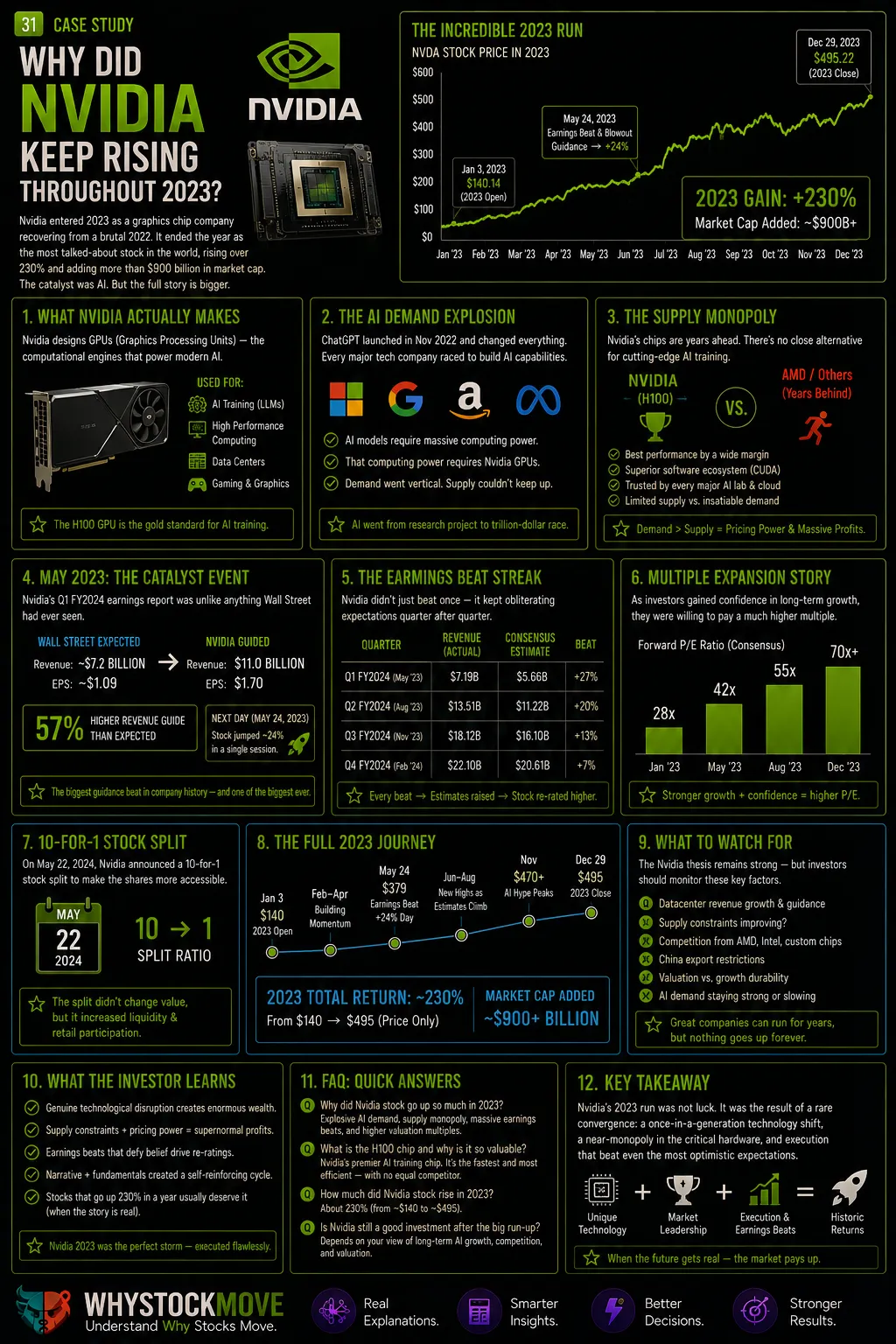
Nvidia entered as a graphics chip company recovering from a brutal . It ended the year as the most talked-about stock in the world, having risen over 230% — adding more than $900 billion in market cap. The catalyst was artificial intelligence. But the full story involves a supply monopoly, explosive demand, earnings beats that defied belief, and a market narrative that became self-reinforcing.
What the Market Believed Before the Move
Nvidia entered as a graphics chip company recovering from a brutal . It ended the year as the most talked-about stock in the world, having risen over 230% — adding more than $900 billion in market cap. The catalyst was artificial intelligence. But the full story involves a supply monopoly, explosive demand, earnings beats that defied belief, and a market narrative that became self-reinforcing. The key to any case study is remembering that the stock was already priced for a story before the catalyst hit. Investors had a growth assumption, a margin assumption, and a level of confidence embedded in the price. Once the new information arrived, the market had to decide whether the old story was still usable or whether it had to be replaced immediately. That re-underwriting process is what creates the violent first move.
Example: This page IS the case study. Key data: Jan ~$140 → May 24, close ~$379 after earnings (+24% that day) → Dec ~$495. Full-year gain: ~230%.
What to watch for: Watch whether volume, estimate revisions, and follow-through confirm the first move instead of assuming the first reaction told the whole story.
The Trigger That Broke the Old Narrative
Most famous stock moves are not caused by one fact alone. They happen because one fact confirms a deeper fear or unlocks a more bullish scenario than the market had fully priced. Once that trigger appears, portfolio managers, analysts, and traders all have to update their assumptions at the same time. That compressed repricing window is why historical case studies are so useful: they show what happens when expectations and reality collide without warning.
The supporting mechanics show up clearly in Why Stocks Rise After Earnings, How Earnings Guidance Moves Stocks, What Is The Pe Ratio, and What Is A Stock Split, which help explain why the move became so large so quickly.
Example: This page IS the case study. Key data: Jan ~$140 → May 24, close ~$379 after earnings (+24% that day) → Dec ~$495. Full-year gain: ~230%.
What to watch for: Watch whether volume, estimate revisions, and follow-through confirm the first move instead of assuming the first reaction told the whole story.
Why the Move Became So Large
The size of the move usually comes from amplifiers layered on top of the original catalyst. It might be valuation compression, short covering, passive flows, or a crowded long trade unwinding all at once. The market does not need every investor to agree. It only needs enough important investors to realize the old price was wrong. From there, liquidity gaps and forced reactions can do the rest.
Example: This page IS the case study. Key data: Jan ~$140 → May 24, close ~$379 after earnings (+24% that day) → Dec ~$495. Full-year gain: ~230%.
What to watch for: Watch whether volume, estimate revisions, and follow-through confirm the first move instead of assuming the first reaction told the whole story.
What Happened After the First Shock
The first day is dramatic, but the second phase is where the lesson becomes useful. Did analysts keep cutting or raising numbers? Did the stock base and recover, or did it keep sliding as new information confirmed the break? Case studies matter because they teach you which first-day moves tend to mean something bigger and which ones were mostly a positioning shock that later settled down.
The supporting mechanics show up clearly in Why Stocks Rise After Earnings, How Earnings Guidance Moves Stocks, What Is The Pe Ratio, and What Is A Stock Split, which help explain why the move became so large so quickly.
Example: This page IS the case study. Key data: Jan ~$140 → May 24, close ~$379 after earnings (+24% that day) → Dec ~$495. Full-year gain: ~230%.
What to watch for: Watch whether volume, estimate revisions, and follow-through confirm the first move instead of assuming the first reaction told the whole story.
How to Use This as an Investor
The real lesson in any famous stock move is not the headline by itself. It is the combination of valuation, positioning, liquidity, and expectations that made the move so violent in the first place. The goal is not to memorize famous charts. It is to recognize the same pattern when a new chart starts forming in front of you. Once you understand how expectations, valuation, and positioning interacted in the historical case, you are much less likely to panic, chase, or misclassify the next one.
Example: This page IS the case study. Key data: Jan ~$140 → May 24, close ~$379 after earnings (+24% that day) → Dec ~$495. Full-year gain: ~230%.
What to watch for: Watch whether volume, estimate revisions, and follow-through confirm the first move instead of assuming the first reaction told the whole story.
Frequently Asked Questions
Why did Nvidia stock go up so much in 2023?
Why Did Nvidia Keep Rising Throughout 2023 matters because markets move on expectation gaps, not on headlines alone. That is why the same event can create a modest move in one setup and a violent repricing in another. This page IS the case study. Key data: Jan 2023 ~$140 → May 24, 2023 close ~$379 after earnings (+24% that day) → Dec 2023 ~$495. Full-year gain: ~230%. Watch whether volume, estimate revisions, and follow-through confirm the first move instead of assuming the first reaction told the whole story.
What is the H100 chip and why is it so valuable?
Nvidia rose over 230% in 2023. Here's the full story of how AI demand, earnings beats, and a supply monopoly combined to drive one of history's greatest stock runs. In practice, the useful part is not the label by itself but the mechanism underneath it: how it changes expectations, liquidity, or positioning. This page IS the case study. Key data: Jan 2023 ~$140 → May 24, 2023 close ~$379 after earnings (+24% that day) → Dec 2023 ~$495. Full-year gain: ~230%. If you want the adjacent setup, start with [Why Stocks Rise After Earnings](/why-stocks-move/why-stocks-rise-after-earnings).
How much did Nvidia stock rise in 2023?
Nvidia rose over 230% in 2023. Here's the full story of how AI demand, earnings beats, and a supply monopoly combined to drive one of history's greatest stock runs. The fastest way to use that information is to compare the catalyst, the tape, and what the market had already priced before the event arrived. Watch whether volume, estimate revisions, and follow-through confirm the first move instead of assuming the first reaction told the whole story. If you want the adjacent setup, start with [Why Stocks Rise After Earnings](/why-stocks-move/why-stocks-rise-after-earnings).
Is Nvidia still a good investment after the big run-up?
Nvidia rose over 230% in 2023. Here's the full story of how AI demand, earnings beats, and a supply monopoly combined to drive one of history's greatest stock runs. The practical edge comes from understanding the mechanism, checking whether the example fits the current setup, and then using the same watchlist items every time you see the pattern. Watch whether volume, estimate revisions, and follow-through confirm the first move instead of assuming the first reaction told the whole story. If you want the adjacent setup, start with [Why Stocks Rise After Earnings](/why-stocks-move/why-stocks-rise-after-earnings).
Why can't other companies compete with Nvidia on AI chips?
Why Did Nvidia Keep Rising Throughout 2023 matters because markets move on expectation gaps, not on headlines alone. That is why the same event can create a modest move in one setup and a violent repricing in another. This page IS the case study. Key data: Jan 2023 ~$140 → May 24, 2023 close ~$379 after earnings (+24% that day) → Dec 2023 ~$495. Full-year gain: ~230%. Watch whether volume, estimate revisions, and follow-through confirm the first move instead of assuming the first reaction told the whole story.
What happened to Nvidia's stock after its big earnings beat in May 2023?
Nvidia rose over 230% in 2023. Here's the full story of how AI demand, earnings beats, and a supply monopoly combined to drive one of history's greatest stock runs. The practical edge comes from understanding the mechanism, checking whether the example fits the current setup, and then using the same watchlist items every time you see the pattern. Watch whether volume, estimate revisions, and follow-through confirm the first move instead of assuming the first reaction told the whole story. If you want the adjacent setup, start with [Why Stocks Rise After Earnings](/why-stocks-move/why-stocks-rise-after-earnings).
What drove the Nvidia stock surge?
Nvidia rose over 230% in 2023. Here's the full story of how AI demand, earnings beats, and a supply monopoly combined to drive one of history's greatest stock runs. The practical edge comes from understanding the mechanism, checking whether the example fits the current setup, and then using the same watchlist items every time you see the pattern. Watch whether volume, estimate revisions, and follow-through confirm the first move instead of assuming the first reaction told the whole story. If you want the adjacent setup, start with [Why Stocks Rise After Earnings](/why-stocks-move/why-stocks-rise-after-earnings).