
What Is a Stock Split and Does It Actually Change a Stock's Value?
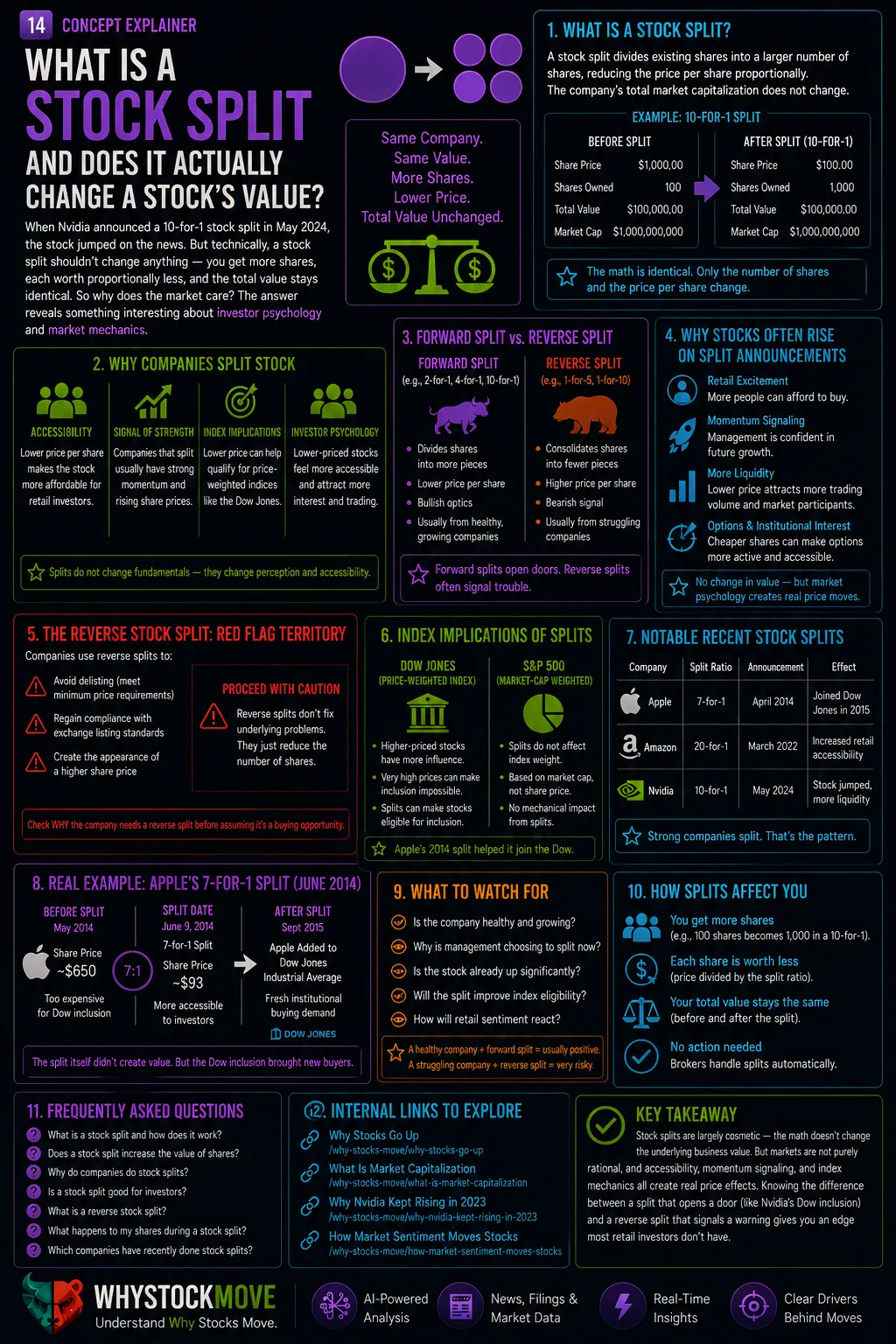
When Nvidia announced a 10-for-1 stock split in May , the stock jumped on the news. But technically, a stock split shouldn't change anything — you get more shares, each worth proportionally less, and the total value stays identical. So why does the market care? The answer reveals something interesting about investor psychology and market mechanics.
What What Is a Stock Split and Does It Actually Change a Stock's Value really means in the market
When Nvidia announced a 10-for-1 stock split in May , the stock jumped on the news. But technically, a stock split shouldn't change anything — you get more shares, each worth proportionally less, and the total value stays identical. So why does the market care? The answer reveals something interesting about investor psychology and market mechanics. In practice, what is a stock split and does it actually change a stock's value matters because it changes how investors interpret risk, liquidity, valuation, or supply and demand before they ever place the trade. Beginners often treat the label as trivia, but desks that manage real money treat it as part of the market's plumbing. Once you understand the mechanism, you stop seeing price action as random and start seeing which variable is actually doing the work.
If you want the adjacent market mechanics, the most useful follow-on reads are Why Do Stocks Go Up, What Is Market Capitalization, Why Nvidia Kept Rising In , and How Market Sentiment Moves Stocks.
Example: Apple's 7-for-1 stock split in June brought the share price from ~$650 to ~$93. In the months following the split, AAPL was added to the Dow Jones Industrial Average — which had been impossible at its previous price given the index's price-weighted structure. That index inclusion brought fresh institutional buying demand.
What to watch for: A forward stock split from a healthy company is a soft positive signal — it usually means the stock has risen enough to warrant the split. A reverse stock split is almost always a warning sign. Check why the company needs to consolidate shares before assuming it's a buying opportunity.
Why what is a stock split and does it actually change a stock's value changes how stocks move
The market does not reward or punish a concept in the abstract. It responds to the way that concept changes who can buy, who needs to sell, and what multiple investors are willing to pay. That is why the same catalyst can produce a calm move in one stock and a chaotic one in another. The concept you are studying here is often the hidden variable that explains the difference. Once funds, market makers, or passive flows have to react, the move becomes mechanical rather than purely opinion-driven.
Example: Apple's 7-for-1 stock split in June brought the share price from ~$650 to ~$93. In the months following the split, AAPL was added to the Dow Jones Industrial Average — which had been impossible at its previous price given the index's price-weighted structure. That index inclusion brought fresh institutional buying demand.
What to watch for: A forward stock split from a healthy company is a soft positive signal — it usually means the stock has risen enough to warrant the split. A reverse stock split is almost always a warning sign. Check why the company needs to consolidate shares before assuming it's a buying opportunity.
Where investors misread what is a stock split and does it actually change a stock's value
Most misreads happen when investors notice the headline result but ignore the setup underneath it. They see the stock moved and then invent the story after the fact. A better approach is to ask how this concept changes liquidity, positioning, or valuation before the move starts. That prevents you from overreacting to noise and helps you judge whether a price move deserves follow-through or skepticism.
Example: Apple's 7-for-1 stock split in June brought the share price from ~$650 to ~$93. In the months following the split, AAPL was added to the Dow Jones Industrial Average — which had been impossible at its previous price given the index's price-weighted structure. That index inclusion brought fresh institutional buying demand.
What to watch for: A forward stock split from a healthy company is a soft positive signal — it usually means the stock has risen enough to warrant the split. A reverse stock split is almost always a warning sign. Check why the company needs to consolidate shares before assuming it's a buying opportunity.
How to read what is a stock split and does it actually change a stock's value in real time
The practical edge is not memorizing a definition. It is recognizing the live signal before the crowd frames it properly. That usually means checking volume, price response, and whether the setup fits what this concept normally does to a stock's trading behavior. If those pieces line up, the move is more likely to be real. If they do not, the market may simply be overshooting on a weak narrative.
If you want the adjacent market mechanics, the most useful follow-on reads are Why Do Stocks Go Up, What Is Market Capitalization, Why Nvidia Kept Rising In , and How Market Sentiment Moves Stocks.
Example: Apple's 7-for-1 stock split in June brought the share price from ~$650 to ~$93. In the months following the split, AAPL was added to the Dow Jones Industrial Average — which had been impossible at its previous price given the index's price-weighted structure. That index inclusion brought fresh institutional buying demand.
What to watch for: A forward stock split from a healthy company is a soft positive signal — it usually means the stock has risen enough to warrant the split. A reverse stock split is almost always a warning sign. Check why the company needs to consolidate shares before assuming it's a buying opportunity.
How to Use This as an Investor
Stock splits are largely cosmetic — the math doesn't change the underlying business value. But markets are not purely rational, and accessibility, momentum signaling, and index mechanics all create real price effects. Knowing the difference between a split that opens a door (like Nvidia's Dow inclusion) and a reverse split that signals a warning gives you an edge most retail investors don't have. Use the concept as a filter before you use it as a trade trigger. It should change how you size the position, where you expect liquidity to appear, and how much surprise a stock can absorb. Investors who do that consistently make fewer emotional decisions because the move already fits a framework before the headline hits.
Example: Apple's 7-for-1 stock split in June brought the share price from ~$650 to ~$93. In the months following the split, AAPL was added to the Dow Jones Industrial Average — which had been impossible at its previous price given the index's price-weighted structure. That index inclusion brought fresh institutional buying demand.
What to watch for: A forward stock split from a healthy company is a soft positive signal — it usually means the stock has risen enough to warrant the split. A reverse stock split is almost always a warning sign. Check why the company needs to consolidate shares before assuming it's a buying opportunity.
Frequently Asked Questions
What is a stock split and how does it work?
A stock split divides shares into smaller pieces. It doesn't change the company's value — but it often moves the stock anyway. Here's why. In practice, the useful part is not the label by itself but the mechanism underneath it: how it changes expectations, liquidity, or positioning. Apple's 7-for-1 stock split in June 2014 brought the share price from ~$650 to ~$93. In the months following the split, AAPL was added to the Dow Jones Industrial Average — which had been impossible at its previous price given the index's price-weighted structure. That index inclusion brought fresh institutional buying demand. If you want the adjacent setup, start with [Why Do Stocks Go Up](/why-stocks-move/why-do-stocks-go-up).
Does a stock split increase the value of shares?
A stock split divides shares into smaller pieces. It doesn't change the company's value — but it often moves the stock anyway. Here's why. The practical edge comes from understanding the mechanism, checking whether the example fits the current setup, and then using the same watchlist items every time you see the pattern. A forward stock split from a healthy company is a soft positive signal — it usually means the stock has risen enough to warrant the split. A reverse stock split is almost always a warning sign. Check why the company needs to consolidate shares before assuming it's a buying opportunity. If you want the adjacent setup, start with [Why Do Stocks Go Up](/why-stocks-move/why-do-stocks-go-up).
Why do companies do stock splits?
What Is a Stock Split and Does It Actually Change a Stock's Value matters because markets move on expectation gaps, not on headlines alone. That is why the same event can create a modest move in one setup and a violent repricing in another. Apple's 7-for-1 stock split in June 2014 brought the share price from ~$650 to ~$93. In the months following the split, AAPL was added to the Dow Jones Industrial Average — which had been impossible at its previous price given the index's price-weighted structure. That index inclusion brought fresh institutional buying demand. A forward stock split from a healthy company is a soft positive signal — it usually means the stock has risen enough to warrant the split. A reverse stock split is almost always a warning sign. Check why the company needs to consolidate shares before assuming it's a buying opportunity.
Is a stock split good for investors?
A stock split divides shares into smaller pieces. It doesn't change the company's value — but it often moves the stock anyway. Here's why. The practical edge comes from understanding the mechanism, checking whether the example fits the current setup, and then using the same watchlist items every time you see the pattern. A forward stock split from a healthy company is a soft positive signal — it usually means the stock has risen enough to warrant the split. A reverse stock split is almost always a warning sign. Check why the company needs to consolidate shares before assuming it's a buying opportunity. If you want the adjacent setup, start with [Why Do Stocks Go Up](/why-stocks-move/why-do-stocks-go-up).
What is a reverse stock split?
A stock split divides shares into smaller pieces. It doesn't change the company's value — but it often moves the stock anyway. Here's why. In practice, the useful part is not the label by itself but the mechanism underneath it: how it changes expectations, liquidity, or positioning. Apple's 7-for-1 stock split in June 2014 brought the share price from ~$650 to ~$93. In the months following the split, AAPL was added to the Dow Jones Industrial Average — which had been impossible at its previous price given the index's price-weighted structure. That index inclusion brought fresh institutional buying demand. If you want the adjacent setup, start with [Why Do Stocks Go Up](/why-stocks-move/why-do-stocks-go-up).
What happens to my shares during a stock split?
A stock split divides shares into smaller pieces. It doesn't change the company's value — but it often moves the stock anyway. Here's why. In practice, the useful part is not the label by itself but the mechanism underneath it: how it changes expectations, liquidity, or positioning. Apple's 7-for-1 stock split in June 2014 brought the share price from ~$650 to ~$93. In the months following the split, AAPL was added to the Dow Jones Industrial Average — which had been impossible at its previous price given the index's price-weighted structure. That index inclusion brought fresh institutional buying demand. If you want the adjacent setup, start with [Why Do Stocks Go Up](/why-stocks-move/why-do-stocks-go-up).
Which companies have recently done stock splits?
A stock split divides shares into smaller pieces. It doesn't change the company's value — but it often moves the stock anyway. Here's why. The practical edge comes from understanding the mechanism, checking whether the example fits the current setup, and then using the same watchlist items every time you see the pattern. A forward stock split from a healthy company is a soft positive signal — it usually means the stock has risen enough to warrant the split. A reverse stock split is almost always a warning sign. Check why the company needs to consolidate shares before assuming it's a buying opportunity. If you want the adjacent setup, start with [Why Do Stocks Go Up](/why-stocks-move/why-do-stocks-go-up).