
What Happens to a Stock's Price During a Merger or Acquisition?
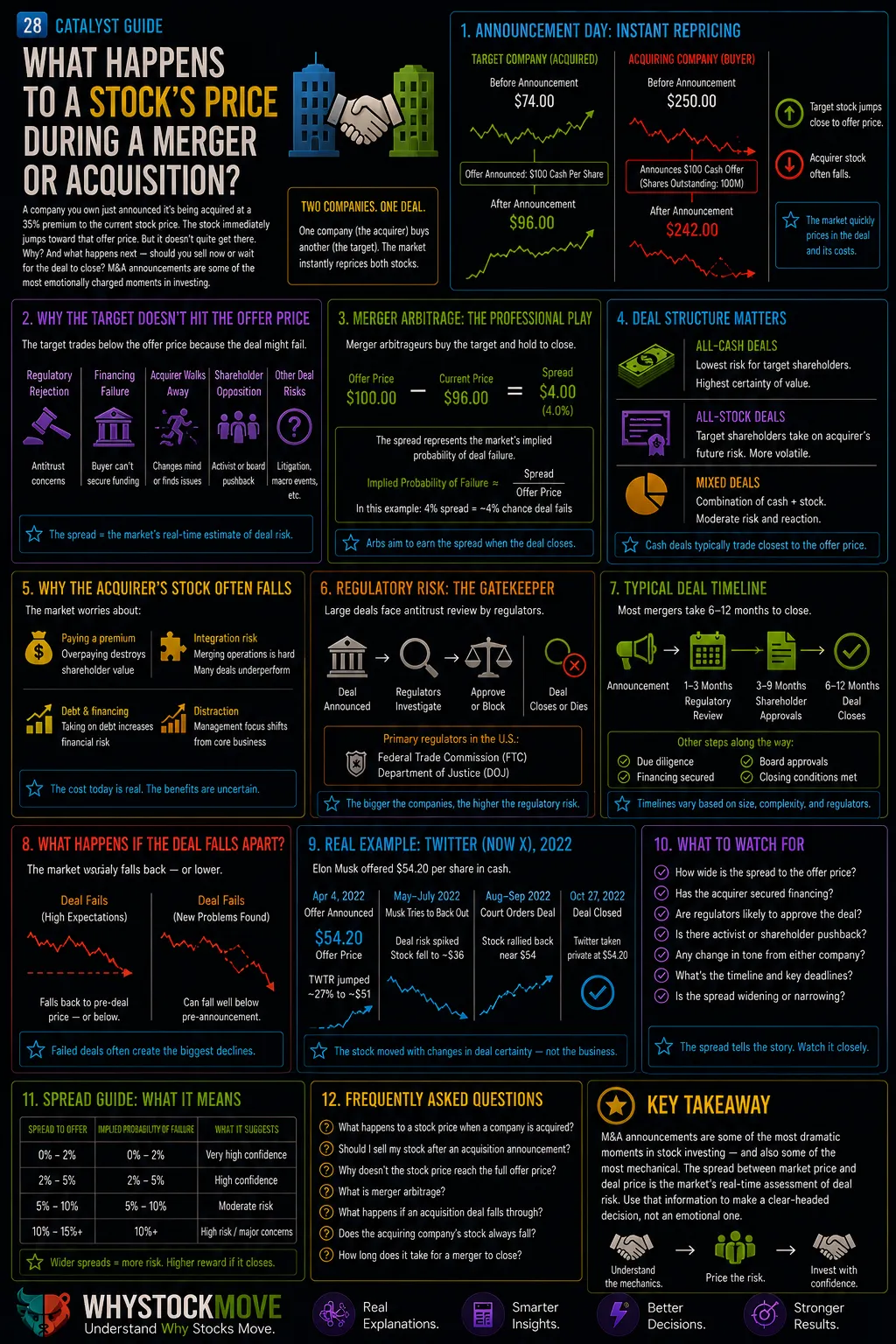
A company you own just announced it's being acquired at a 35% premium to the current stock price. The stock immediately jumps toward that offer price. But it doesn't quite get there. Why? And what happens next — should you sell now or wait for the deal to close? M&A announcements are some of the most emotionally charged moments in investing, and the mechanics are worth understanding precisely.
The Core Mechanism
A company you own just announced it's being acquired at a 35% premium to the current stock price. The stock immediately jumps toward that offer price. But it doesn't quite get there. Why? And what happens next — should you sell now or wait for the deal to close? M&A announcements are some of the most emotionally charged moments in investing, and the mechanics are worth understanding precisely. What matters most is the transmission channel from the event to the tape. In other words, who is forced to react, how fast they react, and whether the move changes the next few quarters of expectations or only short-term positioning. Once that chain starts, the stock can move far more than the headline alone would suggest because flows, hedging, and copycat positioning all join the move.
The mechanism gets even clearer when you compare it with What Makes Stocks Move Fast, Why Gamestop Exploded In , and How Analyst Upgrades Affect Stocks, because these moves rarely operate in isolation.
Example: When Elon Musk made his offer to acquire Twitter at $54.20 per share in April , Twitter stock surged ~27% to near $51. It traded slightly below the offer price because of deal risk. When Musk subsequently tried to back out, Twitter fell sharply as deal risk spiked. After courts compelled him to complete the deal, Twitter traded back near $54 before being taken private in October .
What to watch for: The spread between the current stock price and the announced deal price tells you what the market thinks the probability of deal completion is. A tight spread (1–2%) means high confidence; a wide spread (10–15%) means significant regulatory or financing concern.
Why the Price Reaction Can Overshoot
Markets often overshoot because the first price move triggers a second wave of activity. Analysts revise numbers, ETFs rebalance, shorts cover, or market makers hedge. That feedback loop is why some moves look too large relative to the original catalyst. The original news matters, but the market structure around it matters just as much once the tape starts accelerating.
Example: When Elon Musk made his offer to acquire Twitter at $54.20 per share in April , Twitter stock surged ~27% to near $51. It traded slightly below the offer price because of deal risk. When Musk subsequently tried to back out, Twitter fell sharply as deal risk spiked. After courts compelled him to complete the deal, Twitter traded back near $54 before being taken private in October .
What to watch for: The spread between the current stock price and the announced deal price tells you what the market thinks the probability of deal completion is. A tight spread (1–2%) means high confidence; a wide spread (10–15%) means significant regulatory or financing concern.
What Investors Usually Miss
The common mistake is treating the move as if it came from sentiment alone. In reality, most repeatable stock reactions come from a mechanical process: valuation adjustment, passive flow, liquidity stress, or dealer hedging. If you can identify that process early, you stop reacting to the candle and start judging the durability of the move itself. That is the difference between reading price and understanding it.
Example: When Elon Musk made his offer to acquire Twitter at $54.20 per share in April , Twitter stock surged ~27% to near $51. It traded slightly below the offer price because of deal risk. When Musk subsequently tried to back out, Twitter fell sharply as deal risk spiked. After courts compelled him to complete the deal, Twitter traded back near $54 before being taken private in October .
What to watch for: The spread between the current stock price and the announced deal price tells you what the market thinks the probability of deal completion is. A tight spread (1–2%) means high confidence; a wide spread (10–15%) means significant regulatory or financing concern.
How to Track the Setup Before and After It Hits
The best preparation is to know which data points usually confirm this move once it begins. Sometimes that means pre-market volume. Sometimes it means the 10-year yield, ETF flow data, or the spread to a deal price. The point is to know which scoreboard the market is using before you decide whether the first reaction deserves trust or doubt.
The mechanism gets even clearer when you compare it with What Makes Stocks Move Fast, Why Gamestop Exploded In , and How Analyst Upgrades Affect Stocks, because these moves rarely operate in isolation.
Example: When Elon Musk made his offer to acquire Twitter at $54.20 per share in April , Twitter stock surged ~27% to near $51. It traded slightly below the offer price because of deal risk. When Musk subsequently tried to back out, Twitter fell sharply as deal risk spiked. After courts compelled him to complete the deal, Twitter traded back near $54 before being taken private in October .
What to watch for: The spread between the current stock price and the announced deal price tells you what the market thinks the probability of deal completion is. A tight spread (1–2%) means high confidence; a wide spread (10–15%) means significant regulatory or financing concern.
How to Use This as an Investor
M&A announcements are some of the most dramatic moments in stock investing — and also some of the most mechanical. Once you understand that the spread between market price and deal price is the market's real-time assessment of deal risk, you can make a clear-headed decision about what to do with your position rather than acting on pure emotion. The practical goal is to classify the move before you commit capital. If the reaction is mostly mechanical, you should think in terms of flow and timing. If it changes earnings power, you should think in terms of valuation and holding period. That distinction keeps you from treating every fast move like the same opportunity.
Example: When Elon Musk made his offer to acquire Twitter at $54.20 per share in April , Twitter stock surged ~27% to near $51. It traded slightly below the offer price because of deal risk. When Musk subsequently tried to back out, Twitter fell sharply as deal risk spiked. After courts compelled him to complete the deal, Twitter traded back near $54 before being taken private in October .
What to watch for: The spread between the current stock price and the announced deal price tells you what the market thinks the probability of deal completion is. A tight spread (1–2%) means high confidence; a wide spread (10–15%) means significant regulatory or financing concern.
Frequently Asked Questions
What happens to a stock price when a company is acquired?
M&A announcements instantly reprice stocks — targets surge, acquirers often fall. Here's exactly what happens to stock prices during mergers. In practice, the useful part is not the label by itself but the mechanism underneath it: how it changes expectations, liquidity, or positioning. When Elon Musk made his offer to acquire Twitter at $54.20 per share in April 2022, Twitter stock surged ~27% to near $51. It traded slightly below the offer price because of deal risk. When Musk subsequently tried to back out, Twitter fell sharply as deal risk spiked. After courts compelled him to complete the deal, Twitter traded back near $54 before being taken private in October 2022. If you want the adjacent setup, start with [What Makes Stocks Move Fast](/why-stocks-move/what-makes-stocks-move-fast).
Should I sell my stock after an acquisition announcement?
The spread between the current stock price and the announced deal price tells you what the market thinks the probability of deal completion is. A tight spread (1–2%) means high confidence; a wide spread (10–15%) means significant regulatory or financing concern. The key is to classify the move before you commit capital or change a position. Once you know whether the setup is fundamental, mechanical, or behavioral, the right response becomes much clearer. If you want the adjacent setup, start with [What Makes Stocks Move Fast](/why-stocks-move/what-makes-stocks-move-fast).
Why doesn't the stock price reach the full offer price immediately?
What Happens to a Stock's Price During a Merger or Acquisition matters because markets move on expectation gaps, not on headlines alone. That is why the same event can create a modest move in one setup and a violent repricing in another. When Elon Musk made his offer to acquire Twitter at $54.20 per share in April 2022, Twitter stock surged ~27% to near $51. It traded slightly below the offer price because of deal risk. When Musk subsequently tried to back out, Twitter fell sharply as deal risk spiked. After courts compelled him to complete the deal, Twitter traded back near $54 before being taken private in October 2022. The spread between the current stock price and the announced deal price tells you what the market thinks the probability of deal completion is. A tight spread (1–2%) means high confidence; a wide spread (10–15%) means significant regulatory or financing concern.
What is merger arbitrage?
M&A announcements instantly reprice stocks — targets surge, acquirers often fall. Here's exactly what happens to stock prices during mergers. In practice, the useful part is not the label by itself but the mechanism underneath it: how it changes expectations, liquidity, or positioning. When Elon Musk made his offer to acquire Twitter at $54.20 per share in April 2022, Twitter stock surged ~27% to near $51. It traded slightly below the offer price because of deal risk. When Musk subsequently tried to back out, Twitter fell sharply as deal risk spiked. After courts compelled him to complete the deal, Twitter traded back near $54 before being taken private in October 2022. If you want the adjacent setup, start with [What Makes Stocks Move Fast](/why-stocks-move/what-makes-stocks-move-fast).
What happens if an acquisition deal falls through?
M&A announcements instantly reprice stocks — targets surge, acquirers often fall. Here's exactly what happens to stock prices during mergers. In practice, the useful part is not the label by itself but the mechanism underneath it: how it changes expectations, liquidity, or positioning. When Elon Musk made his offer to acquire Twitter at $54.20 per share in April 2022, Twitter stock surged ~27% to near $51. It traded slightly below the offer price because of deal risk. When Musk subsequently tried to back out, Twitter fell sharply as deal risk spiked. After courts compelled him to complete the deal, Twitter traded back near $54 before being taken private in October 2022. If you want the adjacent setup, start with [What Makes Stocks Move Fast](/why-stocks-move/what-makes-stocks-move-fast).
Does the acquiring company's stock always fall during a merger?
M&A announcements instantly reprice stocks — targets surge, acquirers often fall. Here's exactly what happens to stock prices during mergers. The practical edge comes from understanding the mechanism, checking whether the example fits the current setup, and then using the same watchlist items every time you see the pattern. The spread between the current stock price and the announced deal price tells you what the market thinks the probability of deal completion is. A tight spread (1–2%) means high confidence; a wide spread (10–15%) means significant regulatory or financing concern. If you want the adjacent setup, start with [What Makes Stocks Move Fast](/why-stocks-move/what-makes-stocks-move-fast).
How long does it take for a merger to close?
M&A announcements instantly reprice stocks — targets surge, acquirers often fall. Here's exactly what happens to stock prices during mergers. The fastest way to use that information is to compare the catalyst, the tape, and what the market had already priced before the event arrived. The spread between the current stock price and the announced deal price tells you what the market thinks the probability of deal completion is. A tight spread (1–2%) means high confidence; a wide spread (10–15%) means significant regulatory or financing concern. If you want the adjacent setup, start with [What Makes Stocks Move Fast](/why-stocks-move/what-makes-stocks-move-fast).