
What Is a Stock Buyback and How Does It Affect Share Price?
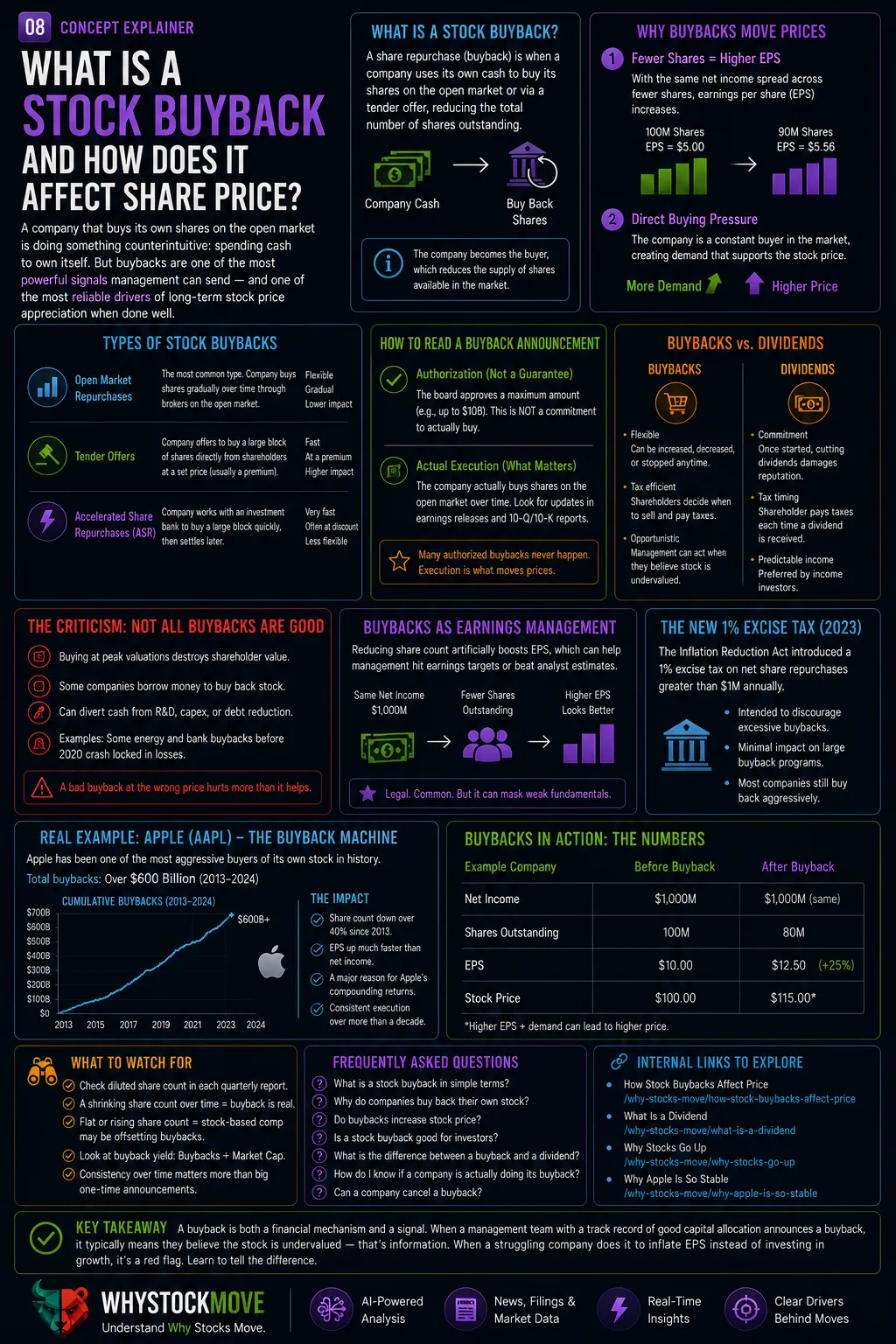
A company that buys its own shares on the open market is doing something counterintuitive: spending cash to own itself. But buybacks are one of the most powerful signals management can send — and one of the most reliable mechanical drivers of long-term stock price appreciation when done well.
What What Is a Stock Buyback and How Does It Affect Share Price really means in the market
A company that buys its own shares on the open market is doing something counterintuitive: spending cash to own itself. But buybacks are one of the most powerful signals management can send — and one of the most reliable mechanical drivers of long-term stock price appreciation when done well. In practice, what is a stock buyback and how does it affect share price matters because it changes how investors interpret risk, liquidity, valuation, or supply and demand before they ever place the trade. Beginners often treat the label as trivia, but desks that manage real money treat it as part of the market's plumbing. Once you understand the mechanism, you stop seeing price action as random and start seeing which variable is actually doing the work.
If you want the adjacent market mechanics, the most useful follow-on reads are How Stock Buybacks Affect Price, What Is A Dividend, Why Do Stocks Go Up, and Why Apple Is So Stable.
Example: Apple (AAPL) has been one of the most aggressive buyback machines in market history, repurchasing over $600 billion of its own shares between and . This mechanical reduction in share count is a major reason EPS has grown faster than net income over that period — and why the stock has compounded so consistently.
What to watch for: Check whether a buyback announcement is being matched by actual share count reduction in quarterly reports. A shrinking diluted share count over time is the signal the buyback is real. A flat or rising share count despite announced buybacks means stock-based compensation is canceling out the repurchases.
Why what is a stock buyback and how does it affect share price changes how stocks move
The market does not reward or punish a concept in the abstract. It responds to the way that concept changes who can buy, who needs to sell, and what multiple investors are willing to pay. That is why the same catalyst can produce a calm move in one stock and a chaotic one in another. The concept you are studying here is often the hidden variable that explains the difference. Once funds, market makers, or passive flows have to react, the move becomes mechanical rather than purely opinion-driven.
Example: Apple (AAPL) has been one of the most aggressive buyback machines in market history, repurchasing over $600 billion of its own shares between and . This mechanical reduction in share count is a major reason EPS has grown faster than net income over that period — and why the stock has compounded so consistently.
What to watch for: Check whether a buyback announcement is being matched by actual share count reduction in quarterly reports. A shrinking diluted share count over time is the signal the buyback is real. A flat or rising share count despite announced buybacks means stock-based compensation is canceling out the repurchases.
Where investors misread what is a stock buyback and how does it affect share price
Most misreads happen when investors notice the headline result but ignore the setup underneath it. They see the stock moved and then invent the story after the fact. A better approach is to ask how this concept changes liquidity, positioning, or valuation before the move starts. That prevents you from overreacting to noise and helps you judge whether a price move deserves follow-through or skepticism.
Example: Apple (AAPL) has been one of the most aggressive buyback machines in market history, repurchasing over $600 billion of its own shares between and . This mechanical reduction in share count is a major reason EPS has grown faster than net income over that period — and why the stock has compounded so consistently.
What to watch for: Check whether a buyback announcement is being matched by actual share count reduction in quarterly reports. A shrinking diluted share count over time is the signal the buyback is real. A flat or rising share count despite announced buybacks means stock-based compensation is canceling out the repurchases.
How to read what is a stock buyback and how does it affect share price in real time
The practical edge is not memorizing a definition. It is recognizing the live signal before the crowd frames it properly. That usually means checking volume, price response, and whether the setup fits what this concept normally does to a stock's trading behavior. If those pieces line up, the move is more likely to be real. If they do not, the market may simply be overshooting on a weak narrative.
If you want the adjacent market mechanics, the most useful follow-on reads are How Stock Buybacks Affect Price, What Is A Dividend, Why Do Stocks Go Up, and Why Apple Is So Stable.
Example: Apple (AAPL) has been one of the most aggressive buyback machines in market history, repurchasing over $600 billion of its own shares between and . This mechanical reduction in share count is a major reason EPS has grown faster than net income over that period — and why the stock has compounded so consistently.
What to watch for: Check whether a buyback announcement is being matched by actual share count reduction in quarterly reports. A shrinking diluted share count over time is the signal the buyback is real. A flat or rising share count despite announced buybacks means stock-based compensation is canceling out the repurchases.
How to Use This as an Investor
A buyback is both a financial mechanism and a signal. When a management team with a track record of good capital allocation announces a buyback, it typically means they believe the stock is undervalued — that's information. When a struggling company does it to inflate EPS instead of investing in growth, it's a red flag. Learn to tell the difference. Use the concept as a filter before you use it as a trade trigger. It should change how you size the position, where you expect liquidity to appear, and how much surprise a stock can absorb. Investors who do that consistently make fewer emotional decisions because the move already fits a framework before the headline hits.
Example: Apple (AAPL) has been one of the most aggressive buyback machines in market history, repurchasing over $600 billion of its own shares between and . This mechanical reduction in share count is a major reason EPS has grown faster than net income over that period — and why the stock has compounded so consistently.
What to watch for: Check whether a buyback announcement is being matched by actual share count reduction in quarterly reports. A shrinking diluted share count over time is the signal the buyback is real. A flat or rising share count despite announced buybacks means stock-based compensation is canceling out the repurchases.
Frequently Asked Questions
What is a stock buyback in simple terms?
Stock buybacks reduce share count, boost EPS, and signal confidence — but they can also mask weak fundamentals. Here's how they move prices. In practice, the useful part is not the label by itself but the mechanism underneath it: how it changes expectations, liquidity, or positioning. Apple (AAPL) has been one of the most aggressive buyback machines in market history, repurchasing over $600 billion of its own shares between 2013 and 2024. This mechanical reduction in share count is a major reason EPS has grown faster than net income over that period — and why the stock has compounded so consistently. If you want the adjacent setup, start with [How Stock Buybacks Affect Price](/why-stocks-move/how-stock-buybacks-affect-price).
Why do companies buy back their own stock?
What Is a Stock Buyback and How Does It Affect Share Price matters because markets move on expectation gaps, not on headlines alone. That is why the same event can create a modest move in one setup and a violent repricing in another. Apple (AAPL) has been one of the most aggressive buyback machines in market history, repurchasing over $600 billion of its own shares between 2013 and 2024. This mechanical reduction in share count is a major reason EPS has grown faster than net income over that period — and why the stock has compounded so consistently. Check whether a buyback announcement is being matched by actual share count reduction in quarterly reports. A shrinking diluted share count over time is the signal the buyback is real. A flat or rising share count despite announced buybacks means stock-based compensation is canceling out the repurchases.
Do buybacks increase stock price?
Stock buybacks reduce share count, boost EPS, and signal confidence — but they can also mask weak fundamentals. Here's how they move prices. The practical edge comes from understanding the mechanism, checking whether the example fits the current setup, and then using the same watchlist items every time you see the pattern. Check whether a buyback announcement is being matched by actual share count reduction in quarterly reports. A shrinking diluted share count over time is the signal the buyback is real. A flat or rising share count despite announced buybacks means stock-based compensation is canceling out the repurchases. If you want the adjacent setup, start with [How Stock Buybacks Affect Price](/why-stocks-move/how-stock-buybacks-affect-price).
Is a stock buyback good for investors?
Stock buybacks reduce share count, boost EPS, and signal confidence — but they can also mask weak fundamentals. Here's how they move prices. The practical edge comes from understanding the mechanism, checking whether the example fits the current setup, and then using the same watchlist items every time you see the pattern. Check whether a buyback announcement is being matched by actual share count reduction in quarterly reports. A shrinking diluted share count over time is the signal the buyback is real. A flat or rising share count despite announced buybacks means stock-based compensation is canceling out the repurchases. If you want the adjacent setup, start with [How Stock Buybacks Affect Price](/why-stocks-move/how-stock-buybacks-affect-price).
What is the difference between a buyback and a dividend?
Stock buybacks reduce share count, boost EPS, and signal confidence — but they can also mask weak fundamentals. Here's how they move prices. In practice, the useful part is not the label by itself but the mechanism underneath it: how it changes expectations, liquidity, or positioning. Apple (AAPL) has been one of the most aggressive buyback machines in market history, repurchasing over $600 billion of its own shares between 2013 and 2024. This mechanical reduction in share count is a major reason EPS has grown faster than net income over that period — and why the stock has compounded so consistently. If you want the adjacent setup, start with [How Stock Buybacks Affect Price](/why-stocks-move/how-stock-buybacks-affect-price).
How do I know if a company is actually doing its buyback?
Check whether a buyback announcement is being matched by actual share count reduction in quarterly reports. A shrinking diluted share count over time is the signal the buyback is real. A flat or rising share count despite announced buybacks means stock-based compensation is canceling out the repurchases. The key is to classify the move before you commit capital or change a position. Once you know whether the setup is fundamental, mechanical, or behavioral, the right response becomes much clearer. If you want the adjacent setup, start with [How Stock Buybacks Affect Price](/why-stocks-move/how-stock-buybacks-affect-price).
Can a company cancel a buyback?
Stock buybacks reduce share count, boost EPS, and signal confidence — but they can also mask weak fundamentals. Here's how they move prices. The practical edge comes from understanding the mechanism, checking whether the example fits the current setup, and then using the same watchlist items every time you see the pattern. Check whether a buyback announcement is being matched by actual share count reduction in quarterly reports. A shrinking diluted share count over time is the signal the buyback is real. A flat or rising share count despite announced buybacks means stock-based compensation is canceling out the repurchases. If you want the adjacent setup, start with [How Stock Buybacks Affect Price](/why-stocks-move/how-stock-buybacks-affect-price).