
What Is a Dividend and How Does It Affect a Stock's Price?
When a company makes money, it has two choices: reinvest in the business or return cash to shareholders. Dividends are the second option — a direct cash payment to investors for simply holding the stock. They sound simple. But the mechanics around them — especially how they affect stock prices — are more nuanced than most beginners realize.
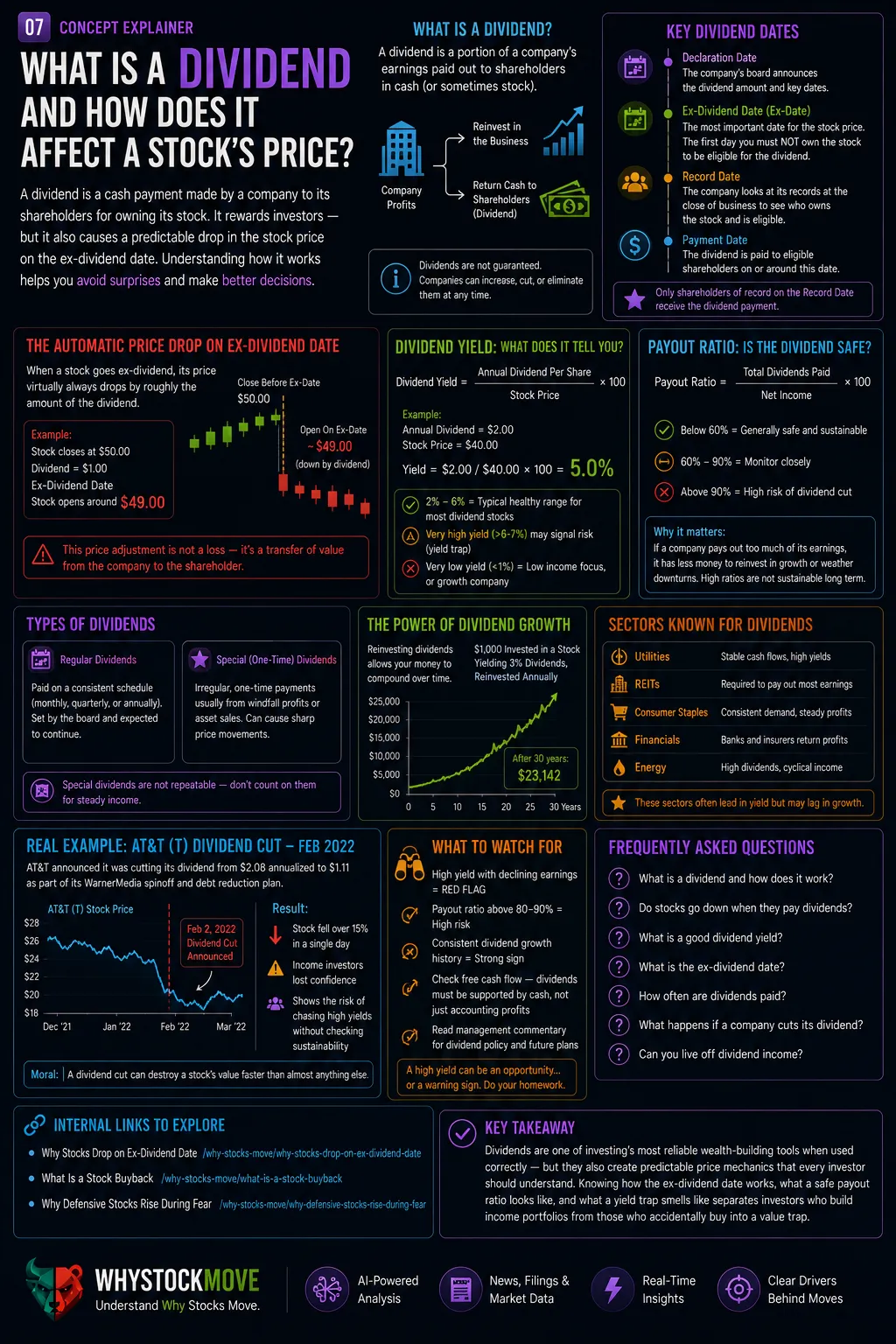
What What Is a Dividend and How Does It Affect a Stock's Price really means in the market
When a company makes money, it has two choices: reinvest in the business or return cash to shareholders. Dividends are the second option — a direct cash payment to investors for simply holding the stock. They sound simple. But the mechanics around them — especially how they affect stock prices — are more nuanced than most beginners realize. In practice, what is a dividend and how does it affect a stock's price matters because it changes how investors interpret risk, liquidity, valuation, or supply and demand before they ever place the trade. Beginners often treat the label as trivia, but desks that manage real money treat it as part of the market's plumbing. Once you understand the mechanism, you stop seeing price action as random and start seeing which variable is actually doing the work.
If you want the adjacent market mechanics, the most useful follow-on reads are Why Stocks Drop On Ex Dividend Date, What Is A Stock Buyback, and Why Defensive Stocks Rise During Fear.
Example: When AT&T (T) announced it was cutting its dividend in February as part of its WarnerMedia spinoff, the stock fell sharply. Dividend-focused investors who owned it for income had their thesis removed overnight. This is the "dividend cut risk" that yield chasers often underestimate.
What to watch for: A dividend yield above 6–7% on a stock with declining earnings is a warning sign, not an opportunity. The market is often pricing in the risk of a dividend cut. Check the payout ratio — if it's above 80–90% of earnings, the dividend may not be sustainable.
Why what is a dividend and how does it affect a stock's price changes how stocks move
The market does not reward or punish a concept in the abstract. It responds to the way that concept changes who can buy, who needs to sell, and what multiple investors are willing to pay. That is why the same catalyst can produce a calm move in one stock and a chaotic one in another. The concept you are studying here is often the hidden variable that explains the difference. Once funds, market makers, or passive flows have to react, the move becomes mechanical rather than purely opinion-driven.
Example: When AT&T (T) announced it was cutting its dividend in February as part of its WarnerMedia spinoff, the stock fell sharply. Dividend-focused investors who owned it for income had their thesis removed overnight. This is the "dividend cut risk" that yield chasers often underestimate.
What to watch for: A dividend yield above 6–7% on a stock with declining earnings is a warning sign, not an opportunity. The market is often pricing in the risk of a dividend cut. Check the payout ratio — if it's above 80–90% of earnings, the dividend may not be sustainable.
Where investors misread what is a dividend and how does it affect a stock's price
Most misreads happen when investors notice the headline result but ignore the setup underneath it. They see the stock moved and then invent the story after the fact. A better approach is to ask how this concept changes liquidity, positioning, or valuation before the move starts. That prevents you from overreacting to noise and helps you judge whether a price move deserves follow-through or skepticism.
Example: When AT&T (T) announced it was cutting its dividend in February as part of its WarnerMedia spinoff, the stock fell sharply. Dividend-focused investors who owned it for income had their thesis removed overnight. This is the "dividend cut risk" that yield chasers often underestimate.
What to watch for: A dividend yield above 6–7% on a stock with declining earnings is a warning sign, not an opportunity. The market is often pricing in the risk of a dividend cut. Check the payout ratio — if it's above 80–90% of earnings, the dividend may not be sustainable.
How to read what is a dividend and how does it affect a stock's price in real time
The practical edge is not memorizing a definition. It is recognizing the live signal before the crowd frames it properly. That usually means checking volume, price response, and whether the setup fits what this concept normally does to a stock's trading behavior. If those pieces line up, the move is more likely to be real. If they do not, the market may simply be overshooting on a weak narrative.
If you want the adjacent market mechanics, the most useful follow-on reads are Why Stocks Drop On Ex Dividend Date, What Is A Stock Buyback, and Why Defensive Stocks Rise During Fear.
Example: When AT&T (T) announced it was cutting its dividend in February as part of its WarnerMedia spinoff, the stock fell sharply. Dividend-focused investors who owned it for income had their thesis removed overnight. This is the "dividend cut risk" that yield chasers often underestimate.
What to watch for: A dividend yield above 6–7% on a stock with declining earnings is a warning sign, not an opportunity. The market is often pricing in the risk of a dividend cut. Check the payout ratio — if it's above 80–90% of earnings, the dividend may not be sustainable.
How to Use This as an Investor
Dividends are one of investing's most reliable wealth-building tools when used correctly — but they also create predictable price mechanics that every investor should understand. Knowing how the ex-dividend date works, what a safe payout ratio looks like, and what a yield trap smells like separates investors who build income portfolios from those who accidentally buy into a value trap. Use the concept as a filter before you use it as a trade trigger. It should change how you size the position, where you expect liquidity to appear, and how much surprise a stock can absorb. Investors who do that consistently make fewer emotional decisions because the move already fits a framework before the headline hits.
Example: When AT&T (T) announced it was cutting its dividend in February as part of its WarnerMedia spinoff, the stock fell sharply. Dividend-focused investors who owned it for income had their thesis removed overnight. This is the "dividend cut risk" that yield chasers often underestimate.
What to watch for: A dividend yield above 6–7% on a stock with declining earnings is a warning sign, not an opportunity. The market is often pricing in the risk of a dividend cut. Check the payout ratio — if it's above 80–90% of earnings, the dividend may not be sustainable.
Frequently Asked Questions
What is a dividend and how does it work?
Dividends reward shareholders with cash — but they also cause predictable stock price drops. Here's exactly how dividends work and what they mean. In practice, the useful part is not the label by itself but the mechanism underneath it: how it changes expectations, liquidity, or positioning. When AT&T (T) announced it was cutting its dividend in February 2022 as part of its WarnerMedia spinoff, the stock fell sharply. Dividend-focused investors who owned it for income had their thesis removed overnight. This is the "dividend cut risk" that yield chasers often underestimate. If you want the adjacent setup, start with [Why Stocks Drop On Ex Dividend Date](/why-stocks-move/why-stocks-drop-on-ex-dividend-date).
Do stocks go down when they pay dividends?
Dividends reward shareholders with cash — but they also cause predictable stock price drops. Here's exactly how dividends work and what they mean. The practical edge comes from understanding the mechanism, checking whether the example fits the current setup, and then using the same watchlist items every time you see the pattern. A dividend yield above 6–7% on a stock with declining earnings is a warning sign, not an opportunity. The market is often pricing in the risk of a dividend cut. Check the payout ratio — if it's above 80–90% of earnings, the dividend may not be sustainable. If you want the adjacent setup, start with [Why Stocks Drop On Ex Dividend Date](/why-stocks-move/why-stocks-drop-on-ex-dividend-date).
What is a good dividend yield?
Dividends reward shareholders with cash — but they also cause predictable stock price drops. Here's exactly how dividends work and what they mean. In practice, the useful part is not the label by itself but the mechanism underneath it: how it changes expectations, liquidity, or positioning. When AT&T (T) announced it was cutting its dividend in February 2022 as part of its WarnerMedia spinoff, the stock fell sharply. Dividend-focused investors who owned it for income had their thesis removed overnight. This is the "dividend cut risk" that yield chasers often underestimate. If you want the adjacent setup, start with [Why Stocks Drop On Ex Dividend Date](/why-stocks-move/why-stocks-drop-on-ex-dividend-date).
What is the ex-dividend date?
Dividends reward shareholders with cash — but they also cause predictable stock price drops. Here's exactly how dividends work and what they mean. In practice, the useful part is not the label by itself but the mechanism underneath it: how it changes expectations, liquidity, or positioning. When AT&T (T) announced it was cutting its dividend in February 2022 as part of its WarnerMedia spinoff, the stock fell sharply. Dividend-focused investors who owned it for income had their thesis removed overnight. This is the "dividend cut risk" that yield chasers often underestimate. If you want the adjacent setup, start with [Why Stocks Drop On Ex Dividend Date](/why-stocks-move/why-stocks-drop-on-ex-dividend-date).
How often are dividends paid?
Dividends reward shareholders with cash — but they also cause predictable stock price drops. Here's exactly how dividends work and what they mean. The fastest way to use that information is to compare the catalyst, the tape, and what the market had already priced before the event arrived. A dividend yield above 6–7% on a stock with declining earnings is a warning sign, not an opportunity. The market is often pricing in the risk of a dividend cut. Check the payout ratio — if it's above 80–90% of earnings, the dividend may not be sustainable. If you want the adjacent setup, start with [Why Stocks Drop On Ex Dividend Date](/why-stocks-move/why-stocks-drop-on-ex-dividend-date).
What happens if a company cuts its dividend?
Dividends reward shareholders with cash — but they also cause predictable stock price drops. Here's exactly how dividends work and what they mean. In practice, the useful part is not the label by itself but the mechanism underneath it: how it changes expectations, liquidity, or positioning. When AT&T (T) announced it was cutting its dividend in February 2022 as part of its WarnerMedia spinoff, the stock fell sharply. Dividend-focused investors who owned it for income had their thesis removed overnight. This is the "dividend cut risk" that yield chasers often underestimate. If you want the adjacent setup, start with [Why Stocks Drop On Ex Dividend Date](/why-stocks-move/why-stocks-drop-on-ex-dividend-date).
Can you live off dividend income?
Dividends reward shareholders with cash — but they also cause predictable stock price drops. Here's exactly how dividends work and what they mean. The practical edge comes from understanding the mechanism, checking whether the example fits the current setup, and then using the same watchlist items every time you see the pattern. A dividend yield above 6–7% on a stock with declining earnings is a warning sign, not an opportunity. The market is often pricing in the risk of a dividend cut. Check the payout ratio — if it's above 80–90% of earnings, the dividend may not be sustainable. If you want the adjacent setup, start with [Why Stocks Drop On Ex Dividend Date](/why-stocks-move/why-stocks-drop-on-ex-dividend-date).