
How Do Federal Reserve Decisions Move the Stock Market?
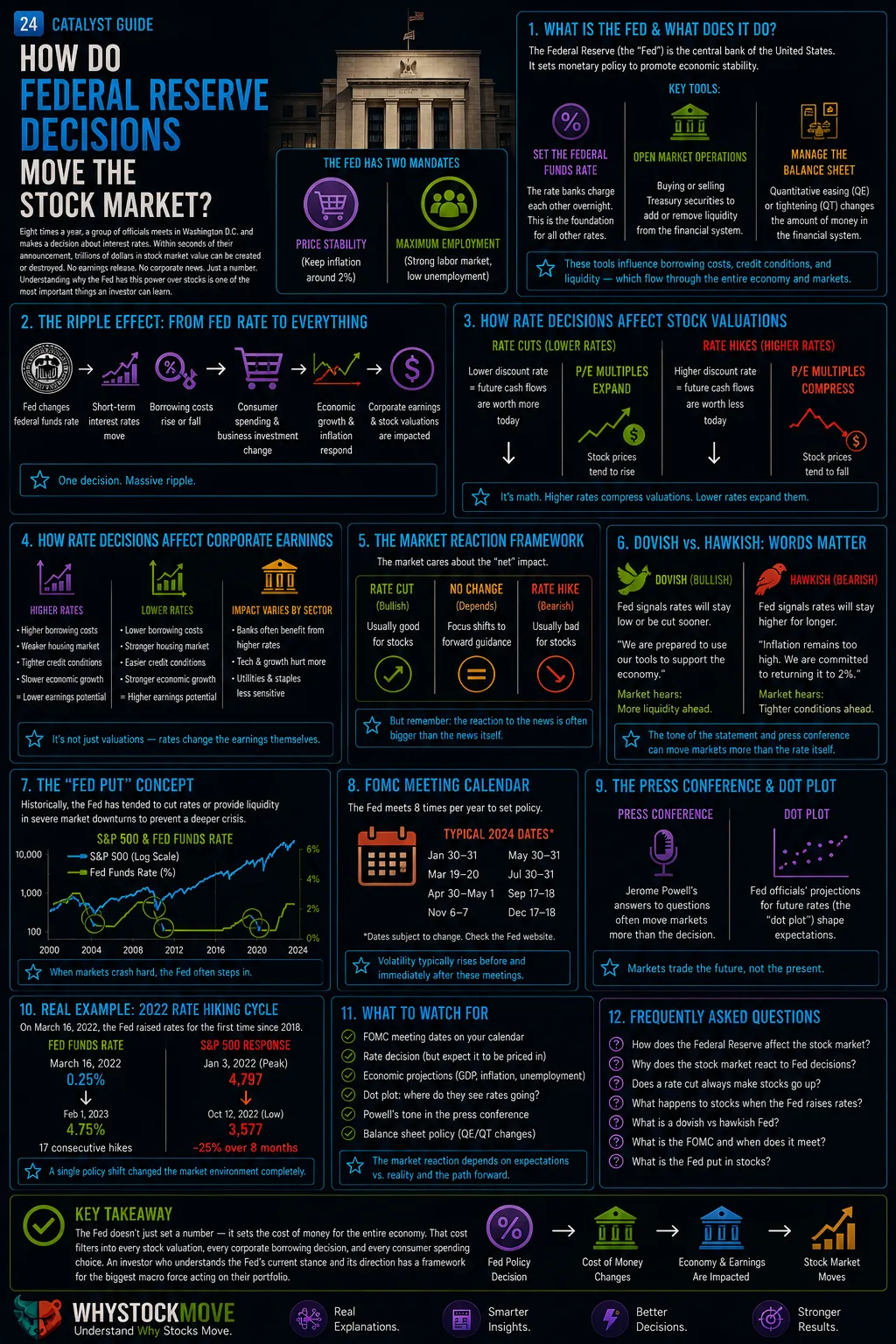
Eight times a year, a group of officials meets in Washington D.C. and makes a decision about interest rates. Within seconds of their announcement, trillions of dollars in stock market value can be created or destroyed. No earnings release. No corporate news. Just a number. Understanding why the Fed has this power over stocks is one of the most important things an investor can learn.
The Core Mechanism
Eight times a year, a group of officials meets in Washington D.C. and makes a decision about interest rates. Within seconds of their announcement, trillions of dollars in stock market value can be created or destroyed. No earnings release. No corporate news. Just a number. Understanding why the Fed has this power over stocks is one of the most important things an investor can learn. What matters most is the transmission channel from the event to the tape. In other words, who is forced to react, how fast they react, and whether the move changes the next few quarters of expectations or only short-term positioning. Once that chain starts, the stock can move far more than the headline alone would suggest because flows, hedging, and copycat positioning all join the move.
The mechanism gets even clearer when you compare it with How Interest Rates Affect Stocks, Why Tech Stocks Fall When Rates Rise, How Inflation Affects Stock Prices, and What Is The Pe Ratio, because these moves rarely operate in isolation.
Example: On March 16, , the Fed raised rates for the first time since . That single meeting launched the most aggressive rate-hiking cycle in four decades. The S&P 500 fell roughly 25% over the following eight months as investors repriced all equities to reflect a structurally higher interest rate environment.
What to watch for: Mark the FOMC meeting dates on your calendar. Volatility typically rises in the days before and can spike dramatically immediately after the decision and press conference. Pay attention to the "dot plot" — Fed officials' projections for future rates — as much as the actual rate change.
Why the Price Reaction Can Overshoot
Markets often overshoot because the first price move triggers a second wave of activity. Analysts revise numbers, ETFs rebalance, shorts cover, or market makers hedge. That feedback loop is why some moves look too large relative to the original catalyst. The original news matters, but the market structure around it matters just as much once the tape starts accelerating.
Example: On March 16, , the Fed raised rates for the first time since . That single meeting launched the most aggressive rate-hiking cycle in four decades. The S&P 500 fell roughly 25% over the following eight months as investors repriced all equities to reflect a structurally higher interest rate environment.
What to watch for: Mark the FOMC meeting dates on your calendar. Volatility typically rises in the days before and can spike dramatically immediately after the decision and press conference. Pay attention to the "dot plot" — Fed officials' projections for future rates — as much as the actual rate change.
What Investors Usually Miss
The common mistake is treating the move as if it came from sentiment alone. In reality, most repeatable stock reactions come from a mechanical process: valuation adjustment, passive flow, liquidity stress, or dealer hedging. If you can identify that process early, you stop reacting to the candle and start judging the durability of the move itself. That is the difference between reading price and understanding it.
Example: On March 16, , the Fed raised rates for the first time since . That single meeting launched the most aggressive rate-hiking cycle in four decades. The S&P 500 fell roughly 25% over the following eight months as investors repriced all equities to reflect a structurally higher interest rate environment.
What to watch for: Mark the FOMC meeting dates on your calendar. Volatility typically rises in the days before and can spike dramatically immediately after the decision and press conference. Pay attention to the "dot plot" — Fed officials' projections for future rates — as much as the actual rate change.
How to Track the Setup Before and After It Hits
The best preparation is to know which data points usually confirm this move once it begins. Sometimes that means pre-market volume. Sometimes it means the 10-year yield, ETF flow data, or the spread to a deal price. The point is to know which scoreboard the market is using before you decide whether the first reaction deserves trust or doubt.
The mechanism gets even clearer when you compare it with How Interest Rates Affect Stocks, Why Tech Stocks Fall When Rates Rise, How Inflation Affects Stock Prices, and What Is The Pe Ratio, because these moves rarely operate in isolation.
Example: On March 16, , the Fed raised rates for the first time since . That single meeting launched the most aggressive rate-hiking cycle in four decades. The S&P 500 fell roughly 25% over the following eight months as investors repriced all equities to reflect a structurally higher interest rate environment.
What to watch for: Mark the FOMC meeting dates on your calendar. Volatility typically rises in the days before and can spike dramatically immediately after the decision and press conference. Pay attention to the "dot plot" — Fed officials' projections for future rates — as much as the actual rate change.
How to Use This as an Investor
The Fed doesn't just set a number — it sets the cost of money for the entire economy. That cost filters into every stock valuation, every corporate borrowing decision, and every consumer spending choice. An investor who understands the Fed's current stance and its direction has a framework for the biggest macro force acting on their portfolio. The practical goal is to classify the move before you commit capital. If the reaction is mostly mechanical, you should think in terms of flow and timing. If it changes earnings power, you should think in terms of valuation and holding period. That distinction keeps you from treating every fast move like the same opportunity.
Example: On March 16, , the Fed raised rates for the first time since . That single meeting launched the most aggressive rate-hiking cycle in four decades. The S&P 500 fell roughly 25% over the following eight months as investors repriced all equities to reflect a structurally higher interest rate environment.
What to watch for: Mark the FOMC meeting dates on your calendar. Volatility typically rises in the days before and can spike dramatically immediately after the decision and press conference. Pay attention to the "dot plot" — Fed officials' projections for future rates — as much as the actual rate change.
Frequently Asked Questions
How does the Federal Reserve affect the stock market?
Federal Reserve rate decisions move every stock in the market. Here's exactly why Fed policy is the most powerful force acting on stock prices. The fastest way to use that information is to compare the catalyst, the tape, and what the market had already priced before the event arrived. Mark the FOMC meeting dates on your calendar. Volatility typically rises in the days before and can spike dramatically immediately after the decision and press conference. Pay attention to the "dot plot" — Fed officials' projections for future rates — as much as the actual rate change. If you want the adjacent setup, start with [How Interest Rates Affect Stocks](/why-stocks-move/how-interest-rates-affect-stocks).
Why does the stock market react to Fed decisions?
How Do Federal Reserve Decisions Move the Stock Market matters because markets move on expectation gaps, not on headlines alone. That is why the same event can create a modest move in one setup and a violent repricing in another. On March 16, 2022, the Fed raised rates for the first time since 2018. That single meeting launched the most aggressive rate-hiking cycle in four decades. The S&P 500 fell roughly 25% over the following eight months as investors repriced all equities to reflect a structurally higher interest rate environment. Mark the FOMC meeting dates on your calendar. Volatility typically rises in the days before and can spike dramatically immediately after the decision and press conference. Pay attention to the "dot plot" — Fed officials' projections for future rates — as much as the actual rate change.
Does a rate cut always make stocks go up?
Federal Reserve rate decisions move every stock in the market. Here's exactly why Fed policy is the most powerful force acting on stock prices. The practical edge comes from understanding the mechanism, checking whether the example fits the current setup, and then using the same watchlist items every time you see the pattern. Mark the FOMC meeting dates on your calendar. Volatility typically rises in the days before and can spike dramatically immediately after the decision and press conference. Pay attention to the "dot plot" — Fed officials' projections for future rates — as much as the actual rate change. If you want the adjacent setup, start with [How Interest Rates Affect Stocks](/why-stocks-move/how-interest-rates-affect-stocks).
What happens to stocks when the Fed raises rates?
Federal Reserve rate decisions move every stock in the market. Here's exactly why Fed policy is the most powerful force acting on stock prices. In practice, the useful part is not the label by itself but the mechanism underneath it: how it changes expectations, liquidity, or positioning. On March 16, 2022, the Fed raised rates for the first time since 2018. That single meeting launched the most aggressive rate-hiking cycle in four decades. The S&P 500 fell roughly 25% over the following eight months as investors repriced all equities to reflect a structurally higher interest rate environment. If you want the adjacent setup, start with [How Interest Rates Affect Stocks](/why-stocks-move/how-interest-rates-affect-stocks).
What is a dovish vs hawkish Fed?
Federal Reserve rate decisions move every stock in the market. Here's exactly why Fed policy is the most powerful force acting on stock prices. In practice, the useful part is not the label by itself but the mechanism underneath it: how it changes expectations, liquidity, or positioning. On March 16, 2022, the Fed raised rates for the first time since 2018. That single meeting launched the most aggressive rate-hiking cycle in four decades. The S&P 500 fell roughly 25% over the following eight months as investors repriced all equities to reflect a structurally higher interest rate environment. If you want the adjacent setup, start with [How Interest Rates Affect Stocks](/why-stocks-move/how-interest-rates-affect-stocks).
What is the FOMC and when does it meet?
Federal Reserve rate decisions move every stock in the market. Here's exactly why Fed policy is the most powerful force acting on stock prices. In practice, the useful part is not the label by itself but the mechanism underneath it: how it changes expectations, liquidity, or positioning. On March 16, 2022, the Fed raised rates for the first time since 2018. That single meeting launched the most aggressive rate-hiking cycle in four decades. The S&P 500 fell roughly 25% over the following eight months as investors repriced all equities to reflect a structurally higher interest rate environment. If you want the adjacent setup, start with [How Interest Rates Affect Stocks](/why-stocks-move/how-interest-rates-affect-stocks).
What is the Fed put in stocks?
Federal Reserve rate decisions move every stock in the market. Here's exactly why Fed policy is the most powerful force acting on stock prices. In practice, the useful part is not the label by itself but the mechanism underneath it: how it changes expectations, liquidity, or positioning. On March 16, 2022, the Fed raised rates for the first time since 2018. That single meeting launched the most aggressive rate-hiking cycle in four decades. The S&P 500 fell roughly 25% over the following eight months as investors repriced all equities to reflect a structurally higher interest rate environment. If you want the adjacent setup, start with [How Interest Rates Affect Stocks](/why-stocks-move/how-interest-rates-affect-stocks).